

High-Pressure Crystallization of Glass-Forming Liquids …
33
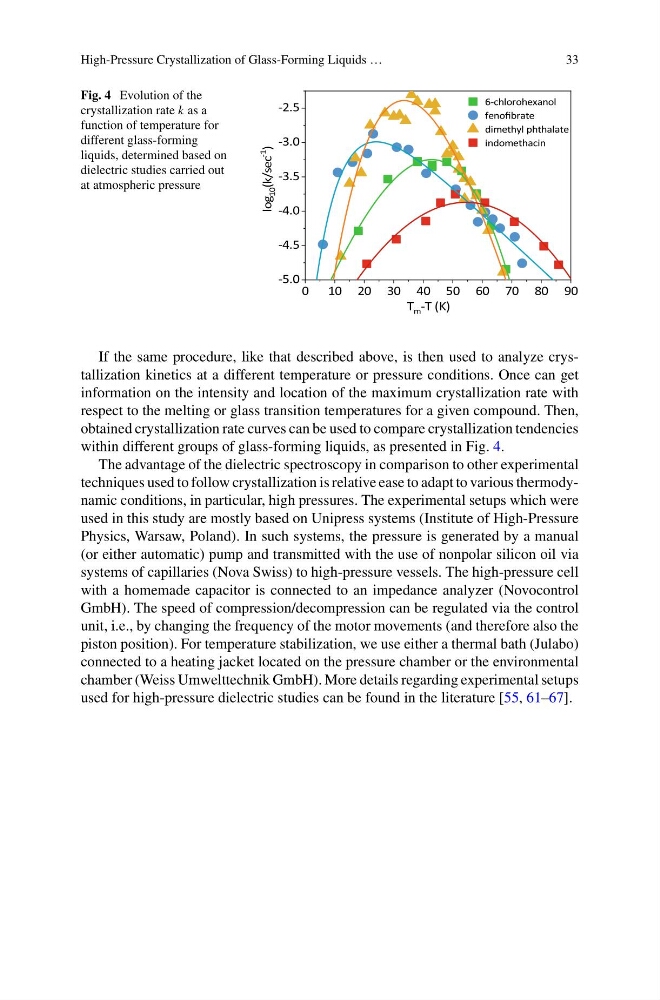
Fig. 4 Evolution of the
crystallization rate k as a
function of temperature for
different glass-forming
liquids, determined based on
dielectric studies carried out
at atmospheric pressure
6-chlorohexanol
fenofibrate
dimethyl phthalate
indomethacin
0 10 20 30 40 50 60 70 80 90
-5.0
-4.5
-4.0
-3.5
-3.0
-2.5
log
10 (k/sec
-1
)
T m -T (K)
If the same procedure, like that described above, is then used to analyze crystallization kinetics at a different temperature or pressure conditions. Once can get
information on the intensity and location of the maximum crystallization rate with
respect to the melting or glass transition temperatures for a given compound. Then,
obtained crystallization rate curves can be used to compare crystallization tendencies
within different groups of glass-forming liquids, as presented in Fig. 4.
The advantage of the dielectric spectroscopy in comparison to other experimental
techniques used to follow crystallization is relative ease to adapt to various thermodynamic conditions, in particular, high pressures. The experimental setups which were
used in this study are mostly based on Unipress systems (Institute of High-Pressure
Physics, Warsaw, Poland). In such systems, the pressure is generated by a manual
(or either automatic) pump and transmitted with the use of nonpolar silicon oil via
systems of capillaries (Nova Swiss) to high-pressure vessels. The high-pressure cell
with a homemade capacitor is connected to an impedance analyzer (Novocontrol
GmbH). The speed of compression/decompression can be regulated via the control
unit, i.e., by changing the frequency of the motor movements (and therefore also the
piston position). For temperature stabilization, we use either a thermal bath (Julabo)
connected to a heating jacket located on the pressure chamber or the environmental
chamber (Weiss Umwelttechnik GmbH). More details regarding experimental setups
used for high-pressure dielectric studies can be found in the literature [55, 61–67].
33
Fig. 4 Evolution of the
crystallization rate k as a
function of temperature for
different glass-forming
liquids, determined based on
dielectric studies carried out
at atmospheric pressure
6-chlorohexanol
fenofibrate
dimethyl phthalate
indomethacin
0 10 20 30 40 50 60 70 80 90
-5.0
-4.5
-4.0
-3.5
-3.0
-2.5
log
10 (k/sec
-1
)
T m -T (K)
If the same procedure, like that described above, is then used to analyze crystallization kinetics at a different temperature or pressure conditions. Once can get
information on the intensity and location of the maximum crystallization rate with
respect to the melting or glass transition temperatures for a given compound. Then,
obtained crystallization rate curves can be used to compare crystallization tendencies
within different groups of glass-forming liquids, as presented in Fig. 4.
The advantage of the dielectric spectroscopy in comparison to other experimental
techniques used to follow crystallization is relative ease to adapt to various thermodynamic conditions, in particular, high pressures. The experimental setups which were
used in this study are mostly based on Unipress systems (Institute of High-Pressure
Physics, Warsaw, Poland). In such systems, the pressure is generated by a manual
(or either automatic) pump and transmitted with the use of nonpolar silicon oil via
systems of capillaries (Nova Swiss) to high-pressure vessels. The high-pressure cell
with a homemade capacitor is connected to an impedance analyzer (Novocontrol
GmbH). The speed of compression/decompression can be regulated via the control
unit, i.e., by changing the frequency of the motor movements (and therefore also the
piston position). For temperature stabilization, we use either a thermal bath (Julabo)
connected to a heating jacket located on the pressure chamber or the environmental
chamber (Weiss Umwelttechnik GmbH). More details regarding experimental setups
used for high-pressure dielectric studies can be found in the literature [55, 61–67].