

30
K. Adrjanowicz
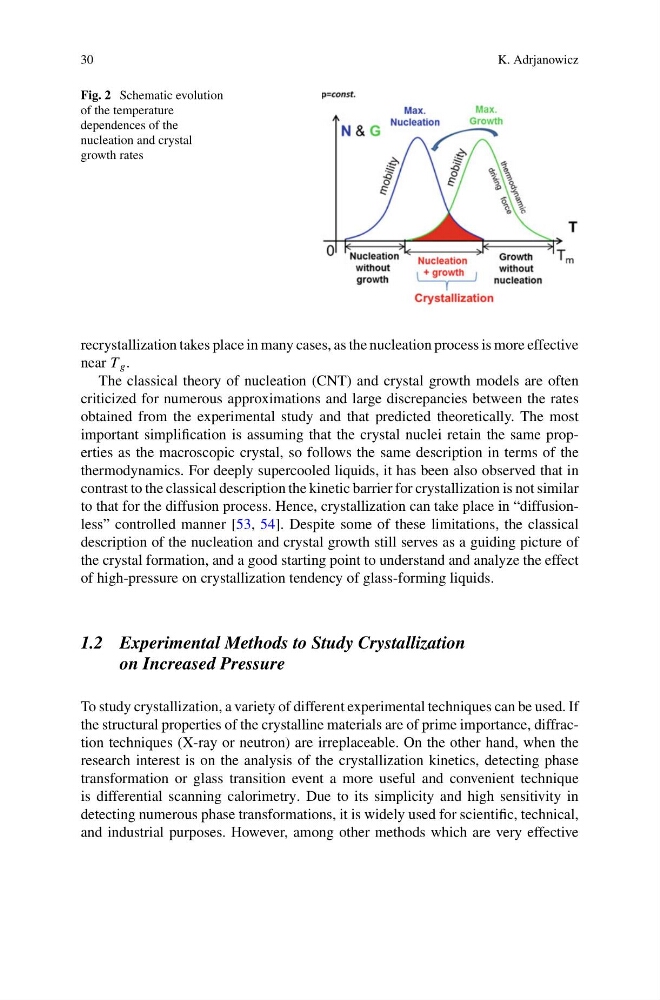
Fig. 2 Schematic evolution
of the temperature
dependences of the
nucleation and crystal
growth rates
recrystallization takes place in many cases, as the nucleation process is more effective
near T g .
The classical theory of nucleation (CNT) and crystal growth models are often
criticized for numerous approximations and large discrepancies between the rates
obtained from the experimental study and that predicted theoretically. The most
important simplification is assuming that the crystal nuclei retain the same properties as the macroscopic crystal, so follows the same description in terms of the
thermodynamics. For deeply supercooled liquids, it has been also observed that in
contrast to the classical description the kinetic barrier for crystallization is not similar
to that for the diffusion process. Hence, crystallization can take place in “diffusionless” controlled manner [53, 54]. Despite some of these limitations, the classical
description of the nucleation and crystal growth still serves as a guiding picture of
the crystal formation, and a good starting point to understand and analyze the effect
of high-pressure on crystallization tendency of glass-forming liquids.
1.2 Experimental Methods to Study Crystallization
on Increased Pressure
To study crystallization, a variety of different experimental techniques can be used. If
the structural properties of the crystalline materials are of prime importance, diffraction techniques (X-ray or neutron) are irreplaceable. On the other hand, when the
research interest is on the analysis of the crystallization kinetics, detecting phase
transformation or glass transition event a more useful and convenient technique
is differential scanning calorimetry. Due to its simplicity and high sensitivity in
detecting numerous phase transformations, it is widely used for scientific, technical,
and industrial purposes. However, among other methods which are very effective
K. Adrjanowicz
Fig. 2 Schematic evolution
of the temperature
dependences of the
nucleation and crystal
growth rates
recrystallization takes place in many cases, as the nucleation process is more effective
near T g .
The classical theory of nucleation (CNT) and crystal growth models are often
criticized for numerous approximations and large discrepancies between the rates
obtained from the experimental study and that predicted theoretically. The most
important simplification is assuming that the crystal nuclei retain the same properties as the macroscopic crystal, so follows the same description in terms of the
thermodynamics. For deeply supercooled liquids, it has been also observed that in
contrast to the classical description the kinetic barrier for crystallization is not similar
to that for the diffusion process. Hence, crystallization can take place in “diffusionless” controlled manner [53, 54]. Despite some of these limitations, the classical
description of the nucleation and crystal growth still serves as a guiding picture of
the crystal formation, and a good starting point to understand and analyze the effect
of high-pressure on crystallization tendency of glass-forming liquids.
1.2 Experimental Methods to Study Crystallization
on Increased Pressure
To study crystallization, a variety of different experimental techniques can be used. If
the structural properties of the crystalline materials are of prime importance, diffraction techniques (X-ray or neutron) are irreplaceable. On the other hand, when the
research interest is on the analysis of the crystallization kinetics, detecting phase
transformation or glass transition event a more useful and convenient technique
is differential scanning calorimetry. Due to its simplicity and high sensitivity in
detecting numerous phase transformations, it is widely used for scientific, technical,
and industrial purposes. However, among other methods which are very effective