

Dielectric Behavior of Nonpolar Polymers and Their Composites …
257
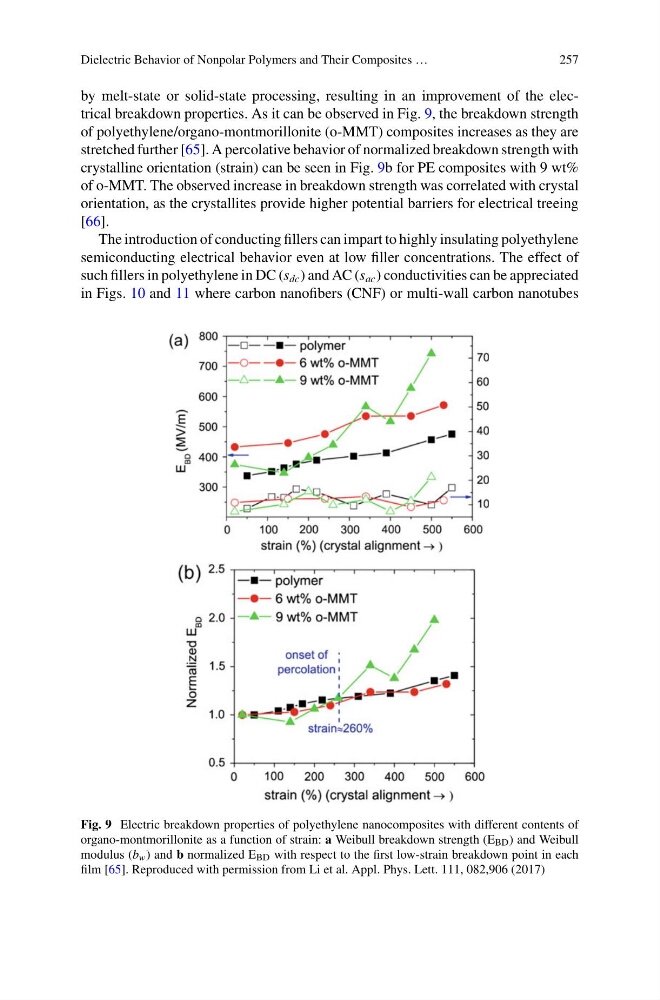
by melt-state or solid-state processing, resulting in an improvement of the electrical breakdown properties. As it can be observed in Fig. 9, the breakdown strength
of polyethylene/organo-montmorillonite (o-MMT) composites increases as they are
stretched further [65]. A percolative behavior of normalized breakdown strength with
crystalline orientation (strain) can be seen in Fig. 9b for PE composites with 9 wt%
of o-MMT. The observed increase in breakdown strength was correlated with crystal
orientation, as the crystallites provide higher potential barriers for electrical treeing
[66].
The introduction of conducting fillers can impart to highly insulating polyethylene
semiconducting electrical behavior even at low filler concentrations. The effect of
such fillers in polyethylene in DC (s dc ) and AC (s ac ) conductivities can be appreciated
in Figs. 10 and 11 where carbon nanofibers (CNF) or multi-wall carbon nanotubes
Fig. 9 Electric breakdown properties of polyethylene nanocomposites with different contents of
organo-montmorillonite as a function of strain: a Weibull breakdown strength (E BD ) and Weibull
modulus (b w ) and b normalized E BD with respect to the first low-strain breakdown point in each
film [65]. Reproduced with permission from Li et al. Appl. Phys. Lett. 111, 082,906 (2017)
257
by melt-state or solid-state processing, resulting in an improvement of the electrical breakdown properties. As it can be observed in Fig. 9, the breakdown strength
of polyethylene/organo-montmorillonite (o-MMT) composites increases as they are
stretched further [65]. A percolative behavior of normalized breakdown strength with
crystalline orientation (strain) can be seen in Fig. 9b for PE composites with 9 wt%
of o-MMT. The observed increase in breakdown strength was correlated with crystal
orientation, as the crystallites provide higher potential barriers for electrical treeing
[66].
The introduction of conducting fillers can impart to highly insulating polyethylene
semiconducting electrical behavior even at low filler concentrations. The effect of
such fillers in polyethylene in DC (s dc ) and AC (s ac ) conductivities can be appreciated
in Figs. 10 and 11 where carbon nanofibers (CNF) or multi-wall carbon nanotubes
Fig. 9 Electric breakdown properties of polyethylene nanocomposites with different contents of
organo-montmorillonite as a function of strain: a Weibull breakdown strength (E BD ) and Weibull
modulus (b w ) and b normalized E BD with respect to the first low-strain breakdown point in each
film [65]. Reproduced with permission from Li et al. Appl. Phys. Lett. 111, 082,906 (2017)