

246
S. X. Drakopoulos et al.
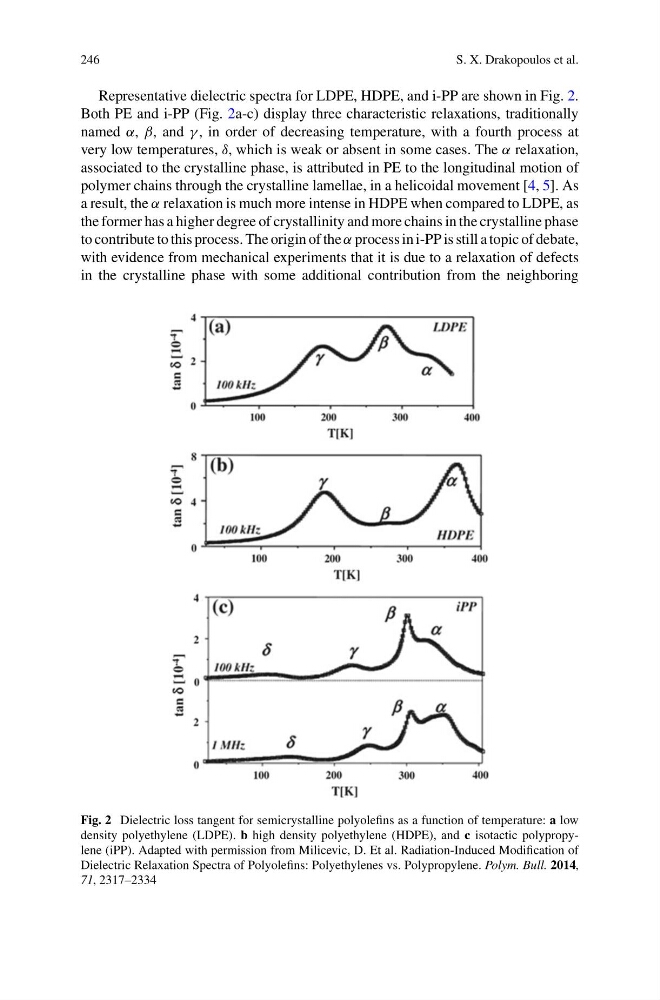
Representative dielectric spectra for LDPE, HDPE, and i-PP are shown in Fig. 2.
Both PE and i-PP (Fig. 2a-c) display three characteristic relaxations, traditionally
named α, β, and γ , in order of decreasing temperature, with a fourth process at
very low temperatures, δ, which is weak or absent in some cases. The α relaxation,
associated to the crystalline phase, is attributed in PE to the longitudinal motion of
polymer chains through the crystalline lamellae, in a helicoidal movement [4, 5]. As
a result, the α relaxation is much more intense in HDPE when compared to LDPE, as
the former has a higher degree of crystallinity and more chains in the crystalline phase
to contribute to this process. The origin of the α process in i-PP is still a topic of debate,
with evidence from mechanical experiments that it is due to a relaxation of defects
in the crystalline phase with some additional contribution from the neighboring
Fig. 2 Dielectric loss tangent for semicrystalline polyolefins as a function of temperature: a low
density polyethylene (LDPE). b high density polyethylene (HDPE), and c isotactic polypropylene (iPP). Adapted with permission from Milicevic, D. Et al. Radiation-Induced Modification of
Dielectric Relaxation Spectra of Polyolefins: Polyethylenes vs. Polypropylene. Polym. Bull. 2014,
71, 2317–2334
S. X. Drakopoulos et al.
Representative dielectric spectra for LDPE, HDPE, and i-PP are shown in Fig. 2.
Both PE and i-PP (Fig. 2a-c) display three characteristic relaxations, traditionally
named α, β, and γ , in order of decreasing temperature, with a fourth process at
very low temperatures, δ, which is weak or absent in some cases. The α relaxation,
associated to the crystalline phase, is attributed in PE to the longitudinal motion of
polymer chains through the crystalline lamellae, in a helicoidal movement [4, 5]. As
a result, the α relaxation is much more intense in HDPE when compared to LDPE, as
the former has a higher degree of crystallinity and more chains in the crystalline phase
to contribute to this process. The origin of the α process in i-PP is still a topic of debate,
with evidence from mechanical experiments that it is due to a relaxation of defects
in the crystalline phase with some additional contribution from the neighboring
Fig. 2 Dielectric loss tangent for semicrystalline polyolefins as a function of temperature: a low
density polyethylene (LDPE). b high density polyethylene (HDPE), and c isotactic polypropylene (iPP). Adapted with permission from Milicevic, D. Et al. Radiation-Induced Modification of
Dielectric Relaxation Spectra of Polyolefins: Polyethylenes vs. Polypropylene. Polym. Bull. 2014,
71, 2317–2334