

244
S. X. Drakopoulos et al.
Abbreviations
PE
Polyethylene
LDPE
Low density polyethylene
HDPE
High density polyethylene
UHMWPE Ultra-high molecular weight polyethylene
PP
Polypropylene
i-PP
Isotactic polypropylene
TiO 2
Titanium oxide
Al 2 O 3
Aluminum oxide
DBANS
4,4
-(N,N-di- butylamino)-(E)-nitrostilbene
MMT
Montmorillonite
o-MMT
Organo-montmorillonite
CNF
Carbon nanofibers
MWCNT Multi-wall carbon nanotubes
CaCO 3
Calcium carbonate
BaTiO 3
Barium titanate
1 Introduction
The global plastic production has increased exponentially since 1950, when
1.5 tonnes were produced, rising to almost 348 million tonnes in 2017. In Europe
alone, over 1.5 million people are directly employed in the 60,000 companies related
to the plastic industry [1]. Polyolefins, consisting of saturated aliphatic hydrocarbon
macromolecules, account for more than 55% of the global plastics demand, with a
market share of 34.4% for polyethylene (PE) and 24.2% for polypropylene (PP) [2].
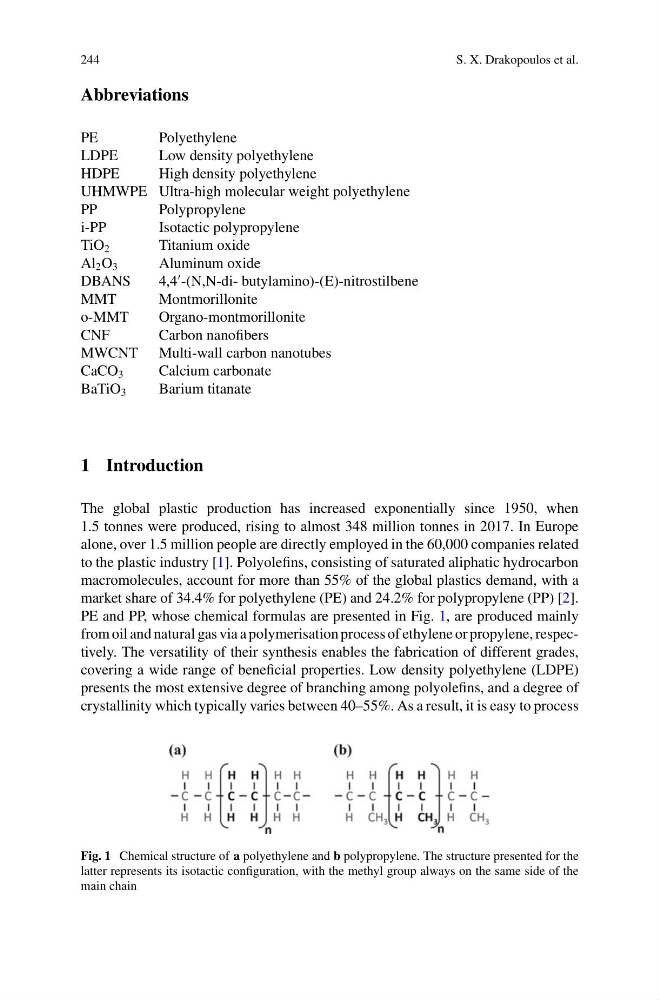
PE and PP, whose chemical formulas are presented in Fig. 1, are produced mainly
from oil and natural gas via a polymerisation process of ethylene or propylene, respectively. The versatility of their synthesis enables the fabrication of different grades,
covering a wide range of beneficial properties. Low density polyethylene (LDPE)
presents the most extensive degree of branching among polyolefins, and a degree of
crystallinity which typically varies between 40–55%. As a result, it is easy to process
Fig. 1 Chemical structure of a polyethylene and b polypropylene. The structure presented for the
latter represents its isotactic configuration, with the methyl group always on the same side of the
main chain
S. X. Drakopoulos et al.
Abbreviations
PE
Polyethylene
LDPE
Low density polyethylene
HDPE
High density polyethylene
UHMWPE Ultra-high molecular weight polyethylene
PP
Polypropylene
i-PP
Isotactic polypropylene
TiO 2
Titanium oxide
Al 2 O 3
Aluminum oxide
DBANS
4,4
-(N,N-di- butylamino)-(E)-nitrostilbene
MMT
Montmorillonite
o-MMT
Organo-montmorillonite
CNF
Carbon nanofibers
MWCNT Multi-wall carbon nanotubes
CaCO 3
Calcium carbonate
BaTiO 3
Barium titanate
1 Introduction
The global plastic production has increased exponentially since 1950, when
1.5 tonnes were produced, rising to almost 348 million tonnes in 2017. In Europe
alone, over 1.5 million people are directly employed in the 60,000 companies related
to the plastic industry [1]. Polyolefins, consisting of saturated aliphatic hydrocarbon
macromolecules, account for more than 55% of the global plastics demand, with a
market share of 34.4% for polyethylene (PE) and 24.2% for polypropylene (PP) [2].
PE and PP, whose chemical formulas are presented in Fig. 1, are produced mainly
from oil and natural gas via a polymerisation process of ethylene or propylene, respectively. The versatility of their synthesis enables the fabrication of different grades,
covering a wide range of beneficial properties. Low density polyethylene (LDPE)
presents the most extensive degree of branching among polyolefins, and a degree of
crystallinity which typically varies between 40–55%. As a result, it is easy to process
Fig. 1 Chemical structure of a polyethylene and b polypropylene. The structure presented for the
latter represents its isotactic configuration, with the methyl group always on the same side of the
main chain