

234
S. Napolitano
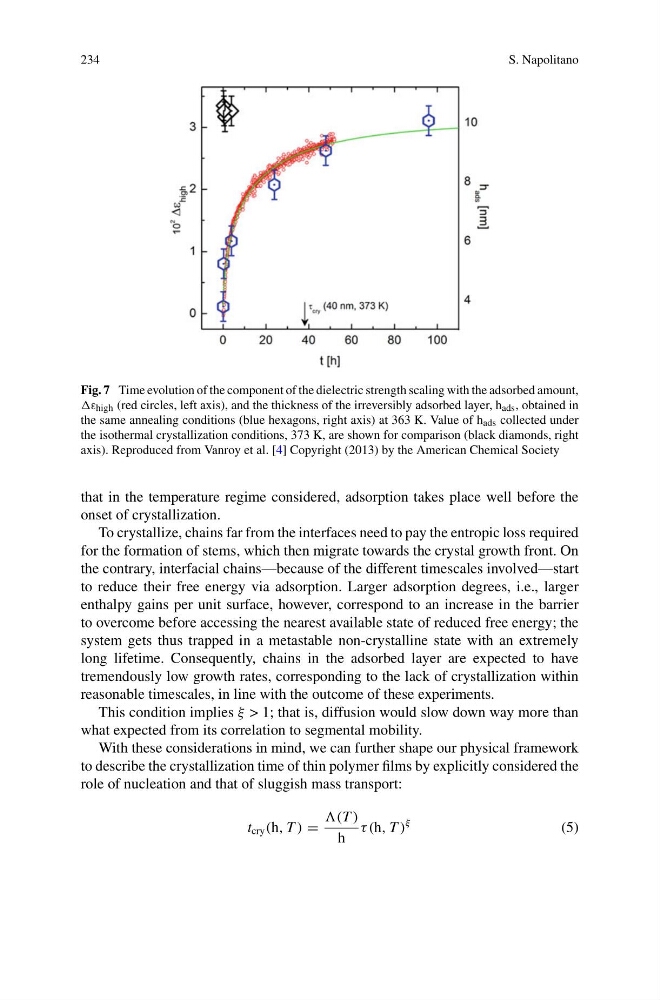
Fig. 7 Time evolution of the component of the dielectric strength scaling with the adsorbed amount,
ε high (red circles, left axis), and the thickness of the irreversibly adsorbed layer, h ads , obtained in
the same annealing conditions (blue hexagons, right axis) at 363 K. Value of h ads collected under
the isothermal crystallization conditions, 373 K, are shown for comparison (black diamonds, right
axis). Reproduced from Vanroy et al. [4] Copyright (2013) by the American Chemical Society
that in the temperature regime considered, adsorption takes place well before the
onset of crystallization.
To crystallize, chains far from the interfaces need to pay the entropic loss required
for the formation of stems, which then migrate towards the crystal growth front. On
the contrary, interfacial chains—because of the different timescales involved—start
to reduce their free energy via adsorption. Larger adsorption degrees, i.e., larger
enthalpy gains per unit surface, however, correspond to an increase in the barrier
to overcome before accessing the nearest available state of reduced free energy; the
system gets thus trapped in a metastable non-crystalline state with an extremely
long lifetime. Consequently, chains in the adsorbed layer are expected to have
tremendously low growth rates, corresponding to the lack of crystallization within
reasonable timescales, in line with the outcome of these experiments.
This condition implies ξ > 1; that is, diffusion would slow down way more than
what expected from its correlation to segmental mobility.
With these considerations in mind, we can further shape our physical framework
to describe the crystallization time of thin polymer films by explicitly considered the
role of nucleation and that of sluggish mass transport:
t cry (h, T ) =
(T )
h
τ (h, T )
ξ
(5)
S. Napolitano
Fig. 7 Time evolution of the component of the dielectric strength scaling with the adsorbed amount,
ε high (red circles, left axis), and the thickness of the irreversibly adsorbed layer, h ads , obtained in
the same annealing conditions (blue hexagons, right axis) at 363 K. Value of h ads collected under
the isothermal crystallization conditions, 373 K, are shown for comparison (black diamonds, right
axis). Reproduced from Vanroy et al. [4] Copyright (2013) by the American Chemical Society
that in the temperature regime considered, adsorption takes place well before the
onset of crystallization.
To crystallize, chains far from the interfaces need to pay the entropic loss required
for the formation of stems, which then migrate towards the crystal growth front. On
the contrary, interfacial chains—because of the different timescales involved—start
to reduce their free energy via adsorption. Larger adsorption degrees, i.e., larger
enthalpy gains per unit surface, however, correspond to an increase in the barrier
to overcome before accessing the nearest available state of reduced free energy; the
system gets thus trapped in a metastable non-crystalline state with an extremely
long lifetime. Consequently, chains in the adsorbed layer are expected to have
tremendously low growth rates, corresponding to the lack of crystallization within
reasonable timescales, in line with the outcome of these experiments.
This condition implies ξ > 1; that is, diffusion would slow down way more than
what expected from its correlation to segmental mobility.
With these considerations in mind, we can further shape our physical framework
to describe the crystallization time of thin polymer films by explicitly considered the
role of nucleation and that of sluggish mass transport:
t cry (h, T ) =
(T )
h
τ (h, T )
ξ
(5)