

14
J. W. P. Schmelzer and C. Schick
density functional approaches of determination of the properties of critical clusters
by methods originally developed by van der Waals. As it turned out, the properties of critical clusters and the size of the critical clusters as determined via density
functional computations first by Hillert, Cahn, and Hilliard are quite different as
compared to the results obtained via the classical Gibbs method. Consequently, the
problem arises which of the theories is correct and which one has to be abandoned,
respectively, generalized.
This problem in the theoretical description can be overcome by generalizing the
classical Gibbs’ approach as performed by us in the last two decades [6, 18, 41,
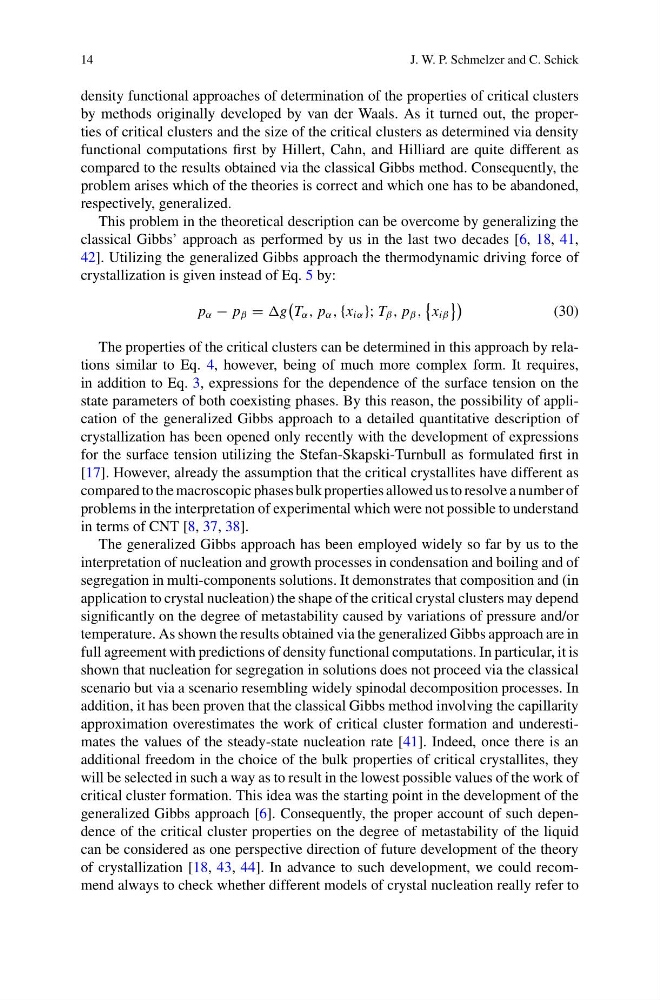
42]. Utilizing the generalized Gibbs approach the thermodynamic driving force of
crystallization is given instead of Eq. 5 by:
p α − p β = g
T α , p α , {x iα }; T β , p β ,
x iβ
(30)
The properties of the critical clusters can be determined in this approach by relations similar to Eq. 4, however, being of much more complex form. It requires,
in addition to Eq. 3, expressions for the dependence of the surface tension on the
state parameters of both coexisting phases. By this reason, the possibility of application of the generalized Gibbs approach to a detailed quantitative description of
crystallization has been opened only recently with the development of expressions
for the surface tension utilizing the Stefan-Skapski-Turnbull as formulated first in
[17]. However, already the assumption that the critical crystallites have different as
compared to the macroscopic phases bulk properties allowed us to resolve a number of
problems in the interpretation of experimental which were not possible to understand
in terms of CNT [8, 37, 38].
The generalized Gibbs approach has been employed widely so far by us to the
interpretation of nucleation and growth processes in condensation and boiling and of
segregation in multi-components solutions. It demonstrates that composition and (in
application to crystal nucleation) the shape of the critical crystal clusters may depend
significantly on the degree of metastability caused by variations of pressure and/or
temperature. As shown the results obtained via the generalized Gibbs approach are in
full agreement with predictions of density functional computations. In particular, it is
shown that nucleation for segregation in solutions does not proceed via the classical
scenario but via a scenario resembling widely spinodal decomposition processes. In
addition, it has been proven that the classical Gibbs method involving the capillarity
approximation overestimates the work of critical cluster formation and underestimates the values of the steady-state nucleation rate [41]. Indeed, once there is an
additional freedom in the choice of the bulk properties of critical crystallites, they
will be selected in such a way as to result in the lowest possible values of the work of
critical cluster formation. This idea was the starting point in the development of the
generalized Gibbs approach [6]. Consequently, the proper account of such dependence of the critical cluster properties on the degree of metastability of the liquid
can be considered as one perspective direction of future development of the theory
of crystallization [18, 43, 44]. In advance to such development, we could recommend always to check whether different models of crystal nucleation really refer to
J. W. P. Schmelzer and C. Schick
density functional approaches of determination of the properties of critical clusters
by methods originally developed by van der Waals. As it turned out, the properties of critical clusters and the size of the critical clusters as determined via density
functional computations first by Hillert, Cahn, and Hilliard are quite different as
compared to the results obtained via the classical Gibbs method. Consequently, the
problem arises which of the theories is correct and which one has to be abandoned,
respectively, generalized.
This problem in the theoretical description can be overcome by generalizing the
classical Gibbs’ approach as performed by us in the last two decades [6, 18, 41,
42]. Utilizing the generalized Gibbs approach the thermodynamic driving force of
crystallization is given instead of Eq. 5 by:
p α − p β = g
T α , p α , {x iα }; T β , p β ,
x iβ
(30)
The properties of the critical clusters can be determined in this approach by relations similar to Eq. 4, however, being of much more complex form. It requires,
in addition to Eq. 3, expressions for the dependence of the surface tension on the
state parameters of both coexisting phases. By this reason, the possibility of application of the generalized Gibbs approach to a detailed quantitative description of
crystallization has been opened only recently with the development of expressions
for the surface tension utilizing the Stefan-Skapski-Turnbull as formulated first in
[17]. However, already the assumption that the critical crystallites have different as
compared to the macroscopic phases bulk properties allowed us to resolve a number of
problems in the interpretation of experimental which were not possible to understand
in terms of CNT [8, 37, 38].
The generalized Gibbs approach has been employed widely so far by us to the
interpretation of nucleation and growth processes in condensation and boiling and of
segregation in multi-components solutions. It demonstrates that composition and (in
application to crystal nucleation) the shape of the critical crystal clusters may depend
significantly on the degree of metastability caused by variations of pressure and/or
temperature. As shown the results obtained via the generalized Gibbs approach are in
full agreement with predictions of density functional computations. In particular, it is
shown that nucleation for segregation in solutions does not proceed via the classical
scenario but via a scenario resembling widely spinodal decomposition processes. In
addition, it has been proven that the classical Gibbs method involving the capillarity
approximation overestimates the work of critical cluster formation and underestimates the values of the steady-state nucleation rate [41]. Indeed, once there is an
additional freedom in the choice of the bulk properties of critical crystallites, they
will be selected in such a way as to result in the lowest possible values of the work of
critical cluster formation. This idea was the starting point in the development of the
generalized Gibbs approach [6]. Consequently, the proper account of such dependence of the critical cluster properties on the degree of metastability of the liquid
can be considered as one perspective direction of future development of the theory
of crystallization [18, 43, 44]. In advance to such development, we could recommend always to check whether different models of crystal nucleation really refer to