

196
A. Nogales et al.
Abbreviations
BDS
Broadband dielectric Spectroscopy
FK
Frölich-Kirkwood
HN
Havriliak Negami equation
NR
Natural rubber
PET
Poly(ethylene terephthalate) (PET)
PPS
Poly(propylene succinate)
PPT
Poly(pentamethylene terephthalate)
PTT
Poly(trimethylene terephthalate)
RAP
Rigid amorphous phase (RAP)
SAXS Small Angle X-ray Scattering
WAXS Wide Angle X-ray Scattering
1 Introduction
Nowadays polymers are ubiquitous in our everyday life. The world polymer materials production reached around 350 million tons in 2017 being about two-thirds of
it related to semicrystalline polymers [1]. Similarly to other glass former materials
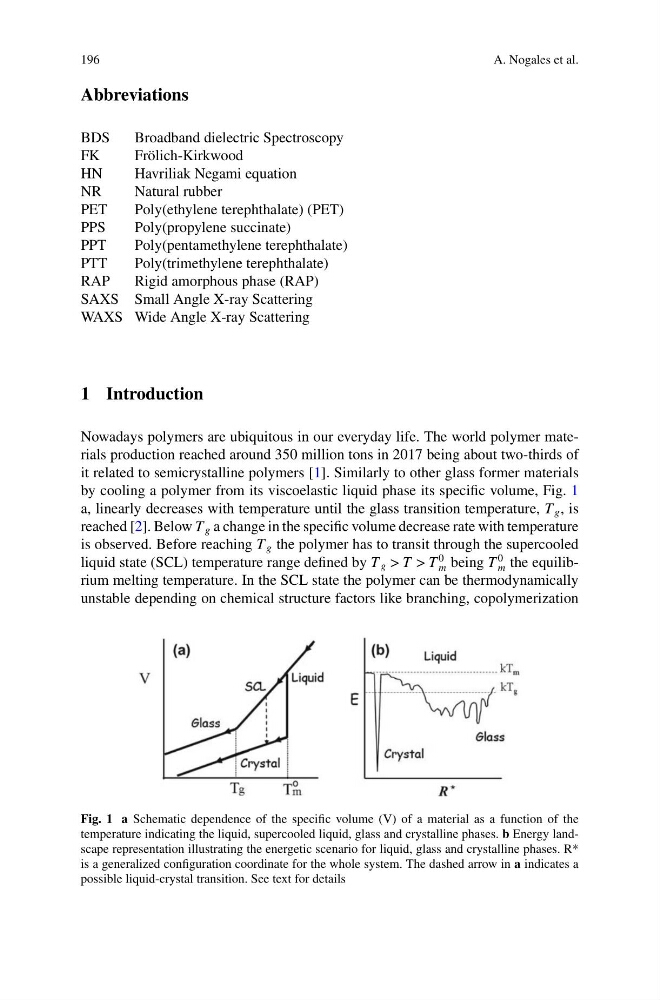
by cooling a polymer from its viscoelastic liquid phase its specific volume, Fig. 1
a, linearly decreases with temperature until the glass transition temperature, T g , is
reached [2]. Below T g a change in the specific volume decrease rate with temperature
is observed. Before reaching T g the polymer has to transit through the supercooled
liquid state (SCL) temperature range defined by T g > T > T
0
m being T
0
m the equilibrium melting temperature. In the SCL state the polymer can be thermodynamically
unstable depending on chemical structure factors like branching, copolymerization
Fig. 1 a Schematic dependence of the specific volume (V) of a material as a function of the
temperature indicating the liquid, supercooled liquid, glass and crystalline phases. b Energy landscape representation illustrating the energetic scenario for liquid, glass and crystalline phases. R*
is a generalized configuration coordinate for the whole system. The dashed arrow in a indicates a
possible liquid-crystal transition. See text for details
A. Nogales et al.
Abbreviations
BDS
Broadband dielectric Spectroscopy
FK
Frölich-Kirkwood
HN
Havriliak Negami equation
NR
Natural rubber
PET
Poly(ethylene terephthalate) (PET)
PPS
Poly(propylene succinate)
PPT
Poly(pentamethylene terephthalate)
PTT
Poly(trimethylene terephthalate)
RAP
Rigid amorphous phase (RAP)
SAXS Small Angle X-ray Scattering
WAXS Wide Angle X-ray Scattering
1 Introduction
Nowadays polymers are ubiquitous in our everyday life. The world polymer materials production reached around 350 million tons in 2017 being about two-thirds of
it related to semicrystalline polymers [1]. Similarly to other glass former materials
by cooling a polymer from its viscoelastic liquid phase its specific volume, Fig. 1
a, linearly decreases with temperature until the glass transition temperature, T g , is
reached [2]. Below T g a change in the specific volume decrease rate with temperature
is observed. Before reaching T g the polymer has to transit through the supercooled
liquid state (SCL) temperature range defined by T g > T > T
0
m being T
0
m the equilibrium melting temperature. In the SCL state the polymer can be thermodynamically
unstable depending on chemical structure factors like branching, copolymerization
Fig. 1 a Schematic dependence of the specific volume (V) of a material as a function of the
temperature indicating the liquid, supercooled liquid, glass and crystalline phases. b Energy landscape representation illustrating the energetic scenario for liquid, glass and crystalline phases. R*
is a generalized configuration coordinate for the whole system. The dashed arrow in a indicates a
possible liquid-crystal transition. See text for details