

12
J. W. P. Schmelzer and C. Schick
The present subsection we would like to complete with the brief analysis of another
question posed by Adrjanowicz et al. [33, 34] and, as far as we know, not having found
a definite answer so far. Adrjanowicz et al. [33, 34] made a variety of efforts to study
so-called by them isochronal crystallization. By definition, this notation describes
the procedure of varying pressure and temperature in such a way that the viscosity
remains constant. This approach is a modification of a method used widely in the
analysis of crystal nucleation where by measuring both steady-state nucleation rates
and the time-lag, kinetic coefficients can be eliminated in the theoretical analysis of
nucleation processes (see, e.g., [16]). In the analysis, it has been found by mentioned
authors that for such type of variation of the external control parameters (temperature
and pressure) the thermodynamic driving force remains nearly constant. We would
like to sketch here how this problem can be understood in terms of CNT.
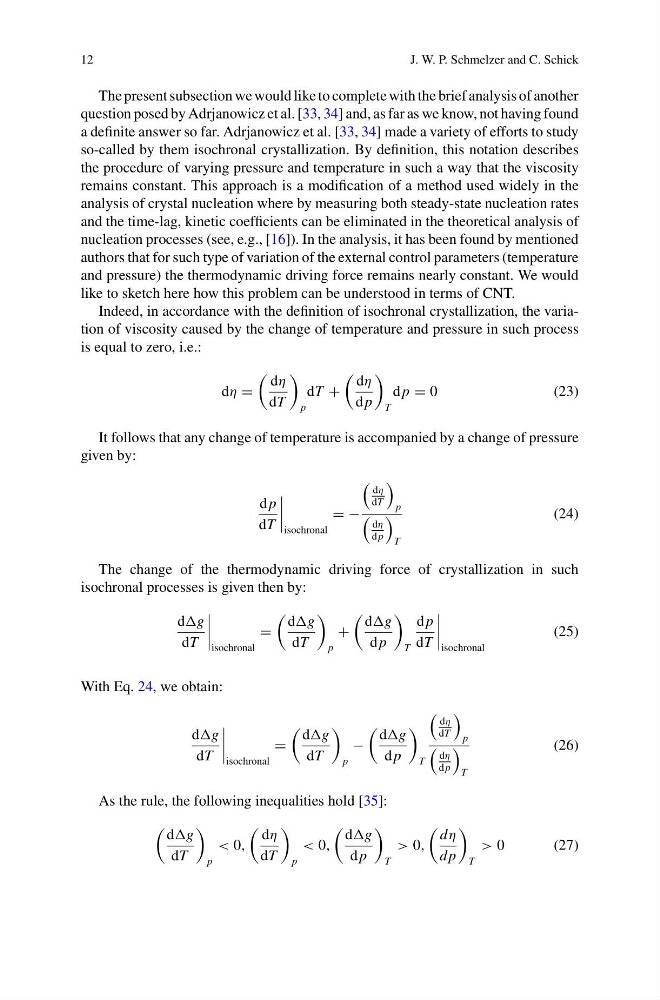
Indeed, in accordance with the definition of isochronal crystallization, the variation of viscosity caused by the change of temperature and pressure in such process
is equal to zero, i.e.:
dη =
dη
dT
p
dT +
dη
d p
T
d p = 0
(23)
It follows that any change of temperature is accompanied by a change of pressure
given by:
d p
dT
isochronal
= −
dη
dT
p
dη
d p
T
(24)
The change of the thermodynamic driving force of crystallization in such
isochronal processes is given then by:
dg
dT
isochronal
=
dg
dT
p
+
dg
d p
T
d p
dT
isochronal
(25)
With Eq. 24, we obtain:
dg
dT
isochronal
=
dg
dT
p
−
dg
d p
T
dη
dT
p
dη
d p
T
(26)
As the rule, the following inequalities hold [35]:
dg
dT
p
< 0,
dη
dT
p
< 0,
dg
d p
T
> 0,
dη
dp
T
> 0
(27)
J. W. P. Schmelzer and C. Schick
The present subsection we would like to complete with the brief analysis of another
question posed by Adrjanowicz et al. [33, 34] and, as far as we know, not having found
a definite answer so far. Adrjanowicz et al. [33, 34] made a variety of efforts to study
so-called by them isochronal crystallization. By definition, this notation describes
the procedure of varying pressure and temperature in such a way that the viscosity
remains constant. This approach is a modification of a method used widely in the
analysis of crystal nucleation where by measuring both steady-state nucleation rates
and the time-lag, kinetic coefficients can be eliminated in the theoretical analysis of
nucleation processes (see, e.g., [16]). In the analysis, it has been found by mentioned
authors that for such type of variation of the external control parameters (temperature
and pressure) the thermodynamic driving force remains nearly constant. We would
like to sketch here how this problem can be understood in terms of CNT.
Indeed, in accordance with the definition of isochronal crystallization, the variation of viscosity caused by the change of temperature and pressure in such process
is equal to zero, i.e.:
dη =
dη
dT
p
dT +
dη
d p
T
d p = 0
(23)
It follows that any change of temperature is accompanied by a change of pressure
given by:
d p
dT
isochronal
= −
dη
dT
p
dη
d p
T
(24)
The change of the thermodynamic driving force of crystallization in such
isochronal processes is given then by:
dg
dT
isochronal
=
dg
dT
p
+
dg
d p
T
d p
dT
isochronal
(25)
With Eq. 24, we obtain:
dg
dT
isochronal
=
dg
dT
p
−
dg
d p
T
dη
dT
p
dη
d p
T
(26)
As the rule, the following inequalities hold [35]:
dg
dT
p
< 0,
dη
dT
p
< 0,
dg
d p
T
> 0,
dη
dp
T
> 0
(27)