

Dynamics of Water in Partially Crystallized Solutions of Glass …
171
biological materials. For instance, in frozen food, the increment in the concentration
of water solutions that does not freeze (partial crystallization of the water causes
freeze-concentration of the amorphous part of the solution) cause a reduction of the
water activity [11, 12]. On the other hand, cells may be damaged by the presence
of ice because it will expand and burst the cell wall destroying the tissues. In fact,
the strategy of several insects, plants, or animals to overcome the problem of water
crystallization in extreme environments is to use compounds in their body fluids
(for instance the sugar trehalosa [13] or anti-freeze proteins [14]) to prevent crystallization. In this case, the solutes act as protection against freezing (cryoprotectant
or super-cooling agents). Therefore, one strategy the nature enforces to avoid water
crystallization is to mix the water molecules with some solute. Another way to avoid
crystallization of water at low temperatures is to confine water in porous materials.
This brings a geological perspective to the problem of water crystallization. Water is
a very mobile molecule and can easily change its aggregation state (liquid, vapor, and
solid) depending on temperature. This fact impacts on minerals like quartz or mineral
clays since a water phase transition could affect the structure of rigid materials.
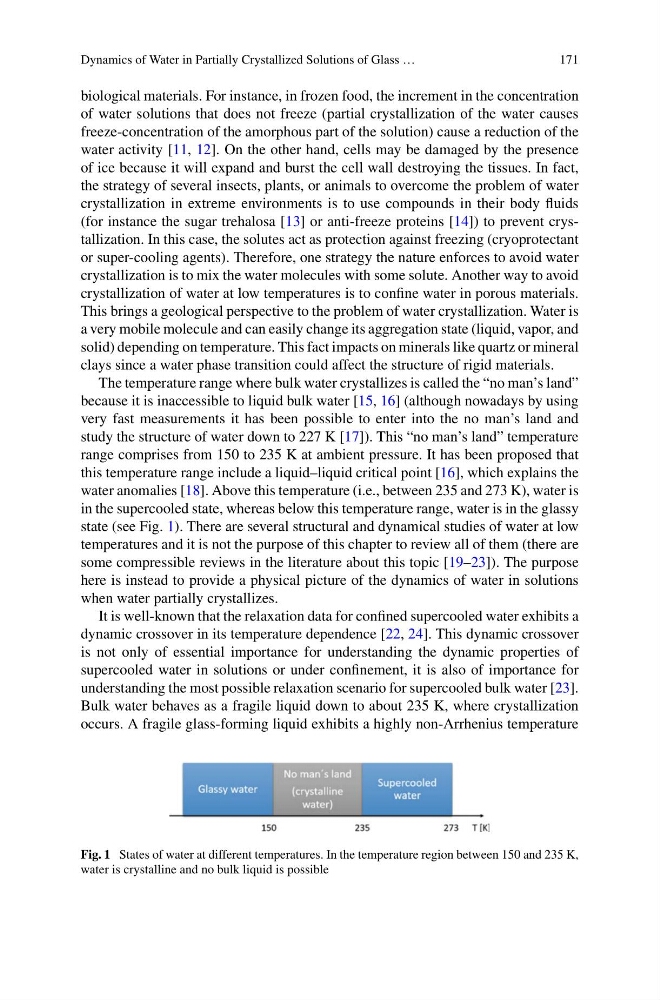
The temperature range where bulk water crystallizes is called the “no man’s land”
because it is inaccessible to liquid bulk water [15, 16] (although nowadays by using
very fast measurements it has been possible to enter into the no man’s land and
study the structure of water down to 227 K [17]). This “no man’s land” temperature
range comprises from 150 to 235 K at ambient pressure. It has been proposed that
this temperature range include a liquid–liquid critical point [16], which explains the
water anomalies [18]. Above this temperature (i.e., between 235 and 273 K), water is
in the supercooled state, whereas below this temperature range, water is in the glassy
state (see Fig. 1). There are several structural and dynamical studies of water at low
temperatures and it is not the purpose of this chapter to review all of them (there are
some compressible reviews in the literature about this topic [19–23]). The purpose
here is instead to provide a physical picture of the dynamics of water in solutions
when water partially crystallizes.
It is well-known that the relaxation data for confined supercooled water exhibits a
dynamic crossover in its temperature dependence [22, 24]. This dynamic crossover
is not only of essential importance for understanding the dynamic properties of
supercooled water in solutions or under confinement, it is also of importance for
understanding the most possible relaxation scenario for supercooled bulk water [23].
Bulk water behaves as a fragile liquid down to about 235 K, where crystallization
occurs. A fragile glass-forming liquid exhibits a highly non-Arrhenius temperature
Fig. 1 States of water at different temperatures. In the temperature region between 150 and 235 K,
water is crystalline and no bulk liquid is possible
171
biological materials. For instance, in frozen food, the increment in the concentration
of water solutions that does not freeze (partial crystallization of the water causes
freeze-concentration of the amorphous part of the solution) cause a reduction of the
water activity [11, 12]. On the other hand, cells may be damaged by the presence
of ice because it will expand and burst the cell wall destroying the tissues. In fact,
the strategy of several insects, plants, or animals to overcome the problem of water
crystallization in extreme environments is to use compounds in their body fluids
(for instance the sugar trehalosa [13] or anti-freeze proteins [14]) to prevent crystallization. In this case, the solutes act as protection against freezing (cryoprotectant
or super-cooling agents). Therefore, one strategy the nature enforces to avoid water
crystallization is to mix the water molecules with some solute. Another way to avoid
crystallization of water at low temperatures is to confine water in porous materials.
This brings a geological perspective to the problem of water crystallization. Water is
a very mobile molecule and can easily change its aggregation state (liquid, vapor, and
solid) depending on temperature. This fact impacts on minerals like quartz or mineral
clays since a water phase transition could affect the structure of rigid materials.
The temperature range where bulk water crystallizes is called the “no man’s land”
because it is inaccessible to liquid bulk water [15, 16] (although nowadays by using
very fast measurements it has been possible to enter into the no man’s land and
study the structure of water down to 227 K [17]). This “no man’s land” temperature
range comprises from 150 to 235 K at ambient pressure. It has been proposed that
this temperature range include a liquid–liquid critical point [16], which explains the
water anomalies [18]. Above this temperature (i.e., between 235 and 273 K), water is
in the supercooled state, whereas below this temperature range, water is in the glassy
state (see Fig. 1). There are several structural and dynamical studies of water at low
temperatures and it is not the purpose of this chapter to review all of them (there are
some compressible reviews in the literature about this topic [19–23]). The purpose
here is instead to provide a physical picture of the dynamics of water in solutions
when water partially crystallizes.
It is well-known that the relaxation data for confined supercooled water exhibits a
dynamic crossover in its temperature dependence [22, 24]. This dynamic crossover
is not only of essential importance for understanding the dynamic properties of
supercooled water in solutions or under confinement, it is also of importance for
understanding the most possible relaxation scenario for supercooled bulk water [23].
Bulk water behaves as a fragile liquid down to about 235 K, where crystallization
occurs. A fragile glass-forming liquid exhibits a highly non-Arrhenius temperature
Fig. 1 States of water at different temperatures. In the temperature region between 150 and 235 K,
water is crystalline and no bulk liquid is possible