

Isothermal and Non-isothermal Crystallization in Liquid Crystals …
145
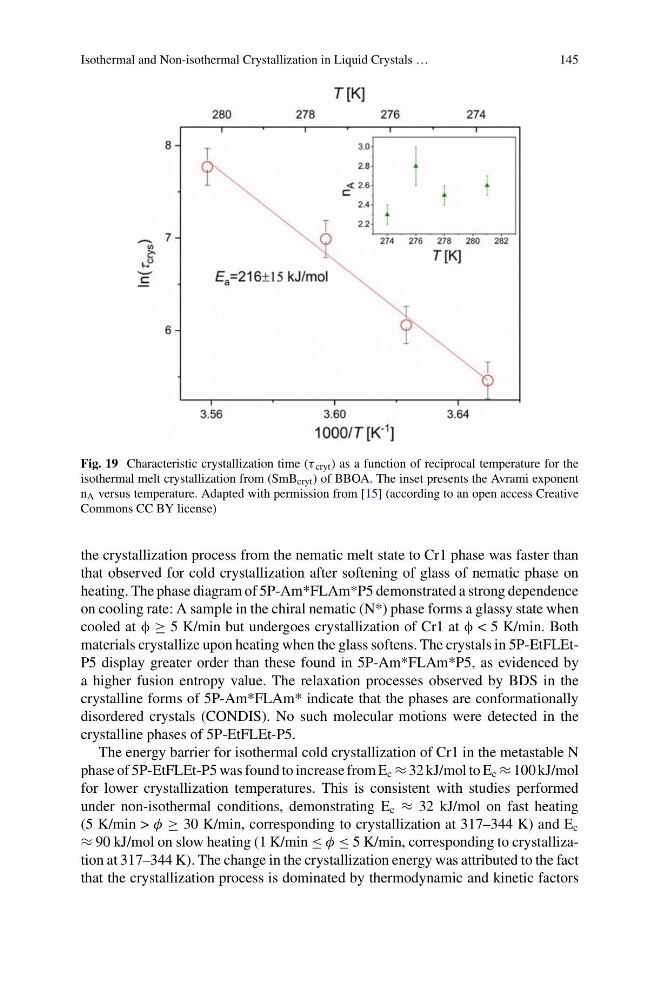
Fig. 19 Characteristic crystallization time (τ cryt ) as a function of reciprocal temperature for the
isothermal melt crystallization from (SmB cryt ) of BBOA. The inset presents the Avrami exponent
n A versus temperature. Adapted with permission from [15] (according to an open access Creative
Commons CC BY license)
the crystallization process from the nematic melt state to Cr1 phase was faster than
that observed for cold crystallization after softening of glass of nematic phase on
heating. The phase diagram of 5P-Am*FLAm*P5 demonstrated a strong dependence
on cooling rate: A sample in the chiral nematic (N*) phase forms a glassy state when
cooled at φ ≥ 5 K/min but undergoes crystallization of Cr1 at φ < 5 K/min. Both
materials crystallize upon heating when the glass softens. The crystals in 5P-EtFLEtP5 display greater order than these found in 5P-Am*FLAm*P5, as evidenced by
a higher fusion entropy value. The relaxation processes observed by BDS in the
crystalline forms of 5P-Am*FLAm* indicate that the phases are conformationally
disordered crystals (CONDIS). No such molecular motions were detected in the
crystalline phases of 5P-EtFLEt-P5.
The energy barrier for isothermal cold crystallization of Cr1 in the metastable N
phase of 5P-EtFLEt-P5 was found to increase from E c ≈ 32 kJ/mol to E c ≈ 100 kJ/mol
for lower crystallization temperatures. This is consistent with studies performed
under non-isothermal conditions, demonstrating E c ≈ 32 kJ/mol on fast heating
(5 K/min > φ ≥ 30 K/min, corresponding to crystallization at 317–344 K) and E c
≈ 90 kJ/mol on slow heating (1 K/min ≤ φ ≤ 5 K/min, corresponding to crystallization at 317–344 K). The change in the crystallization energy was attributed to the fact
that the crystallization process is dominated by thermodynamic and kinetic factors
145
Fig. 19 Characteristic crystallization time (τ cryt ) as a function of reciprocal temperature for the
isothermal melt crystallization from (SmB cryt ) of BBOA. The inset presents the Avrami exponent
n A versus temperature. Adapted with permission from [15] (according to an open access Creative
Commons CC BY license)
the crystallization process from the nematic melt state to Cr1 phase was faster than
that observed for cold crystallization after softening of glass of nematic phase on
heating. The phase diagram of 5P-Am*FLAm*P5 demonstrated a strong dependence
on cooling rate: A sample in the chiral nematic (N*) phase forms a glassy state when
cooled at φ ≥ 5 K/min but undergoes crystallization of Cr1 at φ < 5 K/min. Both
materials crystallize upon heating when the glass softens. The crystals in 5P-EtFLEtP5 display greater order than these found in 5P-Am*FLAm*P5, as evidenced by
a higher fusion entropy value. The relaxation processes observed by BDS in the
crystalline forms of 5P-Am*FLAm* indicate that the phases are conformationally
disordered crystals (CONDIS). No such molecular motions were detected in the
crystalline phases of 5P-EtFLEt-P5.
The energy barrier for isothermal cold crystallization of Cr1 in the metastable N
phase of 5P-EtFLEt-P5 was found to increase from E c ≈ 32 kJ/mol to E c ≈ 100 kJ/mol
for lower crystallization temperatures. This is consistent with studies performed
under non-isothermal conditions, demonstrating E c ≈ 32 kJ/mol on fast heating
(5 K/min > φ ≥ 30 K/min, corresponding to crystallization at 317–344 K) and E c
≈ 90 kJ/mol on slow heating (1 K/min ≤ φ ≤ 5 K/min, corresponding to crystallization at 317–344 K). The change in the crystallization energy was attributed to the fact
that the crystallization process is dominated by thermodynamic and kinetic factors