

Isothermal and Non-isothermal Crystallization in Liquid Crystals …
143
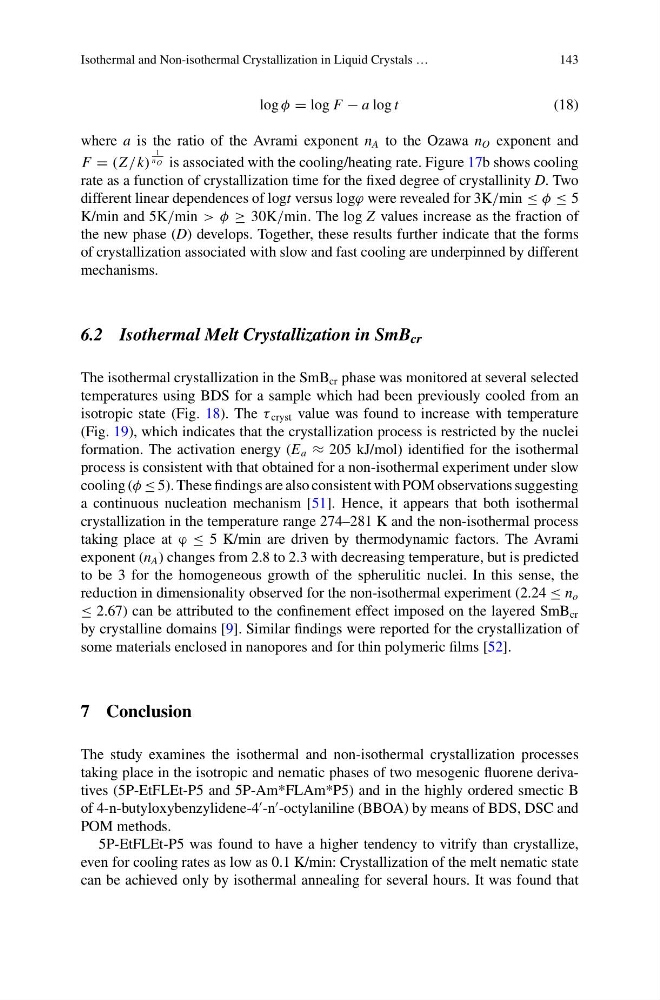
log φ = log F − a log t
(18)
where a is the ratio of the Avrami exponent n A to the Ozawa n O exponent and
F = (Z /k)
1
n O is associated with the cooling/heating rate. Figure 17b shows cooling
rate as a function of crystallization time for the fixed degree of crystallinity D. Two
different linear dependences of logt versus logϕ were revealed for 3K/min ≤ φ ≤ 5
K/min and 5K/min > φ ≥ 30K/min. The log Z values increase as the fraction of
the new phase (D) develops. Together, these results further indicate that the forms
of crystallization associated with slow and fast cooling are underpinned by different
mechanisms.
6.2 Isothermal Melt Crystallization in SmB cr
The isothermal crystallization in the SmB cr phase was monitored at several selected
temperatures using BDS for a sample which had been previously cooled from an
isotropic state (Fig. 18). The τ cryst value was found to increase with temperature
(Fig. 19), which indicates that the crystallization process is restricted by the nuclei
formation. The activation energy (E a ≈ 205 kJ/mol) identified for the isothermal
process is consistent with that obtained for a non-isothermal experiment under slow
cooling (φ ≤ 5). These findings are also consistent with POM observations suggesting
a continuous nucleation mechanism [51]. Hence, it appears that both isothermal
crystallization in the temperature range 274–281 K and the non-isothermal process
taking place at ϕ ≤ 5 K/min are driven by thermodynamic factors. The Avrami
exponent (n A ) changes from 2.8 to 2.3 with decreasing temperature, but is predicted
to be 3 for the homogeneous growth of the spherulitic nuclei. In this sense, the
reduction in dimensionality observed for the non-isothermal experiment (2.24 ≤ n o
≤ 2.67) can be attributed to the confinement effect imposed on the layered SmB cr
by crystalline domains [9]. Similar findings were reported for the crystallization of
some materials enclosed in nanopores and for thin polymeric films [52].
7 Conclusion
The study examines the isothermal and non-isothermal crystallization processes
taking place in the isotropic and nematic phases of two mesogenic fluorene derivatives (5P-EtFLEt-P5 and 5P-Am*FLAm*P5) and in the highly ordered smectic B
of 4-n-butyloxybenzylidene-4
-n
-octylaniline (BBOA) by means of BDS, DSC and
POM methods.
5P-EtFLEt-P5 was found to have a higher tendency to vitrify than crystallize,
even for cooling rates as low as 0.1 K/min: Crystallization of the melt nematic state
can be achieved only by isothermal annealing for several hours. It was found that
143
log φ = log F − a log t
(18)
where a is the ratio of the Avrami exponent n A to the Ozawa n O exponent and
F = (Z /k)
1
n O is associated with the cooling/heating rate. Figure 17b shows cooling
rate as a function of crystallization time for the fixed degree of crystallinity D. Two
different linear dependences of logt versus logϕ were revealed for 3K/min ≤ φ ≤ 5
K/min and 5K/min > φ ≥ 30K/min. The log Z values increase as the fraction of
the new phase (D) develops. Together, these results further indicate that the forms
of crystallization associated with slow and fast cooling are underpinned by different
mechanisms.
6.2 Isothermal Melt Crystallization in SmB cr
The isothermal crystallization in the SmB cr phase was monitored at several selected
temperatures using BDS for a sample which had been previously cooled from an
isotropic state (Fig. 18). The τ cryst value was found to increase with temperature
(Fig. 19), which indicates that the crystallization process is restricted by the nuclei
formation. The activation energy (E a ≈ 205 kJ/mol) identified for the isothermal
process is consistent with that obtained for a non-isothermal experiment under slow
cooling (φ ≤ 5). These findings are also consistent with POM observations suggesting
a continuous nucleation mechanism [51]. Hence, it appears that both isothermal
crystallization in the temperature range 274–281 K and the non-isothermal process
taking place at ϕ ≤ 5 K/min are driven by thermodynamic factors. The Avrami
exponent (n A ) changes from 2.8 to 2.3 with decreasing temperature, but is predicted
to be 3 for the homogeneous growth of the spherulitic nuclei. In this sense, the
reduction in dimensionality observed for the non-isothermal experiment (2.24 ≤ n o
≤ 2.67) can be attributed to the confinement effect imposed on the layered SmB cr
by crystalline domains [9]. Similar findings were reported for the crystallization of
some materials enclosed in nanopores and for thin polymeric films [52].
7 Conclusion
The study examines the isothermal and non-isothermal crystallization processes
taking place in the isotropic and nematic phases of two mesogenic fluorene derivatives (5P-EtFLEt-P5 and 5P-Am*FLAm*P5) and in the highly ordered smectic B
of 4-n-butyloxybenzylidene-4
-n
-octylaniline (BBOA) by means of BDS, DSC and
POM methods.
5P-EtFLEt-P5 was found to have a higher tendency to vitrify than crystallize,
even for cooling rates as low as 0.1 K/min: Crystallization of the melt nematic state
can be achieved only by isothermal annealing for several hours. It was found that