

136
M. Jasiurkowska-Delaporte
growing crystalline centers at 281 K. This also indicates isotropic growth took place
at higher temperatures, whereas a large anisotropy in the growth rate, manifested by
some faces growing faster than others (resulting in spiky crystals), was found at low
temperatures. Further details about crystal growth were obtained by analyzing the
difference of entropy between the melt and crystalline states. According to Jackson,
materials displaying a large entropy of crystal fusion ( m S > 4R, where R is the
gas constant), as it was observed in the case of studied LCs ( m S ≈ 68 Jmol
−1
K
−1 for 5P-Am*FLAm*P5 and m S ≈ 192 Jmol
−1 K
−1 for 5P-EtFLEt-P5), show
a flat melt/crystal interface growing laterally by either screw dislocation or surface
nucleation growth.
5.3 The Non-isothermal Cold Crystallization Process
in 5P-EtFLEt-P5 and 5P-Am*FLAm*P5 as Observed
by DSC
The tendency of the investigated fluorene derivatives to vitrify or crystallize was
verified by DSC measurement for different rates of temperature changes (φ). For
5P-EtFLEt-P5, vitrification of the nematic phase was observed followed by cold
crystallization in a metastable N state upon heating—this was found for all tested
cooling/heating rates (1 ≤ φ ≤ 30); in contrast, the chiral nematic phase of 5PAm*FLAm*P5 formed glass only upon cooling at a φ ≥ 5 K/min. Additionally,
upon heating, the metastable N* of the latter first transformed to an isotropic phase
and then underwent crystallization (see Fig. 2c). The relative degree of the nonisothermal crystallization (D) for each value of φ can be estimated by integrating the
crystallization peaks of DSC curve [43]:
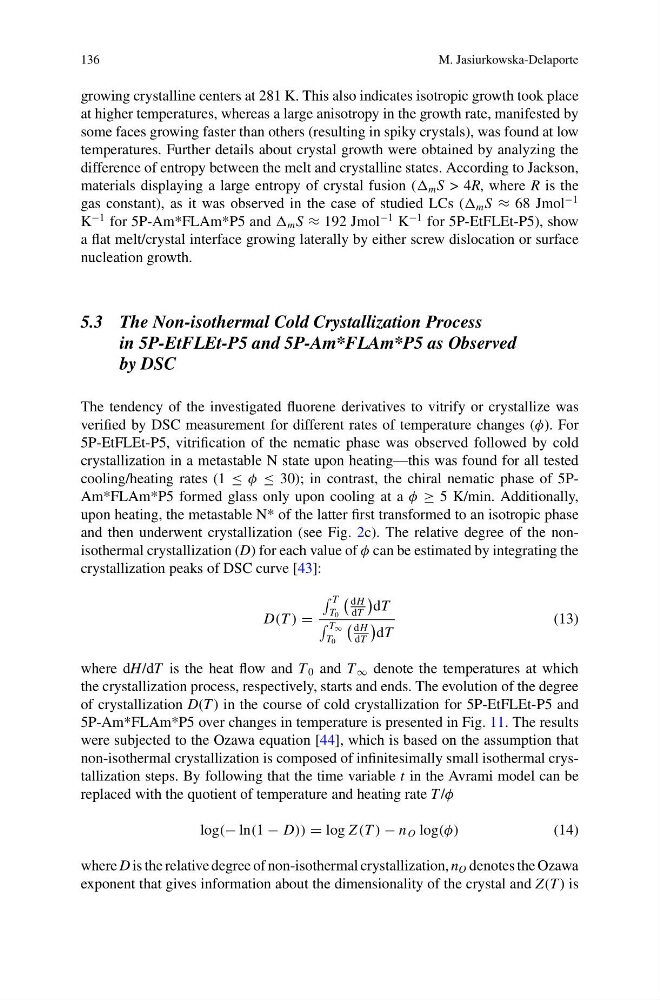
D(T ) =
T
T 0
dH
dT
dT
T ∞
T 0
dH
dT
dT
(13)
where dH/dT is the heat flow and T 0 and T ∞ denote the temperatures at which
the crystallization process, respectively, starts and ends. The evolution of the degree
of crystallization D(T ) in the course of cold crystallization for 5P-EtFLEt-P5 and
5P-Am*FLAm*P5 over changes in temperature is presented in Fig. 11. The results
were subjected to the Ozawa equation [44], which is based on the assumption that
non-isothermal crystallization is composed of infinitesimally small isothermal crystallization steps. By following that the time variable t in the Avrami model can be
replaced with the quotient of temperature and heating rate T /φ
log(− ln(1 − D)) = log Z (T ) − n O log(φ)
(14)
where D is the relative degree of non-isothermal crystallization, n O denotes the Ozawa
exponent that gives information about the dimensionality of the crystal and Z(T ) is
M. Jasiurkowska-Delaporte
growing crystalline centers at 281 K. This also indicates isotropic growth took place
at higher temperatures, whereas a large anisotropy in the growth rate, manifested by
some faces growing faster than others (resulting in spiky crystals), was found at low
temperatures. Further details about crystal growth were obtained by analyzing the
difference of entropy between the melt and crystalline states. According to Jackson,
materials displaying a large entropy of crystal fusion ( m S > 4R, where R is the
gas constant), as it was observed in the case of studied LCs ( m S ≈ 68 Jmol
−1
K
−1 for 5P-Am*FLAm*P5 and m S ≈ 192 Jmol
−1 K
−1 for 5P-EtFLEt-P5), show
a flat melt/crystal interface growing laterally by either screw dislocation or surface
nucleation growth.
5.3 The Non-isothermal Cold Crystallization Process
in 5P-EtFLEt-P5 and 5P-Am*FLAm*P5 as Observed
by DSC
The tendency of the investigated fluorene derivatives to vitrify or crystallize was
verified by DSC measurement for different rates of temperature changes (φ). For
5P-EtFLEt-P5, vitrification of the nematic phase was observed followed by cold
crystallization in a metastable N state upon heating—this was found for all tested
cooling/heating rates (1 ≤ φ ≤ 30); in contrast, the chiral nematic phase of 5PAm*FLAm*P5 formed glass only upon cooling at a φ ≥ 5 K/min. Additionally,
upon heating, the metastable N* of the latter first transformed to an isotropic phase
and then underwent crystallization (see Fig. 2c). The relative degree of the nonisothermal crystallization (D) for each value of φ can be estimated by integrating the
crystallization peaks of DSC curve [43]:
D(T ) =
T
T 0
dH
dT
dT
T ∞
T 0
dH
dT
dT
(13)
where dH/dT is the heat flow and T 0 and T ∞ denote the temperatures at which
the crystallization process, respectively, starts and ends. The evolution of the degree
of crystallization D(T ) in the course of cold crystallization for 5P-EtFLEt-P5 and
5P-Am*FLAm*P5 over changes in temperature is presented in Fig. 11. The results
were subjected to the Ozawa equation [44], which is based on the assumption that
non-isothermal crystallization is composed of infinitesimally small isothermal crystallization steps. By following that the time variable t in the Avrami model can be
replaced with the quotient of temperature and heating rate T /φ
log(− ln(1 − D)) = log Z (T ) − n O log(φ)
(14)
where D is the relative degree of non-isothermal crystallization, n O denotes the Ozawa
exponent that gives information about the dimensionality of the crystal and Z(T ) is