

6
J. W. P. Schmelzer and C. Schick
concept of a Kauzmann pressure [12] can be introduced for crystallization induced
by variations of pressure. It is shown that the thermodynamic driving force of crystal
nucleation has similarly maxima also at the Kauzmann pressure. Further, it is demonstrated that—as far as mentioned basic assumptions of CNT are fulfilled—in melt
crystallization, a spinodal curve does not exist. In addition, it is shown that—in
contrast to some recent statements—Kauzmann’s suggestion of a pseudo-spinodal
in melt crystallization characterized by intensive nucleation has no foundation [13–
15]. Finally, setting in Eq. 6 the thermodynamic driving force equal to zero, we obtain
an analytic expressions for the dependence of pressure on temperature or vice versa
along the melting curve.
2.2 Surface Tension in Dependence on Temperature
and Pressure
In the application of CNT to melt crystallization one very serious problem consists in
the limitations caused by the fact that the surface tension melt-crystal cannot be determined directly experimentally with the accuracy required in nucleation theory. By
this reason, in applications of CNT frequently the Stefan-Skapski-Turnbull relation
is employed for its determination [5, 6]. In its standard so far application, it involves
the assumption of the capillarity approximation, i.e., that the surface tension of critical clusters is equal to the respective value of equilibrium coexistence of both phases
at a planar interface. However, the application of the capillarity approximation leads
to serious problems in CNT [16]. They can be overcome by introducing a curvature
dependence of the surface tension as suggested already by Gibbs [8] and widely
employed in CNT. Based on a generalization of the Stefan–Skapski–Turnbull equation, a relation for the dependence of the surface tension on pressure and temperature
has been derived by us [12, 17, 18]. Here we reproduce the basic results.
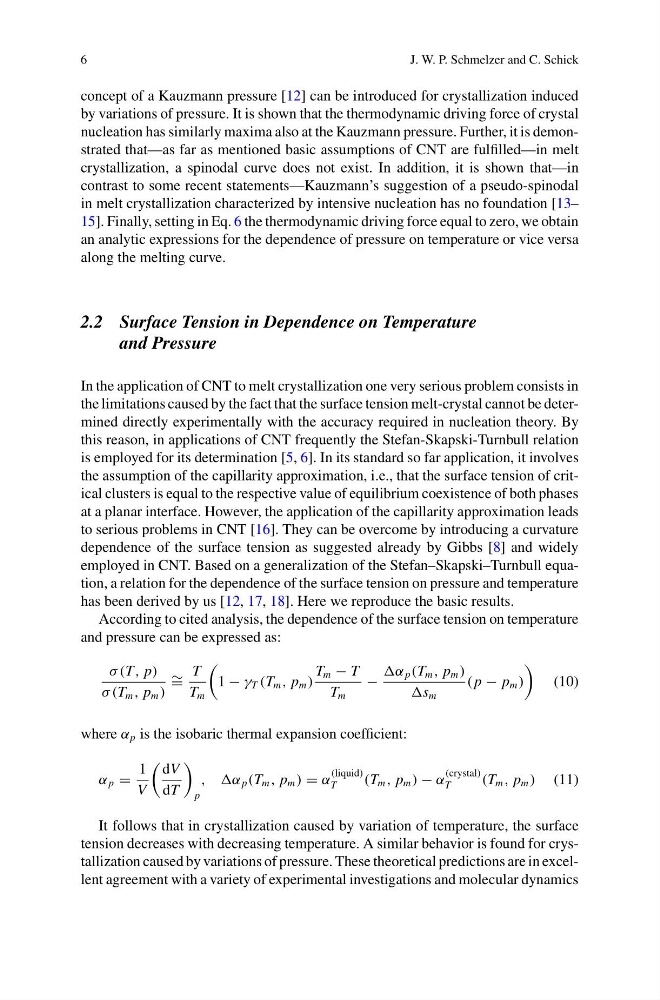
According to cited analysis, the dependence of the surface tension on temperature
and pressure can be expressed as:
σ (T, p)
σ (T m , p m )
∼ =
T
T m
1 − γ T (T m , p m )
T m − T
T m
−
α p (T m , p m )
s m
( p − p m )
(10)
where α p is the isobaric thermal expansion coefficient:
α p =
1
V
dV
dT
p
, ,α p (T m , p m ) = α
(liquid)
T
(T m , p m ) − α
(crystal)
T
(T m , p m ) (11)
It follows that in crystallization caused by variation of temperature, the surface
tension decreases with decreasing temperature. A similar behavior is found for crystallization caused by variations of pressure. These theoretical predictions are in excellent agreement with a variety of experimental investigations and molecular dynamics
J. W. P. Schmelzer and C. Schick
concept of a Kauzmann pressure [12] can be introduced for crystallization induced
by variations of pressure. It is shown that the thermodynamic driving force of crystal
nucleation has similarly maxima also at the Kauzmann pressure. Further, it is demonstrated that—as far as mentioned basic assumptions of CNT are fulfilled—in melt
crystallization, a spinodal curve does not exist. In addition, it is shown that—in
contrast to some recent statements—Kauzmann’s suggestion of a pseudo-spinodal
in melt crystallization characterized by intensive nucleation has no foundation [13–
15]. Finally, setting in Eq. 6 the thermodynamic driving force equal to zero, we obtain
an analytic expressions for the dependence of pressure on temperature or vice versa
along the melting curve.
2.2 Surface Tension in Dependence on Temperature
and Pressure
In the application of CNT to melt crystallization one very serious problem consists in
the limitations caused by the fact that the surface tension melt-crystal cannot be determined directly experimentally with the accuracy required in nucleation theory. By
this reason, in applications of CNT frequently the Stefan-Skapski-Turnbull relation
is employed for its determination [5, 6]. In its standard so far application, it involves
the assumption of the capillarity approximation, i.e., that the surface tension of critical clusters is equal to the respective value of equilibrium coexistence of both phases
at a planar interface. However, the application of the capillarity approximation leads
to serious problems in CNT [16]. They can be overcome by introducing a curvature
dependence of the surface tension as suggested already by Gibbs [8] and widely
employed in CNT. Based on a generalization of the Stefan–Skapski–Turnbull equation, a relation for the dependence of the surface tension on pressure and temperature
has been derived by us [12, 17, 18]. Here we reproduce the basic results.
According to cited analysis, the dependence of the surface tension on temperature
and pressure can be expressed as:
σ (T, p)
σ (T m , p m )
∼ =
T
T m
1 − γ T (T m , p m )
T m − T
T m
−
α p (T m , p m )
s m
( p − p m )
(10)
where α p is the isobaric thermal expansion coefficient:
α p =
1
V
dV
dT
p
, ,α p (T m , p m ) = α
(liquid)
T
(T m , p m ) − α
(crystal)
T
(T m , p m ) (11)
It follows that in crystallization caused by variation of temperature, the surface
tension decreases with decreasing temperature. A similar behavior is found for crystallization caused by variations of pressure. These theoretical predictions are in excellent agreement with a variety of experimental investigations and molecular dynamics