

Isothermal and Non-isothermal Crystallization in Liquid Crystals …
129
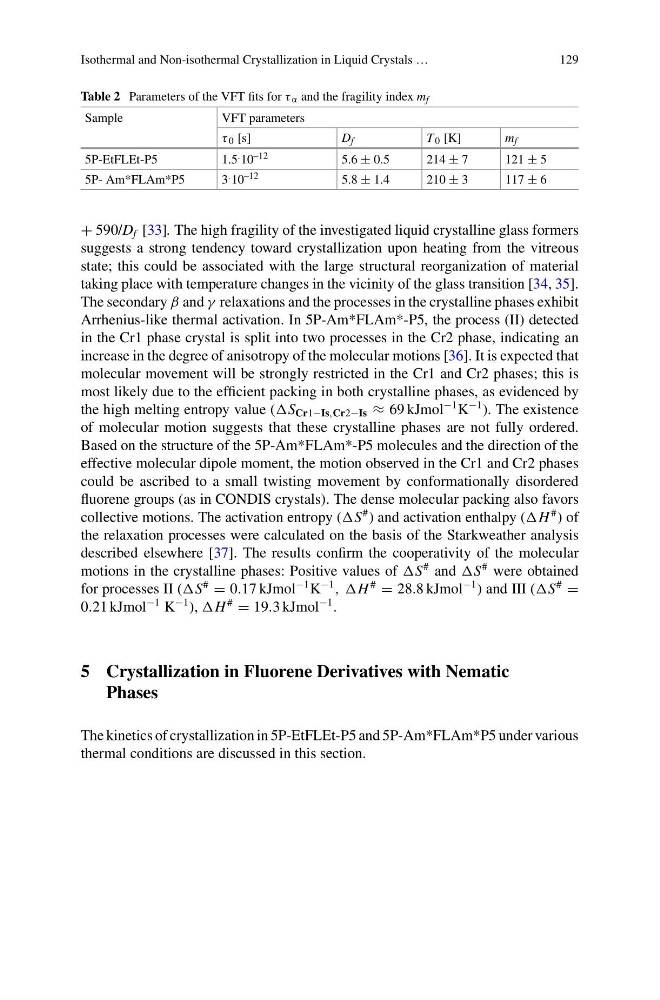
Table 2 Parameters of the VFT fits for τ α and the fragility index m f
Sample
VFT parameters
τ 0 [s]
D f
T 0 [K]
m f
5P-EtFLEt-P5
1.5 . 10 –12
5.6 ± 0.5
214 ± 7
121 ± 5
5P- Am*FLAm*P5
3 . 10 –12
5.8 ± 1.4
210 ± 3
117 ± 6
+ 590/D f [33]. The high fragility of the investigated liquid crystalline glass formers
suggests a strong tendency toward crystallization upon heating from the vitreous
state; this could be associated with the large structural reorganization of material
taking place with temperature changes in the vicinity of the glass transition [34, 35].
The secondary β and γ relaxations and the processes in the crystalline phases exhibit
Arrhenius-like thermal activation. In 5P-Am*FLAm*-P5, the process (II) detected
in the Cr1 phase crystal is split into two processes in the Cr2 phase, indicating an
increase in the degree of anisotropy of the molecular motions [36]. It is expected that
molecular movement will be strongly restricted in the Cr1 and Cr2 phases; this is
most likely due to the efficient packing in both crystalline phases, as evidenced by
the high melting entropy value (S Cr1−Is,Cr2−Is ≈ 69 kJmol
−1 K
−1 ). The existence
of molecular motion suggests that these crystalline phases are not fully ordered.
Based on the structure of the 5P-Am*FLAm*-P5 molecules and the direction of the
effective molecular dipole moment, the motion observed in the Cr1 and Cr2 phases
could be ascribed to a small twisting movement by conformationally disordered
fluorene groups (as in CONDIS crystals). The dense molecular packing also favors
collective motions. The activation entropy (S
# ) and activation enthalpy (H
# ) of
the relaxation processes were calculated on the basis of the Starkweather analysis
described elsewhere [37]. The results confirm the cooperativity of the molecular
motions in the crystalline phases: Positive values of S
# and S
# were obtained
for processes II (S
#
= 0.17 kJmol
−1 K
−1
, ,H
#
= 28.8 kJmol
−1 ) and III (S
#
=
0.21 kJmol
−1 K
−1 ), H
#
= 19.3 kJmol
−1 .
5 Crystallization in Fluorene Derivatives with Nematic
Phases
The kinetics of crystallization in 5P-EtFLEt-P5 and 5P-Am*FLAm*P5 under various
thermal conditions are discussed in this section.
129
Table 2 Parameters of the VFT fits for τ α and the fragility index m f
Sample
VFT parameters
τ 0 [s]
D f
T 0 [K]
m f
5P-EtFLEt-P5
1.5 . 10 –12
5.6 ± 0.5
214 ± 7
121 ± 5
5P- Am*FLAm*P5
3 . 10 –12
5.8 ± 1.4
210 ± 3
117 ± 6
+ 590/D f [33]. The high fragility of the investigated liquid crystalline glass formers
suggests a strong tendency toward crystallization upon heating from the vitreous
state; this could be associated with the large structural reorganization of material
taking place with temperature changes in the vicinity of the glass transition [34, 35].
The secondary β and γ relaxations and the processes in the crystalline phases exhibit
Arrhenius-like thermal activation. In 5P-Am*FLAm*-P5, the process (II) detected
in the Cr1 phase crystal is split into two processes in the Cr2 phase, indicating an
increase in the degree of anisotropy of the molecular motions [36]. It is expected that
molecular movement will be strongly restricted in the Cr1 and Cr2 phases; this is
most likely due to the efficient packing in both crystalline phases, as evidenced by
the high melting entropy value (S Cr1−Is,Cr2−Is ≈ 69 kJmol
−1 K
−1 ). The existence
of molecular motion suggests that these crystalline phases are not fully ordered.
Based on the structure of the 5P-Am*FLAm*-P5 molecules and the direction of the
effective molecular dipole moment, the motion observed in the Cr1 and Cr2 phases
could be ascribed to a small twisting movement by conformationally disordered
fluorene groups (as in CONDIS crystals). The dense molecular packing also favors
collective motions. The activation entropy (S
# ) and activation enthalpy (H
# ) of
the relaxation processes were calculated on the basis of the Starkweather analysis
described elsewhere [37]. The results confirm the cooperativity of the molecular
motions in the crystalline phases: Positive values of S
# and S
# were obtained
for processes II (S
#
= 0.17 kJmol
−1 K
−1
, ,H
#
= 28.8 kJmol
−1 ) and III (S
#
=
0.21 kJmol
−1 K
−1 ), H
#
= 19.3 kJmol
−1 .
5 Crystallization in Fluorene Derivatives with Nematic
Phases
The kinetics of crystallization in 5P-EtFLEt-P5 and 5P-Am*FLAm*P5 under various
thermal conditions are discussed in this section.