

4
J. W. P. Schmelzer and C. Schick
via Eq. 1 the value of the surface tension and the radius of the critical model cluster
leading to this particular value of W c . We will utilize this simplified model here.
The pre-factor, J 0 , in the expression for the steady-state nucleation rate, Eq. 2, is
determined by the kinetic mechanism of aggregation. For one-component systems,
it can be expressed via the diffusion coefficients, D, of the particles in the melt or—
employing the Stokes–Einstein–Eyring relation connecting diffusion coefficient and
the inverse of the viscosity—via the Newtonian viscosity, η. One of the standard
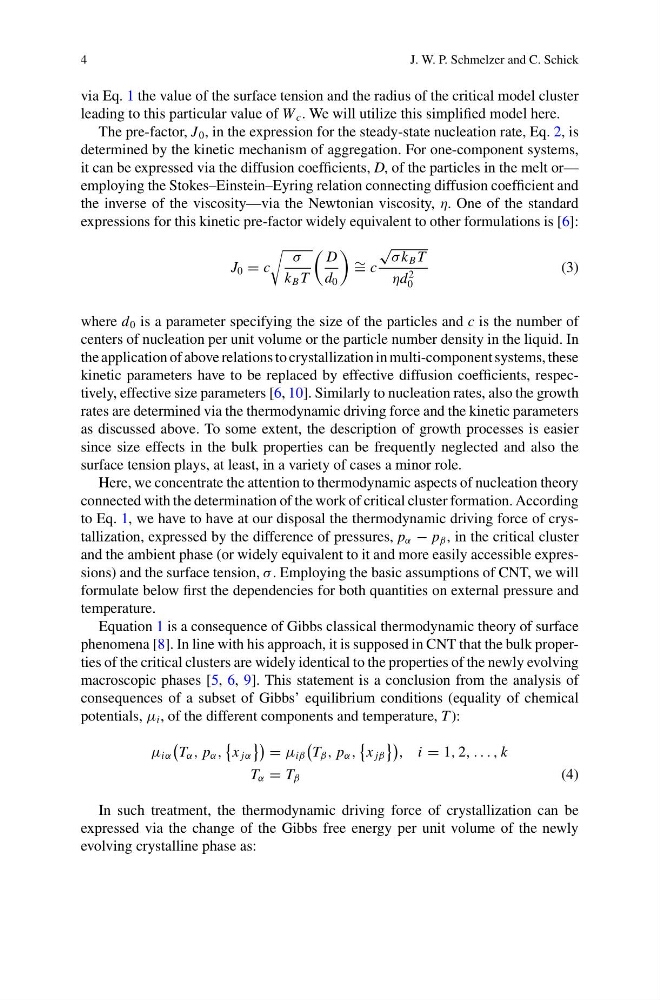
expressions for this kinetic pre-factor widely equivalent to other formulations is [6]:
J 0 = c
σ
k B T
D
d 0
∼ = c
√ σ k B T
ηd
2
0
(3)
where d 0 is a parameter specifying the size of the particles and c is the number of
centers of nucleation per unit volume or the particle number density in the liquid. In
the application of above relations to crystallization in multi-component systems, these
kinetic parameters have to be replaced by effective diffusion coefficients, respectively, effective size parameters [6, 10]. Similarly to nucleation rates, also the growth
rates are determined via the thermodynamic driving force and the kinetic parameters
as discussed above. To some extent, the description of growth processes is easier
since size effects in the bulk properties can be frequently neglected and also the
surface tension plays, at least, in a variety of cases a minor role.
Here, we concentrate the attention to thermodynamic aspects of nucleation theory
connected with the determination of the work of critical cluster formation. According
to Eq. 1, we have to have at our disposal the thermodynamic driving force of crystallization, expressed by the difference of pressures, p α − p β , in the critical cluster
and the ambient phase (or widely equivalent to it and more easily accessible expressions) and the surface tension, σ. Employing the basic assumptions of CNT, we will
formulate below first the dependencies for both quantities on external pressure and
temperature.
Equation 1 is a consequence of Gibbs classical thermodynamic theory of surface
phenomena [8]. In line with his approach, it is supposed in CNT that the bulk properties of the critical clusters are widely identical to the properties of the newly evolving
macroscopic phases [5, 6, 9]. This statement is a conclusion from the analysis of
consequences of a subset of Gibbs’ equilibrium conditions (equality of chemical
potentials, μ i , of the different components and temperature, T ):
μ iα
T α , p α ,
x jα
= μ iβ
T β , p α ,
x jβ
, i = 1, 2, . . . , k
T α = T β
(4)
In such treatment, the thermodynamic driving force of crystallization can be
expressed via the change of the Gibbs free energy per unit volume of the newly
evolving crystalline phase as:
J. W. P. Schmelzer and C. Schick
via Eq. 1 the value of the surface tension and the radius of the critical model cluster
leading to this particular value of W c . We will utilize this simplified model here.
The pre-factor, J 0 , in the expression for the steady-state nucleation rate, Eq. 2, is
determined by the kinetic mechanism of aggregation. For one-component systems,
it can be expressed via the diffusion coefficients, D, of the particles in the melt or—
employing the Stokes–Einstein–Eyring relation connecting diffusion coefficient and
the inverse of the viscosity—via the Newtonian viscosity, η. One of the standard
expressions for this kinetic pre-factor widely equivalent to other formulations is [6]:
J 0 = c
σ
k B T
D
d 0
∼ = c
√ σ k B T
ηd
2
0
(3)
where d 0 is a parameter specifying the size of the particles and c is the number of
centers of nucleation per unit volume or the particle number density in the liquid. In
the application of above relations to crystallization in multi-component systems, these
kinetic parameters have to be replaced by effective diffusion coefficients, respectively, effective size parameters [6, 10]. Similarly to nucleation rates, also the growth
rates are determined via the thermodynamic driving force and the kinetic parameters
as discussed above. To some extent, the description of growth processes is easier
since size effects in the bulk properties can be frequently neglected and also the
surface tension plays, at least, in a variety of cases a minor role.
Here, we concentrate the attention to thermodynamic aspects of nucleation theory
connected with the determination of the work of critical cluster formation. According
to Eq. 1, we have to have at our disposal the thermodynamic driving force of crystallization, expressed by the difference of pressures, p α − p β , in the critical cluster
and the ambient phase (or widely equivalent to it and more easily accessible expressions) and the surface tension, σ. Employing the basic assumptions of CNT, we will
formulate below first the dependencies for both quantities on external pressure and
temperature.
Equation 1 is a consequence of Gibbs classical thermodynamic theory of surface
phenomena [8]. In line with his approach, it is supposed in CNT that the bulk properties of the critical clusters are widely identical to the properties of the newly evolving
macroscopic phases [5, 6, 9]. This statement is a conclusion from the analysis of
consequences of a subset of Gibbs’ equilibrium conditions (equality of chemical
potentials, μ i , of the different components and temperature, T ):
μ iα
T α , p α ,
x jα
= μ iβ
T β , p α ,
x jβ
, i = 1, 2, . . . , k
T α = T β
(4)
In such treatment, the thermodynamic driving force of crystallization can be
expressed via the change of the Gibbs free energy per unit volume of the newly
evolving crystalline phase as: