

82
K. K. Leelamma
usual harmonic oscillator and are q-independent. Only eigenvalues are q-dependent.
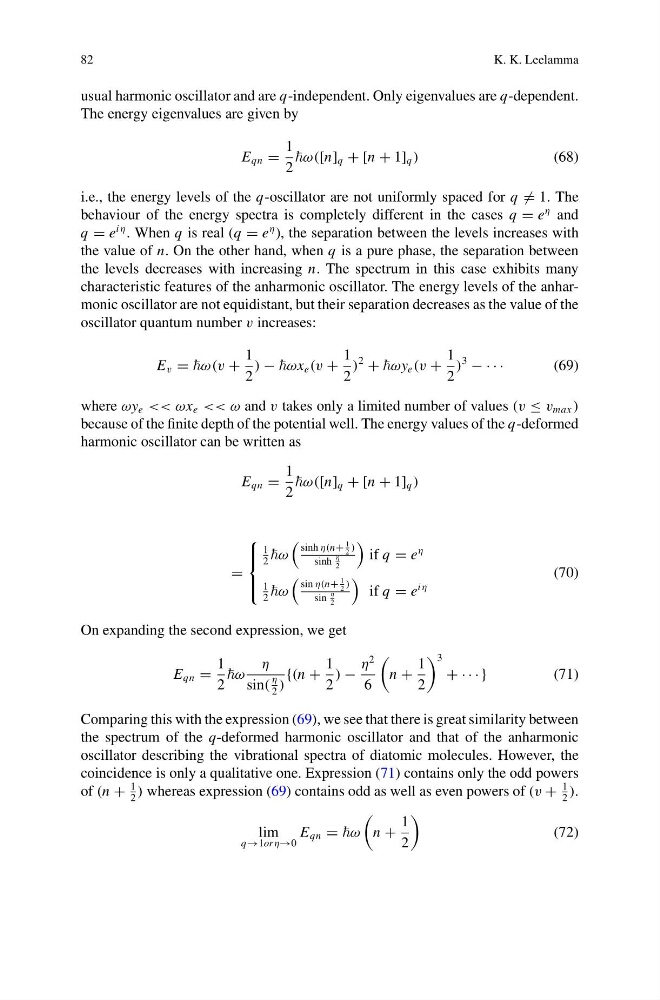
The energy eigenvalues are given by
E qn =
1
2
ω([n] q + [n + 1] q )
(68)
i.e., the energy levels of the q-oscillator are not uniformly spaced for q = 1. The
behaviour of the energy spectra is completely different in the cases q = e
η and
q = e
iη . When q is real (q = e
η ), the separation between the levels increases with
the value of n. On the other hand, when q is a pure phase, the separation between
the levels decreases with increasing n. The spectrum in this case exhibits many
characteristic features of the anharmonic oscillator. The energy levels of the anharmonic oscillator are not equidistant, but their separation decreases as the value of the
oscillator quantum number v increases:
E v = ω(v +
1
2
) − ωx e (v +
1
2
)
2
+ ωy e (v +
1
2
)
3
− · · ·
(69)
where ωy e << ωx e << ω and v takes only a limited number of values (v ≤ v max )
because of the finite depth of the potential well. The energy values of the q-deformed
harmonic oscillator can be written as
E qn =
1
2
ω([n] q + [n + 1] q )
=
⎧
⎪ ⎨
⎪ ⎩
1
2
ω
sinh η(n+
1
2 )
sinh
η
2
if q = e
η
1
2
ω
sin η(n+
1
2 )
sin
η
2
if q = e
iη
(70)
On expanding the second expression, we get
E qn =
1
2
ω
η
sin(
η
2
)
{(n +
1
2
) −
η
2
6
n +
1
2
3
+ · · · }
(71)
Comparing this with the expression (69), we see that there is great similarity between
the spectrum of the q-deformed harmonic oscillator and that of the anharmonic
oscillator describing the vibrational spectra of diatomic molecules. However, the
coincidence is only a qualitative one. Expression (71) contains only the odd powers
of (n +
1
2
) whereas expression (69) contains odd as well as even powers of (v +
1
2
).
lim
q→1or η→0
E qn = ω
n +
1
2
(72)
K. K. Leelamma
usual harmonic oscillator and are q-independent. Only eigenvalues are q-dependent.
The energy eigenvalues are given by
E qn =
1
2
ω([n] q + [n + 1] q )
(68)
i.e., the energy levels of the q-oscillator are not uniformly spaced for q = 1. The
behaviour of the energy spectra is completely different in the cases q = e
η and
q = e
iη . When q is real (q = e
η ), the separation between the levels increases with
the value of n. On the other hand, when q is a pure phase, the separation between
the levels decreases with increasing n. The spectrum in this case exhibits many
characteristic features of the anharmonic oscillator. The energy levels of the anharmonic oscillator are not equidistant, but their separation decreases as the value of the
oscillator quantum number v increases:
E v = ω(v +
1
2
) − ωx e (v +
1
2
)
2
+ ωy e (v +
1
2
)
3
− · · ·
(69)
where ωy e << ωx e << ω and v takes only a limited number of values (v ≤ v max )
because of the finite depth of the potential well. The energy values of the q-deformed
harmonic oscillator can be written as
E qn =
1
2
ω([n] q + [n + 1] q )
=
⎧
⎪ ⎨
⎪ ⎩
1
2
ω
sinh η(n+
1
2 )
sinh
η
2
if q = e
η
1
2
ω
sin η(n+
1
2 )
sin
η
2
if q = e
iη
(70)
On expanding the second expression, we get
E qn =
1
2
ω
η
sin(
η
2
)
{(n +
1
2
) −
η
2
6
n +
1
2
3
+ · · · }
(71)
Comparing this with the expression (69), we see that there is great similarity between
the spectrum of the q-deformed harmonic oscillator and that of the anharmonic
oscillator describing the vibrational spectra of diatomic molecules. However, the
coincidence is only a qualitative one. Expression (71) contains only the odd powers
of (n +
1
2
) whereas expression (69) contains odd as well as even powers of (v +
1
2
).
lim
q→1or η→0
E qn = ω
n +
1
2
(72)