

76
K. K. Leelamma
where the q-factorial
[n] q ! = [n] q [n − 1] q ....[2] q [1] q
(16)
It follows that
[1] q = 1; [0] q = 0; [0] q ! = 1
(17)
The q-sine and q-cosine functions are defined as
sin q (x) =
1
2i
(e q (i x) − e q (−i x))
(18)
cos q (x) =
1
2
(e q (i x) + e q (−i x))
(19)
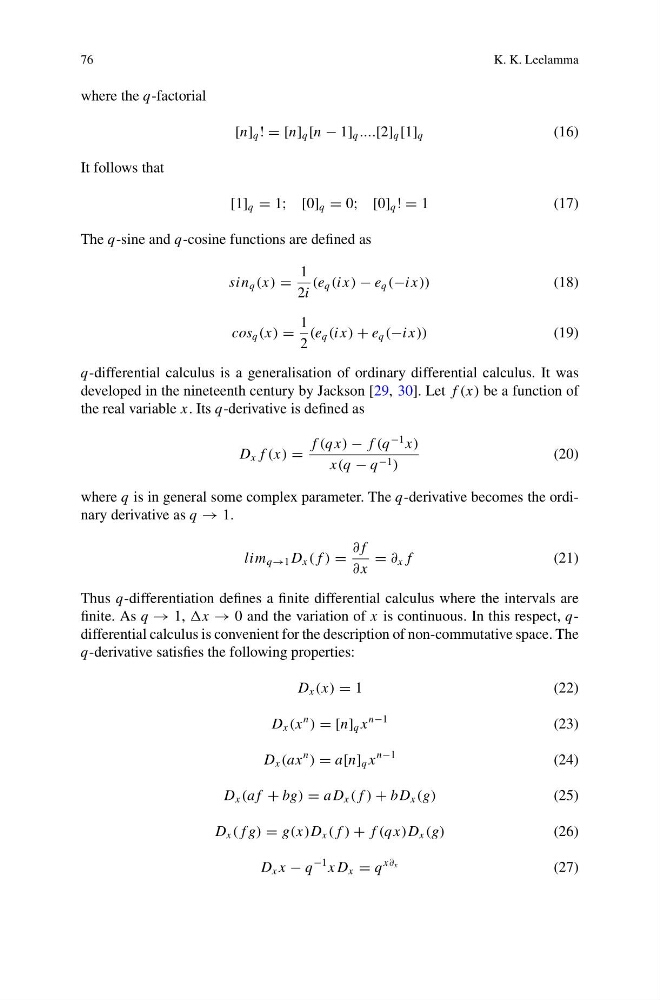
q-differential calculus is a generalisation of ordinary differential calculus. It was
developed in the nineteenth century by Jackson [29, 30]. Let f (x) be a function of
the real variable x. Its q-derivative is defined as
D x f (x) =
f (qx) − f (q
−1 x)
x(q − q −1 )
(20)
where q is in general some complex parameter. The q-derivative becomes the ordinary derivative as q → 1.
lim q→1 D x ( f ) =
∂ f
∂ x
= ∂ x f
(21)
Thus q-differentiation defines a finite differential calculus where the intervals are
finite. As q → 1, x → 0 and the variation of x is continuous. In this respect, qdifferential calculus is convenient for the description of non-commutative space. The
q-derivative satisfies the following properties:
D x (x) = 1
( 2 2 )
D x (x
n
) = [n] q x
n−1
(23)
D x (ax
n
) = a[n] q x
n−1
(24)
D x (a f + bg) = a D x ( f ) + bD x (g)
(25)
D x ( f g) = g(x)D x ( f ) + f (qx)D x (g)
(26)
D x x − q
−1 x D x = q
x∂ x
(27)
K. K. Leelamma
where the q-factorial
[n] q ! = [n] q [n − 1] q ....[2] q [1] q
(16)
It follows that
[1] q = 1; [0] q = 0; [0] q ! = 1
(17)
The q-sine and q-cosine functions are defined as
sin q (x) =
1
2i
(e q (i x) − e q (−i x))
(18)
cos q (x) =
1
2
(e q (i x) + e q (−i x))
(19)
q-differential calculus is a generalisation of ordinary differential calculus. It was
developed in the nineteenth century by Jackson [29, 30]. Let f (x) be a function of
the real variable x. Its q-derivative is defined as
D x f (x) =
f (qx) − f (q
−1 x)
x(q − q −1 )
(20)
where q is in general some complex parameter. The q-derivative becomes the ordinary derivative as q → 1.
lim q→1 D x ( f ) =
∂ f
∂ x
= ∂ x f
(21)
Thus q-differentiation defines a finite differential calculus where the intervals are
finite. As q → 1, x → 0 and the variation of x is continuous. In this respect, qdifferential calculus is convenient for the description of non-commutative space. The
q-derivative satisfies the following properties:
D x (x) = 1
( 2 2 )
D x (x
n
) = [n] q x
n−1
(23)
D x (ax
n
) = a[n] q x
n−1
(24)
D x (a f + bg) = a D x ( f ) + bD x (g)
(25)
D x ( f g) = g(x)D x ( f ) + f (qx)D x (g)
(26)
D x x − q
−1 x D x = q
x∂ x
(27)