

74
K. K. Leelamma
where q is some parameter which is real. The width of the interval x is not a constant.
In the limit q → 1, the interval x → 0 and we have space-time continuum.
Consider a system with two degrees of freedom. The quantum mechanical phasespace of the system is spanned by the co-ordinates x, y and conjugate momenta p x
and p y . The phase-space is only partially non-commuting:
[x, p x ] = i = [y, p y ]
(3)
[x, y] = 0 = [p x , p y ]
(4)
i.e., the x − y plane and p x − p y plane have continuum structure and only x − p x
and y − p y planes may have discrete structure. In a non-commutative space, noncommutativity is prescribed for co-ordinates also:
x y = qyx
(5)
The q-commutator
[x, y] q = x y − qyx = 0
( 6 )
In general, for any two operators A and B, [A, B] q = AB − q B A, where q is
some parameter which may be real or complex. It satisfies the properties [A, B] q =
−q[B, A] q −1 and lim q→1 [A, B] q = [A, B], the usual commutator in quantum mechanics. The q-commutators do not satisfy the Jacobi identity.
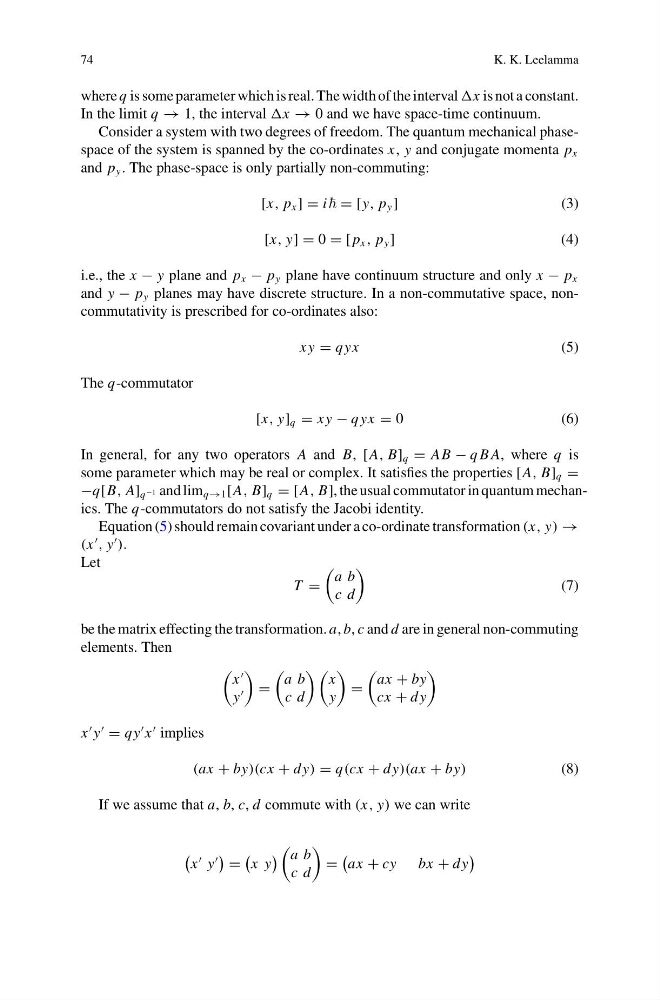
Equation (5) should remain covariant under a co-ordinate transformation (x, y) →
(x
, y
).
Let
T =
a b
c d
(7)
be the matrix effecting the transformation. a, b, c and d are in general non-commuting
elements. Then
x
y
=
a b
c d
x
y
=
ax + by
cx + dy
x
y
= qy
x
implies
(ax + by)(cx + dy) = q(cx + dy)(ax + by)
(8)
If we assume that a, b, c, d commute with (x, y) we can write
x
y
=
x y
a b
c d
=
ax + cy bx + dy
K. K. Leelamma
where q is some parameter which is real. The width of the interval x is not a constant.
In the limit q → 1, the interval x → 0 and we have space-time continuum.
Consider a system with two degrees of freedom. The quantum mechanical phasespace of the system is spanned by the co-ordinates x, y and conjugate momenta p x
and p y . The phase-space is only partially non-commuting:
[x, p x ] = i = [y, p y ]
(3)
[x, y] = 0 = [p x , p y ]
(4)
i.e., the x − y plane and p x − p y plane have continuum structure and only x − p x
and y − p y planes may have discrete structure. In a non-commutative space, noncommutativity is prescribed for co-ordinates also:
x y = qyx
(5)
The q-commutator
[x, y] q = x y − qyx = 0
( 6 )
In general, for any two operators A and B, [A, B] q = AB − q B A, where q is
some parameter which may be real or complex. It satisfies the properties [A, B] q =
−q[B, A] q −1 and lim q→1 [A, B] q = [A, B], the usual commutator in quantum mechanics. The q-commutators do not satisfy the Jacobi identity.
Equation (5) should remain covariant under a co-ordinate transformation (x, y) →
(x
, y
).
Let
T =
a b
c d
(7)
be the matrix effecting the transformation. a, b, c and d are in general non-commuting
elements. Then
x
y
=
a b
c d
x
y
=
ax + by
cx + dy
x
y
= qy
x
implies
(ax + by)(cx + dy) = q(cx + dy)(ax + by)
(8)
If we assume that a, b, c, d commute with (x, y) we can write
x
y
=
x y
a b
c d
=
ax + cy bx + dy