

On Gravity: Remembrance of the Association Between a Guru …
67
R
μν
= −
∇ i F
i j,a
δ A
a
j
δg μν
+ ∇ i G
i j,a
δ B
a
j
δg μν
.
(10)
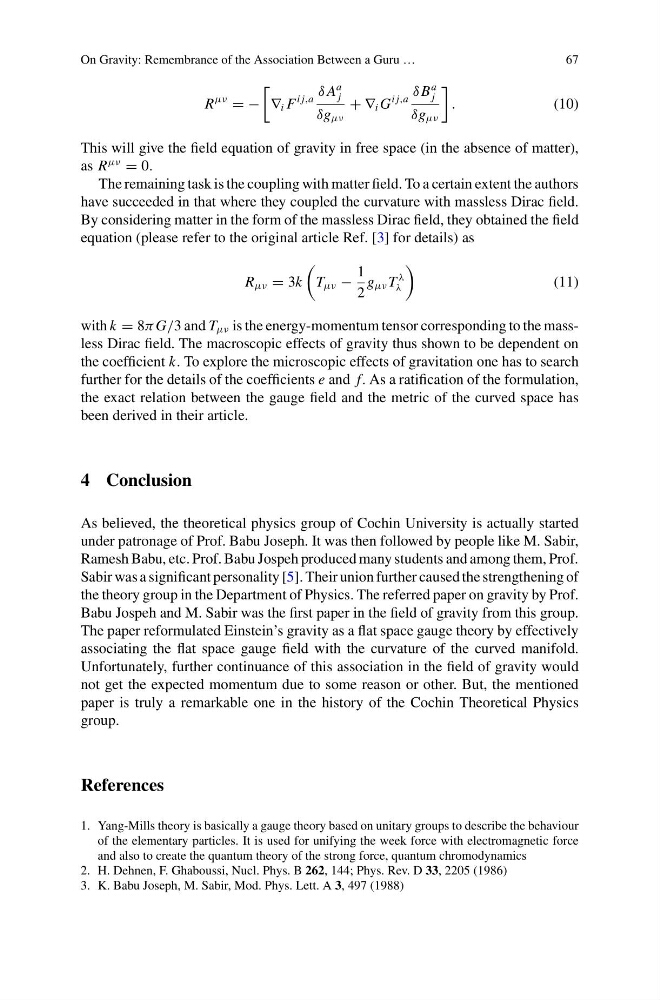
This will give the field equation of gravity in free space (in the absence of matter),
as R
μν
= 0.
The remaining task is the coupling with matter field. To a certain extent the authors
have succeeded in that where they coupled the curvature with massless Dirac field.
By considering matter in the form of the massless Dirac field, they obtained the field
equation (please refer to the original article Ref. [3] for details) as
R μν = 3k
T μν −
1
2
g μν T
λ
λ
(11)
with k = 8π G/3 and T μν is the energy-momentum tensor corresponding to the massless Dirac field. The macroscopic effects of gravity thus shown to be dependent on
the coefficient k. To explore the microscopic effects of gravitation one has to search
further for the details of the coefficients e and f. As a ratification of the formulation,
the exact relation between the gauge field and the metric of the curved space has
been derived in their article.
4 Conclusion
As believed, the theoretical physics group of Cochin University is actually started
under patronage of Prof. Babu Joseph. It was then followed by people like M. Sabir,
Ramesh Babu, etc. Prof. Babu Jospeh produced many students and among them, Prof.
Sabir was a significant personality [5]. Their union further caused the strengthening of
the theory group in the Department of Physics. The referred paper on gravity by Prof.
Babu Jospeh and M. Sabir was the first paper in the field of gravity from this group.
The paper reformulated Einstein’s gravity as a flat space gauge theory by effectively
associating the flat space gauge field with the curvature of the curved manifold.
Unfortunately, further continuance of this association in the field of gravity would
not get the expected momentum due to some reason or other. But, the mentioned
paper is truly a remarkable one in the history of the Cochin Theoretical Physics
group.
References
1. Yang-Mills theory is basically a gauge theory based on unitary groups to describe the behaviour
of the elementary particles. It is used for unifying the week force with electromagnetic force
and also to create the quantum theory of the strong force, quantum chromodynamics
2. H. Dehnen, F. Ghaboussi, Nucl. Phys. B 262, 144; Phys. Rev. D 33, 2205 (1986)
3. K. Babu Joseph, M. Sabir, Mod. Phys. Lett. A 3, 497 (1988)
67
R
μν
= −
∇ i F
i j,a
δ A
a
j
δg μν
+ ∇ i G
i j,a
δ B
a
j
δg μν
.
(10)
This will give the field equation of gravity in free space (in the absence of matter),
as R
μν
= 0.
The remaining task is the coupling with matter field. To a certain extent the authors
have succeeded in that where they coupled the curvature with massless Dirac field.
By considering matter in the form of the massless Dirac field, they obtained the field
equation (please refer to the original article Ref. [3] for details) as
R μν = 3k
T μν −
1
2
g μν T
λ
λ
(11)
with k = 8π G/3 and T μν is the energy-momentum tensor corresponding to the massless Dirac field. The macroscopic effects of gravity thus shown to be dependent on
the coefficient k. To explore the microscopic effects of gravitation one has to search
further for the details of the coefficients e and f. As a ratification of the formulation,
the exact relation between the gauge field and the metric of the curved space has
been derived in their article.
4 Conclusion
As believed, the theoretical physics group of Cochin University is actually started
under patronage of Prof. Babu Joseph. It was then followed by people like M. Sabir,
Ramesh Babu, etc. Prof. Babu Jospeh produced many students and among them, Prof.
Sabir was a significant personality [5]. Their union further caused the strengthening of
the theory group in the Department of Physics. The referred paper on gravity by Prof.
Babu Jospeh and M. Sabir was the first paper in the field of gravity from this group.
The paper reformulated Einstein’s gravity as a flat space gauge theory by effectively
associating the flat space gauge field with the curvature of the curved manifold.
Unfortunately, further continuance of this association in the field of gravity would
not get the expected momentum due to some reason or other. But, the mentioned
paper is truly a remarkable one in the history of the Cochin Theoretical Physics
group.
References
1. Yang-Mills theory is basically a gauge theory based on unitary groups to describe the behaviour
of the elementary particles. It is used for unifying the week force with electromagnetic force
and also to create the quantum theory of the strong force, quantum chromodynamics
2. H. Dehnen, F. Ghaboussi, Nucl. Phys. B 262, 144; Phys. Rev. D 33, 2205 (1986)
3. K. Babu Joseph, M. Sabir, Mod. Phys. Lett. A 3, 497 (1988)