

On Gravity: Remembrance of the Association Between a Guru …
65
Einstein gravity using Yang-Mills action based on SU (2) × U (1) group. However,
this theory has some severe drawbacks. The major drawback is that the metric of the
curved space is a composite one obtained from the basic YM fields and hence is not
fundamental. Secondly, many of the assumptions made in their paper are completely
arbitrary, hence of doubtful validity. In 1988, KBJ and MS [3] came up with an
alternative theory, in which they have rectified the above two shortcomings of the
DG theory, and have specifically showed that it is possible to reformulate Einstein’s
gravity using non-YM gauge fields in flat space based on U (2) × U (2) symmetry
and it reduces to the usual YM form in the linear limit.
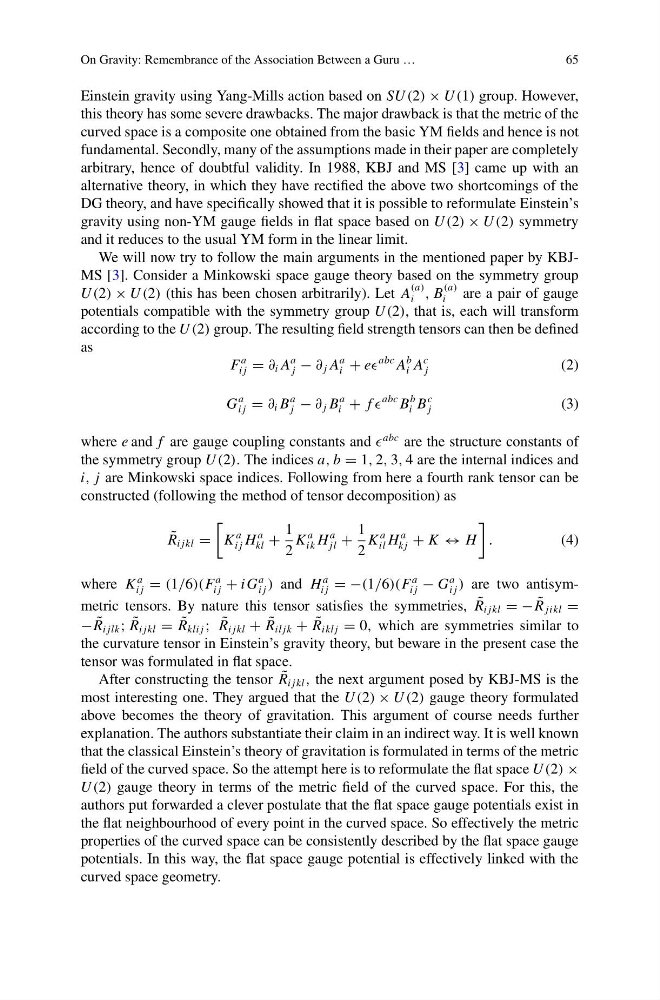
We will now try to follow the main arguments in the mentioned paper by KBJMS [3]. Consider a Minkowski space gauge theory based on the symmetry group
U (2) × U (2) (this has been chosen arbitrarily). Let A
(a)
i , B
(a)
i
are a pair of gauge
potentials compatible with the symmetry group U (2), that is, each will transform
according to the U (2) group. The resulting field strength tensors can then be defined
as
F
a
i j = ∂ i A
a
j − ∂ j A
a
i + e
abc A
b
i A
c
j
(2)
G
a
i j = ∂ i B
a
j − ∂ j B
a
i + f
abc B
b
i B
c
j
(3)
where e and f are gauge coupling constants and
abc are the structure constants of
the symmetry group U (2). The indices a, b = 1, 2, 3, 4 are the internal indices and
i, j are Minkowski space indices. Following from here a fourth rank tensor can be
constructed (following the method of tensor decomposition) as
˜
R i jkl =
K
a
i j H
a
kl +
1
2
K
a
ik H
a
jl +
1
2
K
a
il H
a
k j + K ↔ H
.
(4)
where K
a
i j = (1/6)(F
a
i j + i G
a
i j ) and H
a
i j = −(1/6)(F
a
i j − G
a
i j ) are two antisymmetric tensors. By nature this tensor satisfies the symmetries, ˜
R i jkl = − ˜
R jikl =
− ˜
R i jlk ; ˜
R i jkl = ˜
R kli j ; ˜
R i jkl + ˜
R il jk + ˜
R ikl j = 0, which are symmetries similar to
the curvature tensor in Einstein’s gravity theory, but beware in the present case the
tensor was formulated in flat space.
After constructing the tensor ˜
R i jkl , the next argument posed by KBJ-MS is the
most interesting one. They argued that the U (2) × U (2) gauge theory formulated
above becomes the theory of gravitation. This argument of course needs further
explanation. The authors substantiate their claim in an indirect way. It is well known
that the classical Einstein’s theory of gravitation is formulated in terms of the metric
field of the curved space. So the attempt here is to reformulate the flat space U (2) ×
U (2) gauge theory in terms of the metric field of the curved space. For this, the
authors put forwarded a clever postulate that the flat space gauge potentials exist in
the flat neighbourhood of every point in the curved space. So effectively the metric
properties of the curved space can be consistently described by the flat space gauge
potentials. In this way, the flat space gauge potential is effectively linked with the
curved space geometry.
65
Einstein gravity using Yang-Mills action based on SU (2) × U (1) group. However,
this theory has some severe drawbacks. The major drawback is that the metric of the
curved space is a composite one obtained from the basic YM fields and hence is not
fundamental. Secondly, many of the assumptions made in their paper are completely
arbitrary, hence of doubtful validity. In 1988, KBJ and MS [3] came up with an
alternative theory, in which they have rectified the above two shortcomings of the
DG theory, and have specifically showed that it is possible to reformulate Einstein’s
gravity using non-YM gauge fields in flat space based on U (2) × U (2) symmetry
and it reduces to the usual YM form in the linear limit.
We will now try to follow the main arguments in the mentioned paper by KBJMS [3]. Consider a Minkowski space gauge theory based on the symmetry group
U (2) × U (2) (this has been chosen arbitrarily). Let A
(a)
i , B
(a)
i
are a pair of gauge
potentials compatible with the symmetry group U (2), that is, each will transform
according to the U (2) group. The resulting field strength tensors can then be defined
as
F
a
i j = ∂ i A
a
j − ∂ j A
a
i + e
abc A
b
i A
c
j
(2)
G
a
i j = ∂ i B
a
j − ∂ j B
a
i + f
abc B
b
i B
c
j
(3)
where e and f are gauge coupling constants and
abc are the structure constants of
the symmetry group U (2). The indices a, b = 1, 2, 3, 4 are the internal indices and
i, j are Minkowski space indices. Following from here a fourth rank tensor can be
constructed (following the method of tensor decomposition) as
˜
R i jkl =
K
a
i j H
a
kl +
1
2
K
a
ik H
a
jl +
1
2
K
a
il H
a
k j + K ↔ H
.
(4)
where K
a
i j = (1/6)(F
a
i j + i G
a
i j ) and H
a
i j = −(1/6)(F
a
i j − G
a
i j ) are two antisymmetric tensors. By nature this tensor satisfies the symmetries, ˜
R i jkl = − ˜
R jikl =
− ˜
R i jlk ; ˜
R i jkl = ˜
R kli j ; ˜
R i jkl + ˜
R il jk + ˜
R ikl j = 0, which are symmetries similar to
the curvature tensor in Einstein’s gravity theory, but beware in the present case the
tensor was formulated in flat space.
After constructing the tensor ˜
R i jkl , the next argument posed by KBJ-MS is the
most interesting one. They argued that the U (2) × U (2) gauge theory formulated
above becomes the theory of gravitation. This argument of course needs further
explanation. The authors substantiate their claim in an indirect way. It is well known
that the classical Einstein’s theory of gravitation is formulated in terms of the metric
field of the curved space. So the attempt here is to reformulate the flat space U (2) ×
U (2) gauge theory in terms of the metric field of the curved space. For this, the
authors put forwarded a clever postulate that the flat space gauge potentials exist in
the flat neighbourhood of every point in the curved space. So effectively the metric
properties of the curved space can be consistently described by the flat space gauge
potentials. In this way, the flat space gauge potential is effectively linked with the
curved space geometry.