

Signature of the Quantum Gravity on the CMB
35
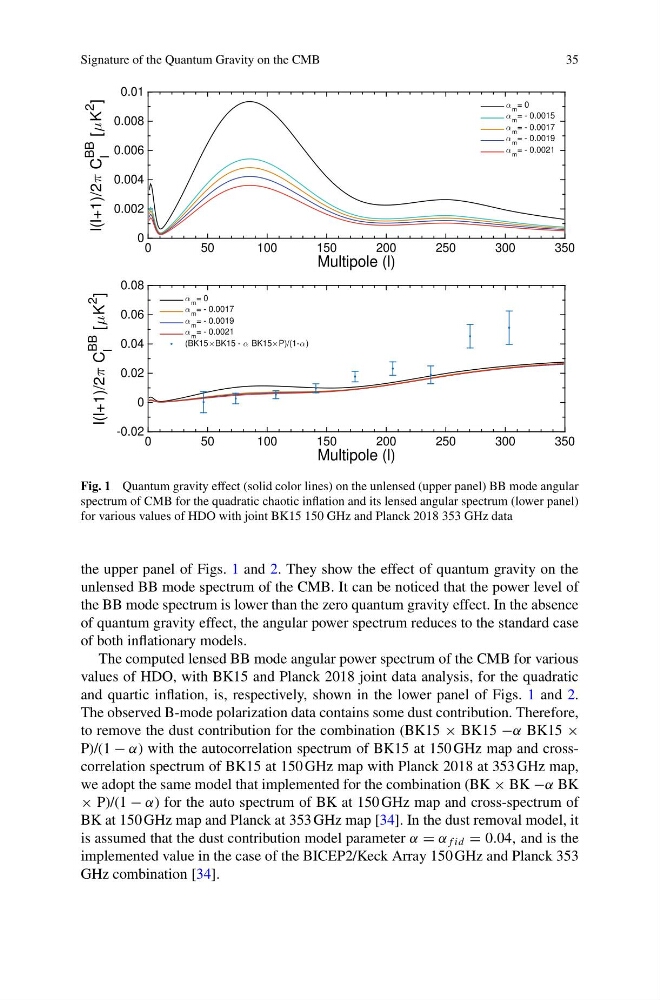
Fig. 1 Quantum gravity effect (solid color lines) on the unlensed (upper panel) BB mode angular
spectrum of CMB for the quadratic chaotic inflation and its lensed angular spectrum (lower panel)
for various values of HDO with joint BK15 150 GHz and Planck 2018 353 GHz data
the upper panel of Figs. 1 and 2. They show the effect of quantum gravity on the
unlensed BB mode spectrum of the CMB. It can be noticed that the power level of
the BB mode spectrum is lower than the zero quantum gravity effect. In the absence
of quantum gravity effect, the angular power spectrum reduces to the standard case
of both inflationary models.
The computed lensed BB mode angular power spectrum of the CMB for various
values of HDO, with BK15 and Planck 2018 joint data analysis, for the quadratic
and quartic inflation, is, respectively, shown in the lower panel of Figs. 1 and 2.
The observed B-mode polarization data contains some dust contribution. Therefore,
to remove the dust contribution for the combination (BK15 × BK15 −α BK15 ×
P)/(1 − α) with the autocorrelation spectrum of BK15 at 150 GHz map and crosscorrelation spectrum of BK15 at 150 GHz map with Planck 2018 at 353 GHz map,
we adopt the same model that implemented for the combination (BK × BK −α BK
× P)/(1 − α) for the auto spectrum of BK at 150 GHz map and cross-spectrum of
BK at 150 GHz map and Planck at 353 GHz map [34]. In the dust removal model, it
is assumed that the dust contribution model parameter α = α f id = 0.04, and is the
implemented value in the case of the BICEP2/Keck Array 150 GHz and Planck 353
GHz combination [34].
35
Fig. 1 Quantum gravity effect (solid color lines) on the unlensed (upper panel) BB mode angular
spectrum of CMB for the quadratic chaotic inflation and its lensed angular spectrum (lower panel)
for various values of HDO with joint BK15 150 GHz and Planck 2018 353 GHz data
the upper panel of Figs. 1 and 2. They show the effect of quantum gravity on the
unlensed BB mode spectrum of the CMB. It can be noticed that the power level of
the BB mode spectrum is lower than the zero quantum gravity effect. In the absence
of quantum gravity effect, the angular power spectrum reduces to the standard case
of both inflationary models.
The computed lensed BB mode angular power spectrum of the CMB for various
values of HDO, with BK15 and Planck 2018 joint data analysis, for the quadratic
and quartic inflation, is, respectively, shown in the lower panel of Figs. 1 and 2.
The observed B-mode polarization data contains some dust contribution. Therefore,
to remove the dust contribution for the combination (BK15 × BK15 −α BK15 ×
P)/(1 − α) with the autocorrelation spectrum of BK15 at 150 GHz map and crosscorrelation spectrum of BK15 at 150 GHz map with Planck 2018 at 353 GHz map,
we adopt the same model that implemented for the combination (BK × BK −α BK
× P)/(1 − α) for the auto spectrum of BK at 150 GHz map and cross-spectrum of
BK at 150 GHz map and Planck at 353 GHz map [34]. In the dust removal model, it
is assumed that the dust contribution model parameter α = α f id = 0.04, and is the
implemented value in the case of the BICEP2/Keck Array 150 GHz and Planck 353
GHz combination [34].