

Signature of the Quantum Gravity on the CMB
33
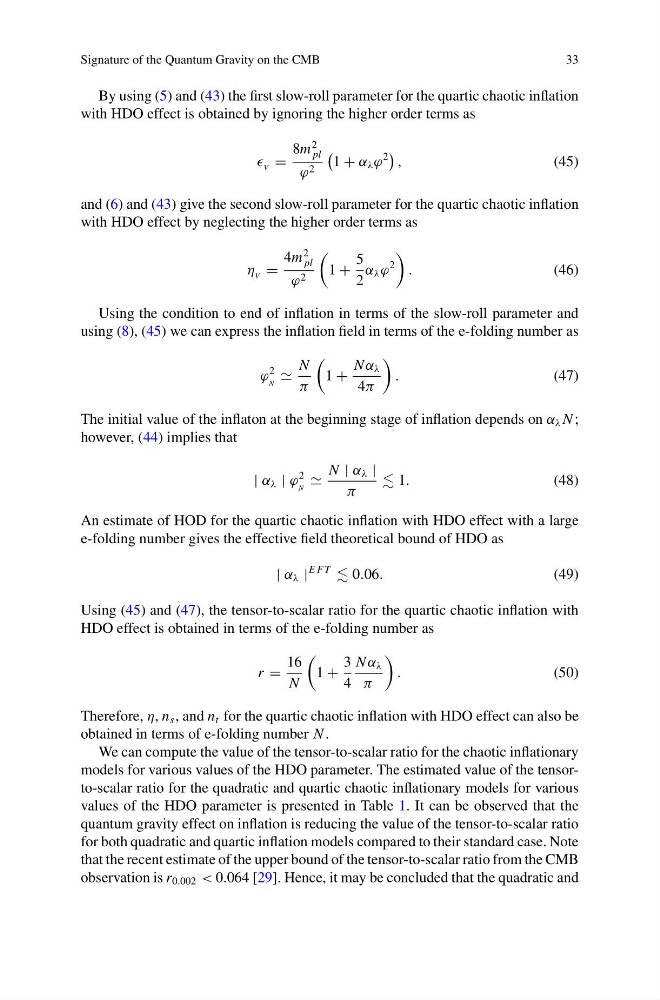
By using (5) and (43) the first slow-roll parameter for the quartic chaotic inflation
with HDO effect is obtained by ignoring the higher order terms as
V =
8m
2
pl
ϕ 2
1 + α λ ϕ
2
,
(45)
and (6) and (43) give the second slow-roll parameter for the quartic chaotic inflation
with HDO effect by neglecting the higher order terms as
η V =
4m
2
pl
ϕ 2
1 +
5
2
α λ ϕ
2
.
(46)
Using the condition to end of inflation in terms of the slow-roll parameter and
using (8), (45) we can express the inflation field in terms of the e-folding number as
ϕ
2
N
N
π
1 +
N α λ
4π
.
(47)
The initial value of the inflaton at the beginning stage of inflation depends on α λ N ;
however, (44) implies that
| α λ | ϕ
2
N
N | α λ |
π
1.
(48)
An estimate of HOD for the quartic chaotic inflation with HDO effect with a large
e-folding number gives the effective field theoretical bound of HDO as
| α λ |
E FT
0.06.
(49)
Using (45) and (47), the tensor-to-scalar ratio for the quartic chaotic inflation with
HDO effect is obtained in terms of the e-folding number as
r =
16
N
1 +
3
4
N α λ
π
.
(50)
Therefore, η, n s , and n t for the quartic chaotic inflation with HDO effect can also be
obtained in terms of e-folding number N .
We can compute the value of the tensor-to-scalar ratio for the chaotic inflationary
models for various values of the HDO parameter. The estimated value of the tensorto-scalar ratio for the quadratic and quartic chaotic inflationary models for various
values of the HDO parameter is presented in Table 1. It can be observed that the
quantum gravity effect on inflation is reducing the value of the tensor-to-scalar ratio
for both quadratic and quartic inflation models compared to their standard case. Note
that the recent estimate of the upper bound of the tensor-to-scalar ratio from the CMB
observation is r 0.002 < 0.064 [29]. Hence, it may be concluded that the quadratic and
33
By using (5) and (43) the first slow-roll parameter for the quartic chaotic inflation
with HDO effect is obtained by ignoring the higher order terms as
V =
8m
2
pl
ϕ 2
1 + α λ ϕ
2
,
(45)
and (6) and (43) give the second slow-roll parameter for the quartic chaotic inflation
with HDO effect by neglecting the higher order terms as
η V =
4m
2
pl
ϕ 2
1 +
5
2
α λ ϕ
2
.
(46)
Using the condition to end of inflation in terms of the slow-roll parameter and
using (8), (45) we can express the inflation field in terms of the e-folding number as
ϕ
2
N
N
π
1 +
N α λ
4π
.
(47)
The initial value of the inflaton at the beginning stage of inflation depends on α λ N ;
however, (44) implies that
| α λ | ϕ
2
N
N | α λ |
π
1.
(48)
An estimate of HOD for the quartic chaotic inflation with HDO effect with a large
e-folding number gives the effective field theoretical bound of HDO as
| α λ |
E FT
0.06.
(49)
Using (45) and (47), the tensor-to-scalar ratio for the quartic chaotic inflation with
HDO effect is obtained in terms of the e-folding number as
r =
16
N
1 +
3
4
N α λ
π
.
(50)
Therefore, η, n s , and n t for the quartic chaotic inflation with HDO effect can also be
obtained in terms of e-folding number N .
We can compute the value of the tensor-to-scalar ratio for the chaotic inflationary
models for various values of the HDO parameter. The estimated value of the tensorto-scalar ratio for the quadratic and quartic chaotic inflationary models for various
values of the HDO parameter is presented in Table 1. It can be observed that the
quantum gravity effect on inflation is reducing the value of the tensor-to-scalar ratio
for both quadratic and quartic inflation models compared to their standard case. Note
that the recent estimate of the upper bound of the tensor-to-scalar ratio from the CMB
observation is r 0.002 < 0.064 [29]. Hence, it may be concluded that the quadratic and