

18
C. Sivakumar
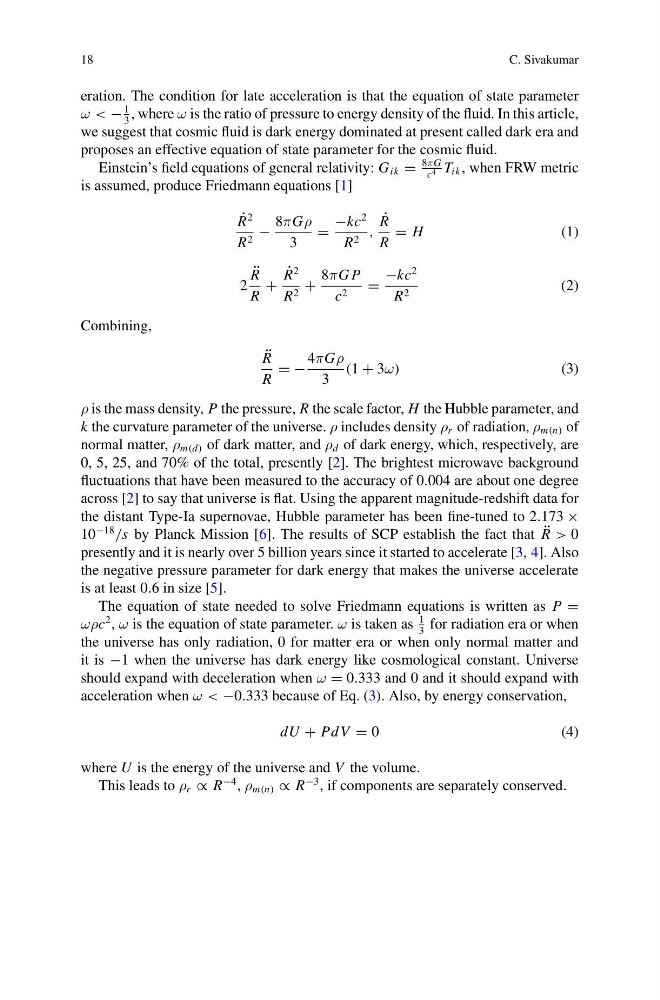
eration. The condition for late acceleration is that the equation of state parameter
ω < −
1
3
, where ω is the ratio of pressure to energy density of the fluid. In this article,
we suggest that cosmic fluid is dark energy dominated at present called dark era and
proposes an effective equation of state parameter for the cosmic fluid.
Einstein’s field equations of general relativity: G ik =
8πG
c 4 T ik , when FRW metric
is assumed, produce Friedmann equations [1]
˙
R
2
R 2 −
8πGρ
3
=
−kc
2
R 2 ,
˙
R
R
= H
(1)
2
¨
R
R
+
˙
R
2
R 2 +
8πG P
c 2 =
−kc
2
R 2
(2)
Combining,
¨
R
R
= −
4πGρ
3
(1 + 3ω)
(3)
ρ is the mass density, P the pressure, R the scale factor, H the Hubble parameter, and
k the curvature parameter of the universe. ρ includes density ρ r of radiation, ρ m(n) of
normal matter, ρ m(d) of dark matter, and ρ d of dark energy, which, respectively, are
0, 5, 25, and 70% of the total, presently [2]. The brightest microwave background
fluctuations that have been measured to the accuracy of 0.004 are about one degree
across [2] to say that universe is flat. Using the apparent magnitude-redshift data for
the distant Type-Ia supernovae, Hubble parameter has been fine-tuned to 2.173 ×
10
−18
/s by Planck Mission [6]. The results of SCP establish the fact that ¨
R > 0
presently and it is nearly over 5 billion years since it started to accelerate [3, 4]. Also
the negative pressure parameter for dark energy that makes the universe accelerate
is at least 0.6 in size [5].
The equation of state needed to solve Friedmann equations is written as P =
ωρc
2 , ω is the equation of state parameter. ω is taken as
1
3
for radiation era or when
the universe has only radiation, 0 for matter era or when only normal matter and
it is −1 when the universe has dark energy like cosmological constant. Universe
should expand with deceleration when ω = 0.333 and 0 and it should expand with
acceleration when ω < −0.333 because of Eq. (3). Also, by energy conservation,
dU + PdV = 0
( 4 )
where U is the energy of the universe and V the volume.
This leads to ρ r ∝ R
−4 , ρ m(n) ∝ R
−3 , if components are separately conserved.
C. Sivakumar
eration. The condition for late acceleration is that the equation of state parameter
ω < −
1
3
, where ω is the ratio of pressure to energy density of the fluid. In this article,
we suggest that cosmic fluid is dark energy dominated at present called dark era and
proposes an effective equation of state parameter for the cosmic fluid.
Einstein’s field equations of general relativity: G ik =
8πG
c 4 T ik , when FRW metric
is assumed, produce Friedmann equations [1]
˙
R
2
R 2 −
8πGρ
3
=
−kc
2
R 2 ,
˙
R
R
= H
(1)
2
¨
R
R
+
˙
R
2
R 2 +
8πG P
c 2 =
−kc
2
R 2
(2)
Combining,
¨
R
R
= −
4πGρ
3
(1 + 3ω)
(3)
ρ is the mass density, P the pressure, R the scale factor, H the Hubble parameter, and
k the curvature parameter of the universe. ρ includes density ρ r of radiation, ρ m(n) of
normal matter, ρ m(d) of dark matter, and ρ d of dark energy, which, respectively, are
0, 5, 25, and 70% of the total, presently [2]. The brightest microwave background
fluctuations that have been measured to the accuracy of 0.004 are about one degree
across [2] to say that universe is flat. Using the apparent magnitude-redshift data for
the distant Type-Ia supernovae, Hubble parameter has been fine-tuned to 2.173 ×
10
−18
/s by Planck Mission [6]. The results of SCP establish the fact that ¨
R > 0
presently and it is nearly over 5 billion years since it started to accelerate [3, 4]. Also
the negative pressure parameter for dark energy that makes the universe accelerate
is at least 0.6 in size [5].
The equation of state needed to solve Friedmann equations is written as P =
ωρc
2 , ω is the equation of state parameter. ω is taken as
1
3
for radiation era or when
the universe has only radiation, 0 for matter era or when only normal matter and
it is −1 when the universe has dark energy like cosmological constant. Universe
should expand with deceleration when ω = 0.333 and 0 and it should expand with
acceleration when ω < −0.333 because of Eq. (3). Also, by energy conservation,
dU + PdV = 0
( 4 )
where U is the energy of the universe and V the volume.
This leads to ρ r ∝ R
−4 , ρ m(n) ∝ R
−3 , if components are separately conserved.