

174
K. S. Sreelatha
3.3 Solitary Wave Solutions
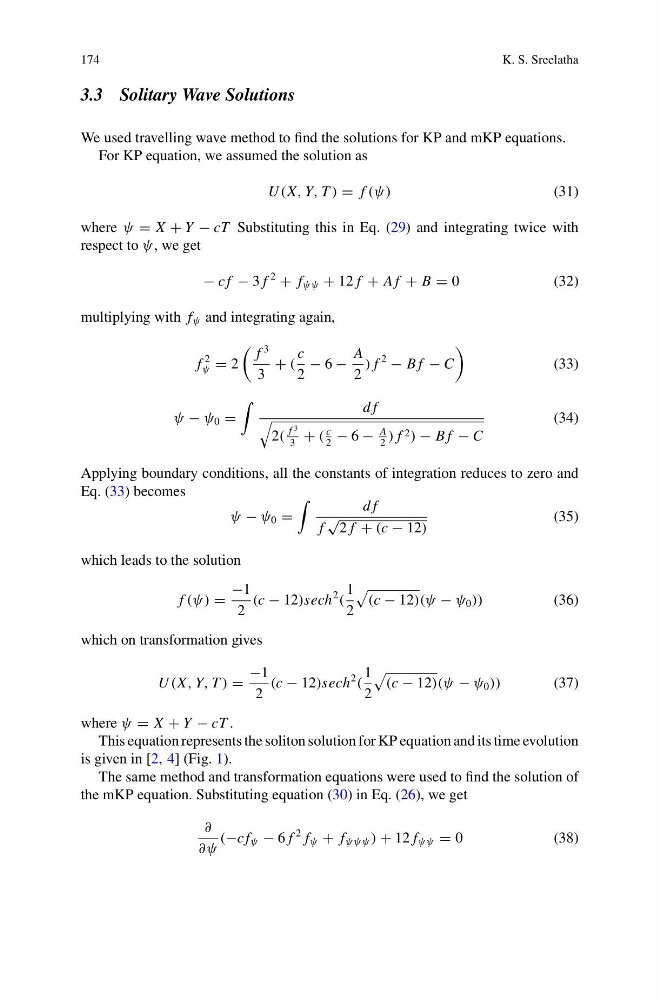
We used travelling wave method to find the solutions for KP and mKP equations.
For KP equation, we assumed the solution as
U (X, Y, T ) = f (ψ)
(31)
where ψ = X + Y − cT Substituting this in Eq. (29) and integrating twice with
respect to ψ, we get
− c f − 3 f
2
+ f ψψ + 12 f + A f + B = 0
( 3 2 )
multiplying with f ψ and integrating again,
f
2
ψ = 2
f
3
3
+ (
c
2
− 6 −
A
2
) f
2
− B f − C
(33)
ψ − ψ 0 =
d f
2(
f 3
3
+ (
c
2
− 6 −
A
2
) f 2 ) − B f − C
(34)
Applying boundary conditions, all the constants of integration reduces to zero and
Eq. (33) becomes
ψ − ψ 0 =
d f
f
√
2 f + (c − 12)
(35)
which leads to the solution
f (ψ) =
−1
2
(c − 12)sech
2
(
1
2
(c − 12)(ψ − ψ 0 ))
(36)
which on transformation gives
U (X, Y, T ) =
−1
2
(c − 12)sech
2
(
1
2
(c − 12)(ψ − ψ 0 ))
(37)
where ψ = X + Y − cT .
This equation represents the soliton solution for KP equation and its time evolution
is given in [2, 4] (Fig. 1).
The same method and transformation equations were used to find the solution of
the mKP equation. Substituting equation (30) in Eq. (26), we get
∂
∂ψ
(−c f ψ − 6 f
2 f ψ + f ψψψ ) + 12 f ψψ = 0
(38)
K. S. Sreelatha
3.3 Solitary Wave Solutions
We used travelling wave method to find the solutions for KP and mKP equations.
For KP equation, we assumed the solution as
U (X, Y, T ) = f (ψ)
(31)
where ψ = X + Y − cT Substituting this in Eq. (29) and integrating twice with
respect to ψ, we get
− c f − 3 f
2
+ f ψψ + 12 f + A f + B = 0
( 3 2 )
multiplying with f ψ and integrating again,
f
2
ψ = 2
f
3
3
+ (
c
2
− 6 −
A
2
) f
2
− B f − C
(33)
ψ − ψ 0 =
d f
2(
f 3
3
+ (
c
2
− 6 −
A
2
) f 2 ) − B f − C
(34)
Applying boundary conditions, all the constants of integration reduces to zero and
Eq. (33) becomes
ψ − ψ 0 =
d f
f
√
2 f + (c − 12)
(35)
which leads to the solution
f (ψ) =
−1
2
(c − 12)sech
2
(
1
2
(c − 12)(ψ − ψ 0 ))
(36)
which on transformation gives
U (X, Y, T ) =
−1
2
(c − 12)sech
2
(
1
2
(c − 12)(ψ − ψ 0 ))
(37)
where ψ = X + Y − cT .
This equation represents the soliton solution for KP equation and its time evolution
is given in [2, 4] (Fig. 1).
The same method and transformation equations were used to find the solution of
the mKP equation. Substituting equation (30) in Eq. (26), we get
∂
∂ψ
(−c f ψ − 6 f
2 f ψ + f ψψψ ) + 12 f ψψ = 0
(38)