

172
K. S. Sreelatha
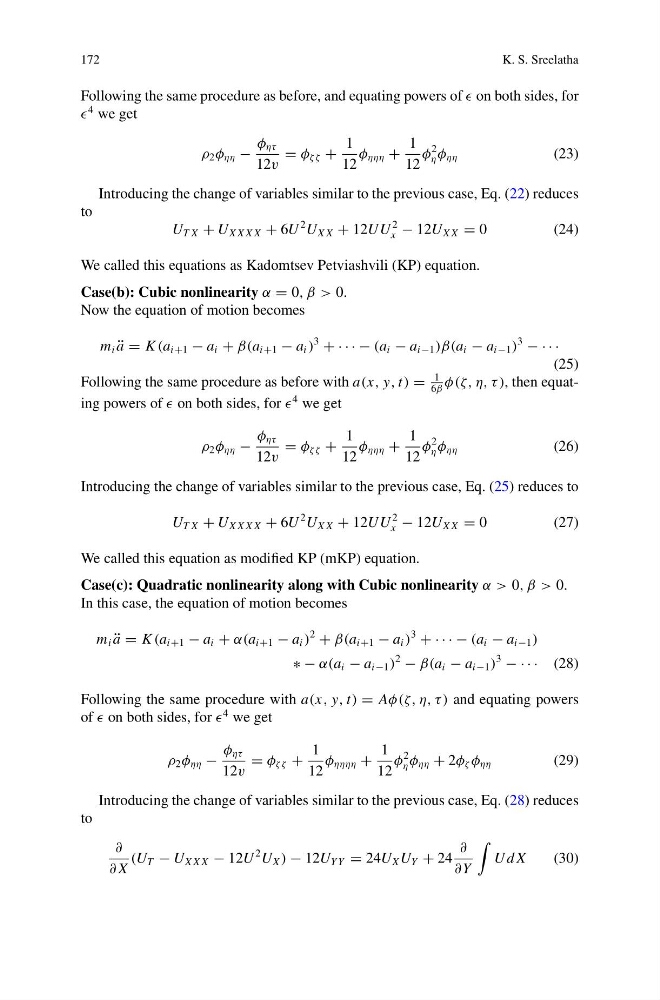
Following the same procedure as before, and equating powers of on both sides, for
4 we get
ρ 2 φ ηη −
φ ητ
12v
= φ ζ ζ +
1
12
φ ηηη +
1
12
φ
2
η φ ηη
(23)
Introducing the change of variables similar to the previous case, Eq. (22) reduces
to
U T X + U X X X X + 6U
2 U X X + 12UU
2
x − 12U X X = 0
( 2 4 )
We called this equations as Kadomtsev Petviashvili (KP) equation.
Case(b): Cubic nonlinearity α = 0, β > 0.
Now the equation of motion becomes
m i ¨
a = K (a i+1 − a i + β(a i+1 − a i )
3
+ · · · − (a i − a i−1 )β(a i − a i−1 )
3
− · · ·
(25)
Following the same procedure as before with a(x, y, t) =
1
6β
φ(ζ, η, τ ), then equating powers of on both sides, for
4 we get
ρ 2 φ ηη −
φ ητ
12v
= φ ζ ζ +
1
12
φ ηηη +
1
12
φ
2
η φ ηη
(26)
Introducing the change of variables similar to the previous case, Eq. (25) reduces to
U T X + U X X X X + 6U
2 U X X + 12UU
2
x − 12U X X = 0
(27)
We called this equation as modified KP (mKP) equation.
Case(c): Quadratic nonlinearity along with Cubic nonlinearity α > 0, β > 0.
In this case, the equation of motion becomes
m i ¨
a = K (a i+1 − a i + α(a i+1 − a i )
2
+ β(a i+1 − a i )
3
+ · · · − (a i − a i−1 )
∗ − α(a i − a i−1 )
2
− β(a i − a i−1 )
3
− · · · (28)
Following the same procedure with a(x, y, t) = Aφ(ζ, η, τ ) and equating powers
of on both sides, for
4 we get
ρ 2 φ ηη −
φ ητ
12v
= φ ζ ζ +
1
12
φ ηηηη +
1
12
φ
2
η φ ηη + 2φ ζ φ ηη
(29)
Introducing the change of variables similar to the previous case, Eq. (28) reduces
to
∂
∂ X
(U T − U X X X − 12U
2 U X ) − 12U Y Y = 24U X U Y + 24
∂
∂Y
U d X
(30)
K. S. Sreelatha
Following the same procedure as before, and equating powers of on both sides, for
4 we get
ρ 2 φ ηη −
φ ητ
12v
= φ ζ ζ +
1
12
φ ηηη +
1
12
φ
2
η φ ηη
(23)
Introducing the change of variables similar to the previous case, Eq. (22) reduces
to
U T X + U X X X X + 6U
2 U X X + 12UU
2
x − 12U X X = 0
( 2 4 )
We called this equations as Kadomtsev Petviashvili (KP) equation.
Case(b): Cubic nonlinearity α = 0, β > 0.
Now the equation of motion becomes
m i ¨
a = K (a i+1 − a i + β(a i+1 − a i )
3
+ · · · − (a i − a i−1 )β(a i − a i−1 )
3
− · · ·
(25)
Following the same procedure as before with a(x, y, t) =
1
6β
φ(ζ, η, τ ), then equating powers of on both sides, for
4 we get
ρ 2 φ ηη −
φ ητ
12v
= φ ζ ζ +
1
12
φ ηηη +
1
12
φ
2
η φ ηη
(26)
Introducing the change of variables similar to the previous case, Eq. (25) reduces to
U T X + U X X X X + 6U
2 U X X + 12UU
2
x − 12U X X = 0
(27)
We called this equation as modified KP (mKP) equation.
Case(c): Quadratic nonlinearity along with Cubic nonlinearity α > 0, β > 0.
In this case, the equation of motion becomes
m i ¨
a = K (a i+1 − a i + α(a i+1 − a i )
2
+ β(a i+1 − a i )
3
+ · · · − (a i − a i−1 )
∗ − α(a i − a i−1 )
2
− β(a i − a i−1 )
3
− · · · (28)
Following the same procedure with a(x, y, t) = Aφ(ζ, η, τ ) and equating powers
of on both sides, for
4 we get
ρ 2 φ ηη −
φ ητ
12v
= φ ζ ζ +
1
12
φ ηηηη +
1
12
φ
2
η φ ηη + 2φ ζ φ ηη
(29)
Introducing the change of variables similar to the previous case, Eq. (28) reduces
to
∂
∂ X
(U T − U X X X − 12U
2 U X ) − 12U Y Y = 24U X U Y + 24
∂
∂Y
U d X
(30)