

168
K. S. Sreelatha
where β and γ are constants. Here |U |
2 represents the potential which traps the wave
energy that may tend to spread due to dispersion. At some values of the pulse width,
the spreading effect due to nonlinearity balances and a stationary pulse or soliton can
be formed. The propagation of solutions of NLSE through fiber is an important area of
research for the last few years, which has experimentally proved to be an efficient way
of pulse compression. Eventhough the theoretical model assumed lossless fibers, it is
difficult to apply soliton propagation in practical long distance systems because the
real fibers have finite losses. The first experimental observation of solitons in optical
fibers was made in l980. Now, of the research laboratories around the world, solitons
are proving the key to repeaterless transoceanic optical fiber cables. Motivated by
these observations, we investigated the influence of nonlinearity on the process of
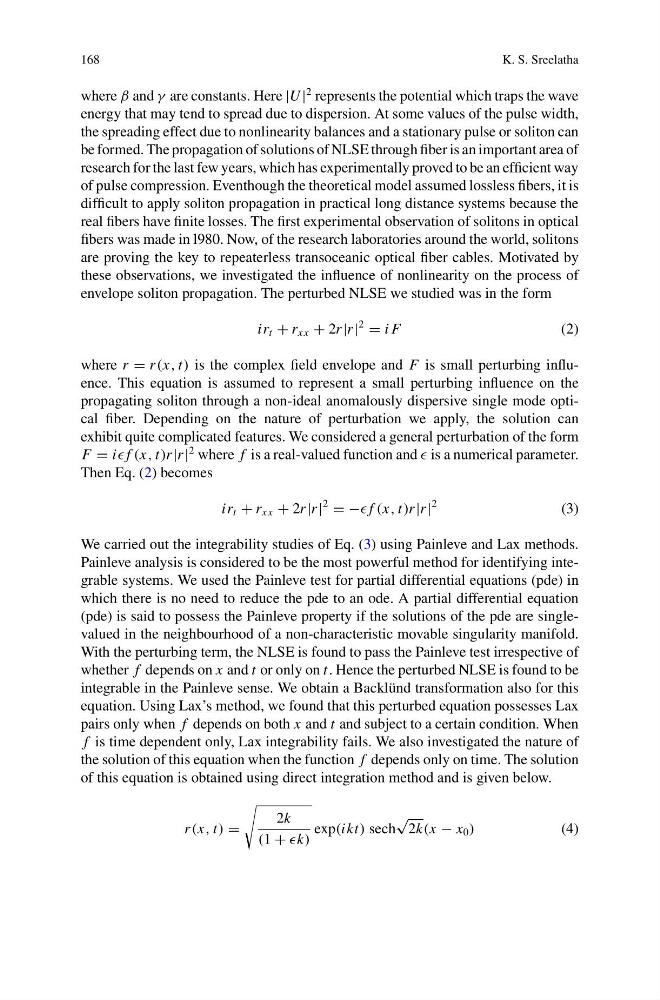
envelope soliton propagation. The perturbed NLSE we studied was in the form
ir t + r xx + 2r |r |
2
= i F
(2)
where r = r (x, t) is the complex field envelope and F is small perturbing influence. This equation is assumed to represent a small perturbing influence on the
propagating soliton through a non-ideal anomalously dispersive single mode optical fiber. Depending on the nature of perturbation we apply, the solution can
exhibit quite complicated features. We considered a general perturbation of the form
F = i f (x, t)r |r |
2 where f is a real-valued function and is a numerical parameter.
Then Eq. (2) becomes
ir t + r xx + 2r |r |
2
= − f (x, t)r |r |
2
(3)
We carried out the integrability studies of Eq. (3) using Painleve and Lax methods.
Painleve analysis is considered to be the most powerful method for identifying integrable systems. We used the Painleve test for partial differential equations (pde) in
which there is no need to reduce the pde to an ode. A partial differential equation
(pde) is said to possess the Painleve property if the solutions of the pde are singlevalued in the neighbourhood of a non-characteristic movable singularity manifold.
With the perturbing term, the NLSE is found to pass the Painleve test irrespective of
whether f depends on x and t or only on t. Hence the perturbed NLSE is found to be
integrable in the Painleve sense. We obtain a Backlünd transformation also for this
equation. Using Lax’s method, we found that this perturbed equation possesses Lax
pairs only when f depends on both x and t and subject to a certain condition. When
f is time dependent only, Lax integrability fails. We also investigated the nature of
the solution of this equation when the function f depends only on time. The solution
of this equation is obtained using direct integration method and is given below.
r (x, t) =
2k
(1 + k)
exp(ikt) sech
√
2k(x − x 0 )
(4)
K. S. Sreelatha
where β and γ are constants. Here |U |
2 represents the potential which traps the wave
energy that may tend to spread due to dispersion. At some values of the pulse width,
the spreading effect due to nonlinearity balances and a stationary pulse or soliton can
be formed. The propagation of solutions of NLSE through fiber is an important area of
research for the last few years, which has experimentally proved to be an efficient way
of pulse compression. Eventhough the theoretical model assumed lossless fibers, it is
difficult to apply soliton propagation in practical long distance systems because the
real fibers have finite losses. The first experimental observation of solitons in optical
fibers was made in l980. Now, of the research laboratories around the world, solitons
are proving the key to repeaterless transoceanic optical fiber cables. Motivated by
these observations, we investigated the influence of nonlinearity on the process of
envelope soliton propagation. The perturbed NLSE we studied was in the form
ir t + r xx + 2r |r |
2
= i F
(2)
where r = r (x, t) is the complex field envelope and F is small perturbing influence. This equation is assumed to represent a small perturbing influence on the
propagating soliton through a non-ideal anomalously dispersive single mode optical fiber. Depending on the nature of perturbation we apply, the solution can
exhibit quite complicated features. We considered a general perturbation of the form
F = i f (x, t)r |r |
2 where f is a real-valued function and is a numerical parameter.
Then Eq. (2) becomes
ir t + r xx + 2r |r |
2
= − f (x, t)r |r |
2
(3)
We carried out the integrability studies of Eq. (3) using Painleve and Lax methods.
Painleve analysis is considered to be the most powerful method for identifying integrable systems. We used the Painleve test for partial differential equations (pde) in
which there is no need to reduce the pde to an ode. A partial differential equation
(pde) is said to possess the Painleve property if the solutions of the pde are singlevalued in the neighbourhood of a non-characteristic movable singularity manifold.
With the perturbing term, the NLSE is found to pass the Painleve test irrespective of
whether f depends on x and t or only on t. Hence the perturbed NLSE is found to be
integrable in the Painleve sense. We obtain a Backlünd transformation also for this
equation. Using Lax’s method, we found that this perturbed equation possesses Lax
pairs only when f depends on both x and t and subject to a certain condition. When
f is time dependent only, Lax integrability fails. We also investigated the nature of
the solution of this equation when the function f depends only on time. The solution
of this equation is obtained using direct integration method and is given below.
r (x, t) =
2k
(1 + k)
exp(ikt) sech
√
2k(x − x 0 )
(4)