

Machine Learning and the Bigdata Paradigm
161
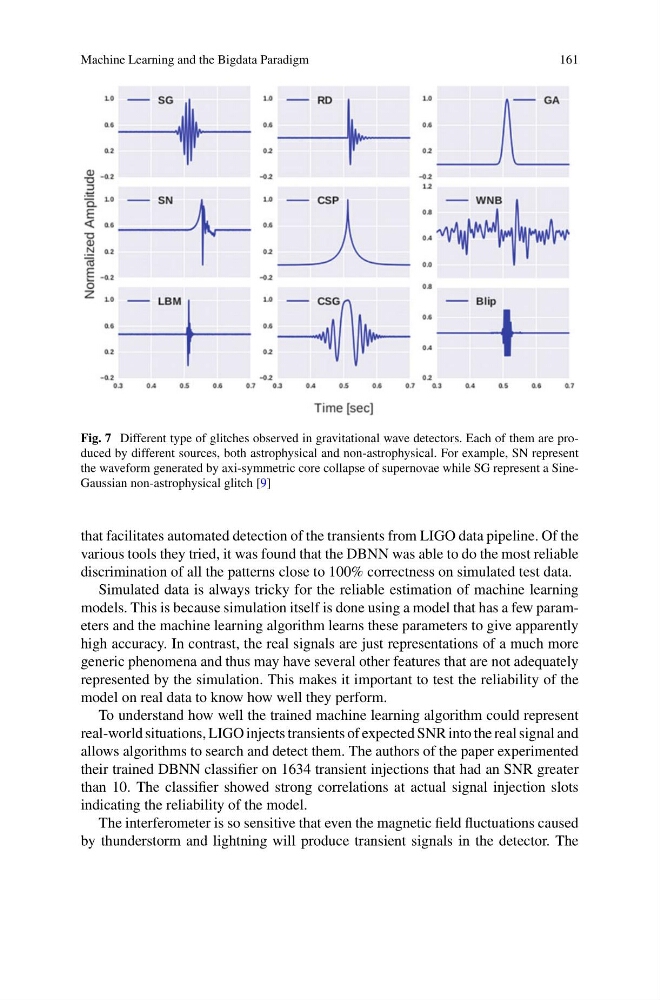
Fig. 7 Different type of glitches observed in gravitational wave detectors. Each of them are produced by different sources, both astrophysical and non-astrophysical. For example, SN represent
the waveform generated by axi-symmetric core collapse of supernovae while SG represent a SineGaussian non-astrophysical glitch [9]
that facilitates automated detection of the transients from LIGO data pipeline. Of the
various tools they tried, it was found that the DBNN was able to do the most reliable
discrimination of all the patterns close to 100% correctness on simulated test data.
Simulated data is always tricky for the reliable estimation of machine learning
models. This is because simulation itself is done using a model that has a few parameters and the machine learning algorithm learns these parameters to give apparently
high accuracy. In contrast, the real signals are just representations of a much more
generic phenomena and thus may have several other features that are not adequately
represented by the simulation. This makes it important to test the reliability of the
model on real data to know how well they perform.
To understand how well the trained machine learning algorithm could represent
real-world situations, LIGO injects transients of expected SNR into the real signal and
allows algorithms to search and detect them. The authors of the paper experimented
their trained DBNN classifier on 1634 transient injections that had an SNR greater
than 10. The classifier showed strong correlations at actual signal injection slots
indicating the reliability of the model.
The interferometer is so sensitive that even the magnetic field fluctuations caused
by thunderstorm and lightning will produce transient signals in the detector. The
161
Fig. 7 Different type of glitches observed in gravitational wave detectors. Each of them are produced by different sources, both astrophysical and non-astrophysical. For example, SN represent
the waveform generated by axi-symmetric core collapse of supernovae while SG represent a SineGaussian non-astrophysical glitch [9]
that facilitates automated detection of the transients from LIGO data pipeline. Of the
various tools they tried, it was found that the DBNN was able to do the most reliable
discrimination of all the patterns close to 100% correctness on simulated test data.
Simulated data is always tricky for the reliable estimation of machine learning
models. This is because simulation itself is done using a model that has a few parameters and the machine learning algorithm learns these parameters to give apparently
high accuracy. In contrast, the real signals are just representations of a much more
generic phenomena and thus may have several other features that are not adequately
represented by the simulation. This makes it important to test the reliability of the
model on real data to know how well they perform.
To understand how well the trained machine learning algorithm could represent
real-world situations, LIGO injects transients of expected SNR into the real signal and
allows algorithms to search and detect them. The authors of the paper experimented
their trained DBNN classifier on 1634 transient injections that had an SNR greater
than 10. The classifier showed strong correlations at actual signal injection slots
indicating the reliability of the model.
The interferometer is so sensitive that even the magnetic field fluctuations caused
by thunderstorm and lightning will produce transient signals in the detector. The