

Neurons and Near-Death Spikes
139
network, bifurcation diagram of a representative excitatory neuron can be drawn. In
the network, the dynamics of individual neurons are controlled by network-related
parameters rather than the individual parameter values of neurons.In pulse-coupled
heterogeneous biological neural network, such an activity is not yet reported although
the marked deviation of neuron activity in random and homogenous network from
individual ones are already reported.
2.2 Entropy of Network
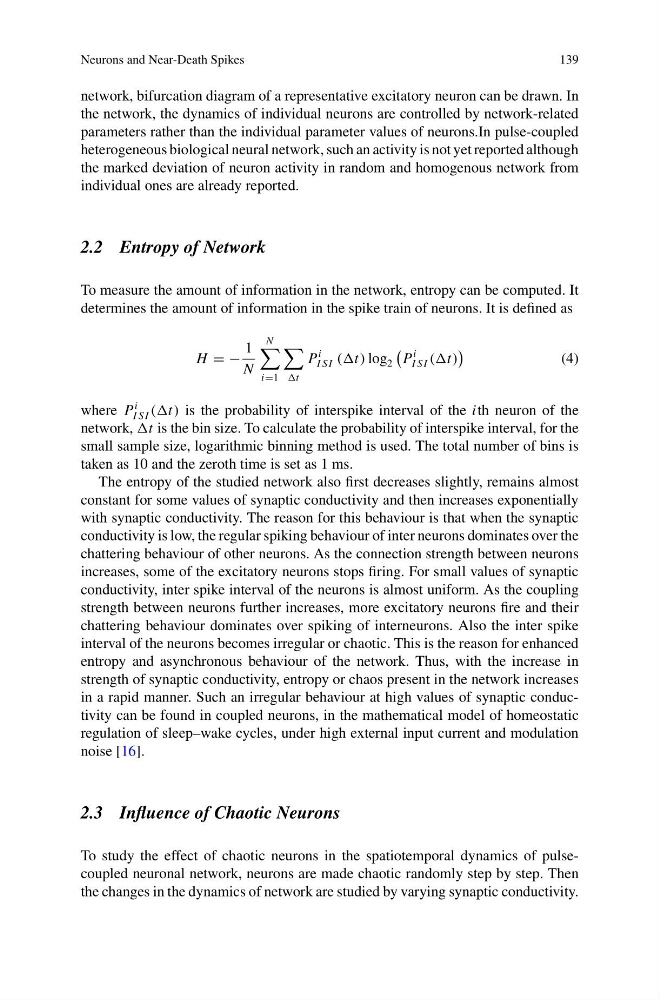
To measure the amount of information in the network, entropy can be computed. It
determines the amount of information in the spike train of neurons. It is defined as
H = −
1
N
N
i=1
t
P
i
I SI (t) log 2
P
i
I SI ((t)
(4)
where P
i
I SI ((t) is the probability of interspike interval of the ith neuron of the
network, t is the bin size. To calculate the probability of interspike interval, for the
small sample size, logarithmic binning method is used. The total number of bins is
taken as 10 and the zeroth time is set as 1 ms.
The entropy of the studied network also first decreases slightly, remains almost
constant for some values of synaptic conductivity and then increases exponentially
with synaptic conductivity. The reason for this behaviour is that when the synaptic
conductivity is low, the regular spiking behaviour of inter neurons dominates over the
chattering behaviour of other neurons. As the connection strength between neurons
increases, some of the excitatory neurons stops firing. For small values of synaptic
conductivity, inter spike interval of the neurons is almost uniform. As the coupling
strength between neurons further increases, more excitatory neurons fire and their
chattering behaviour dominates over spiking of interneurons. Also the inter spike
interval of the neurons becomes irregular or chaotic. This is the reason for enhanced
entropy and asynchronous behaviour of the network. Thus, with the increase in
strength of synaptic conductivity, entropy or chaos present in the network increases
in a rapid manner. Such an irregular behaviour at high values of synaptic conductivity can be found in coupled neurons, in the mathematical model of homeostatic
regulation of sleep–wake cycles, under high external input current and modulation
noise [16].
2.3 Influence of Chaotic Neurons
To study the effect of chaotic neurons in the spatiotemporal dynamics of pulsecoupled neuronal network, neurons are made chaotic randomly step by step. Then
the changes in the dynamics of network are studied by varying synaptic conductivity.
139
network, bifurcation diagram of a representative excitatory neuron can be drawn. In
the network, the dynamics of individual neurons are controlled by network-related
parameters rather than the individual parameter values of neurons.In pulse-coupled
heterogeneous biological neural network, such an activity is not yet reported although
the marked deviation of neuron activity in random and homogenous network from
individual ones are already reported.
2.2 Entropy of Network
To measure the amount of information in the network, entropy can be computed. It
determines the amount of information in the spike train of neurons. It is defined as
H = −
1
N
N
i=1
t
P
i
I SI (t) log 2
P
i
I SI ((t)
(4)
where P
i
I SI ((t) is the probability of interspike interval of the ith neuron of the
network, t is the bin size. To calculate the probability of interspike interval, for the
small sample size, logarithmic binning method is used. The total number of bins is
taken as 10 and the zeroth time is set as 1 ms.
The entropy of the studied network also first decreases slightly, remains almost
constant for some values of synaptic conductivity and then increases exponentially
with synaptic conductivity. The reason for this behaviour is that when the synaptic
conductivity is low, the regular spiking behaviour of inter neurons dominates over the
chattering behaviour of other neurons. As the connection strength between neurons
increases, some of the excitatory neurons stops firing. For small values of synaptic
conductivity, inter spike interval of the neurons is almost uniform. As the coupling
strength between neurons further increases, more excitatory neurons fire and their
chattering behaviour dominates over spiking of interneurons. Also the inter spike
interval of the neurons becomes irregular or chaotic. This is the reason for enhanced
entropy and asynchronous behaviour of the network. Thus, with the increase in
strength of synaptic conductivity, entropy or chaos present in the network increases
in a rapid manner. Such an irregular behaviour at high values of synaptic conductivity can be found in coupled neurons, in the mathematical model of homeostatic
regulation of sleep–wake cycles, under high external input current and modulation
noise [16].
2.3 Influence of Chaotic Neurons
To study the effect of chaotic neurons in the spatiotemporal dynamics of pulsecoupled neuronal network, neurons are made chaotic randomly step by step. Then
the changes in the dynamics of network are studied by varying synaptic conductivity.