

130
L. Parameswar
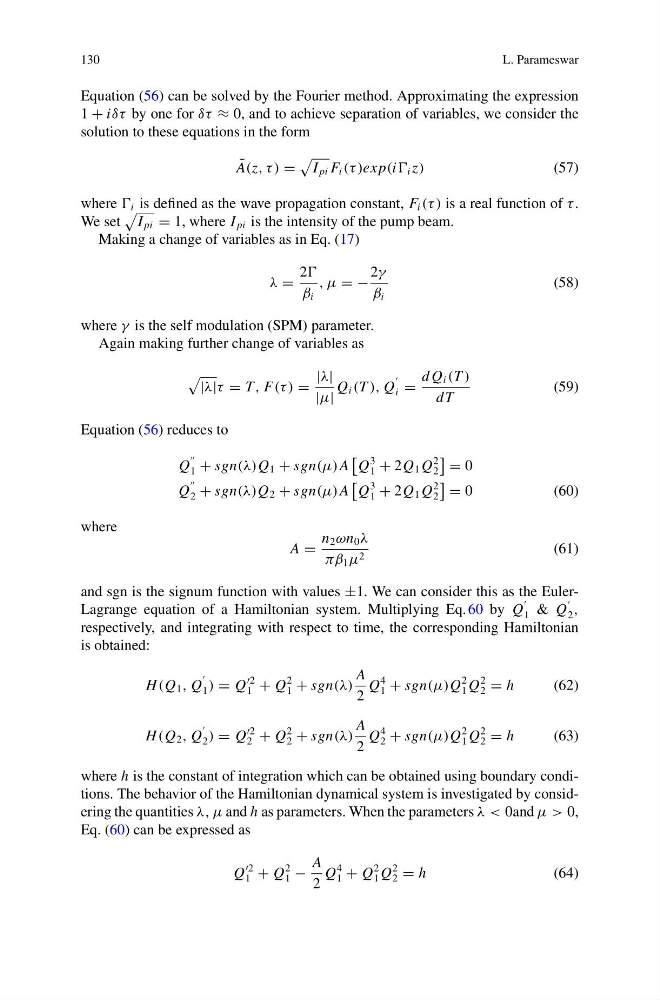
Equation (56) can be solved by the Fourier method. Approximating the expression
1 + iδτ by one for δτ ≈ 0, and to achieve separation of variables, we consider the
solution to these equations in the form
˜
A(z, τ ) =
I pi F i (τ )ex p(i i z)
(57)
where i is defined as the wave propagation constant, F i (τ ) is a real function of τ .
We set
I pi = 1, where I pi is the intensity of the pump beam.
Making a change of variables as in Eq. (17)
λ =
2
β i
, μ = −
2γ
β i
(58)
where γ is the self modulation (SPM) parameter.
Again making further change of variables as
|λ|τ = T, F(τ ) =
|λ|
|μ|
Q i (T ), Q
i =
d Q i (T )
dT
(59)
Equation (56) reduces to
Q
1 + sgn(λ)Q 1 + sgn(μ)A
Q
3
1 + 2Q 1 Q
2
2
= 0
Q
2 + sgn(λ)Q 2 + sgn(μ)A
Q
3
1 + 2Q 1 Q
2
2
= 0
( 6 0 )
where
A =
n 2 ωn 0 λ
πβ 1 μ 2
(61)
and sgn is the signum function with values ±1. We can consider this as the EulerLagrange equation of a Hamiltonian system. Multiplying Eq. 60 by Q
1 & Q
2 ,
respectively, and integrating with respect to time, the corresponding Hamiltonian
is obtained:
H (Q 1 , Q
1 ) = Q
2
1 + Q
2
1 + sgn(λ)
A
2
Q
4
1 + sgn(μ)Q
2
1 Q
2
2 = h
(62)
H (Q 2 , Q
2 ) = Q
2
2 + Q
2
2 + sgn(λ)
A
2
Q
4
2 + sgn(μ)Q
2
1 Q
2
2 = h
(63)
where h is the constant of integration which can be obtained using boundary conditions. The behavior of the Hamiltonian dynamical system is investigated by considering the quantities λ, μ and h as parameters. When the parameters λ < 0and μ > 0,
Eq. (60) can be expressed as
Q
2
1 + Q
2
1 −
A
2
Q
4
1 + Q
2
1 Q
2
2 = h
(64)
L. Parameswar
Equation (56) can be solved by the Fourier method. Approximating the expression
1 + iδτ by one for δτ ≈ 0, and to achieve separation of variables, we consider the
solution to these equations in the form
˜
A(z, τ ) =
I pi F i (τ )ex p(i i z)
(57)
where i is defined as the wave propagation constant, F i (τ ) is a real function of τ .
We set
I pi = 1, where I pi is the intensity of the pump beam.
Making a change of variables as in Eq. (17)
λ =
2
β i
, μ = −
2γ
β i
(58)
where γ is the self modulation (SPM) parameter.
Again making further change of variables as
|λ|τ = T, F(τ ) =
|λ|
|μ|
Q i (T ), Q
i =
d Q i (T )
dT
(59)
Equation (56) reduces to
Q
1 + sgn(λ)Q 1 + sgn(μ)A
Q
3
1 + 2Q 1 Q
2
2
= 0
Q
2 + sgn(λ)Q 2 + sgn(μ)A
Q
3
1 + 2Q 1 Q
2
2
= 0
( 6 0 )
where
A =
n 2 ωn 0 λ
πβ 1 μ 2
(61)
and sgn is the signum function with values ±1. We can consider this as the EulerLagrange equation of a Hamiltonian system. Multiplying Eq. 60 by Q
1 & Q
2 ,
respectively, and integrating with respect to time, the corresponding Hamiltonian
is obtained:
H (Q 1 , Q
1 ) = Q
2
1 + Q
2
1 + sgn(λ)
A
2
Q
4
1 + sgn(μ)Q
2
1 Q
2
2 = h
(62)
H (Q 2 , Q
2 ) = Q
2
2 + Q
2
2 + sgn(λ)
A
2
Q
4
2 + sgn(μ)Q
2
1 Q
2
2 = h
(63)
where h is the constant of integration which can be obtained using boundary conditions. The behavior of the Hamiltonian dynamical system is investigated by considering the quantities λ, μ and h as parameters. When the parameters λ < 0and μ > 0,
Eq. (60) can be expressed as
Q
2
1 + Q
2
1 −
A
2
Q
4
1 + Q
2
1 Q
2
2 = h
(64)