

Soliton Propagation Through Photorefractive Media
127
A(z, ω
) =
∞
−∞
A(z, t)e
−iωt dt
(31)
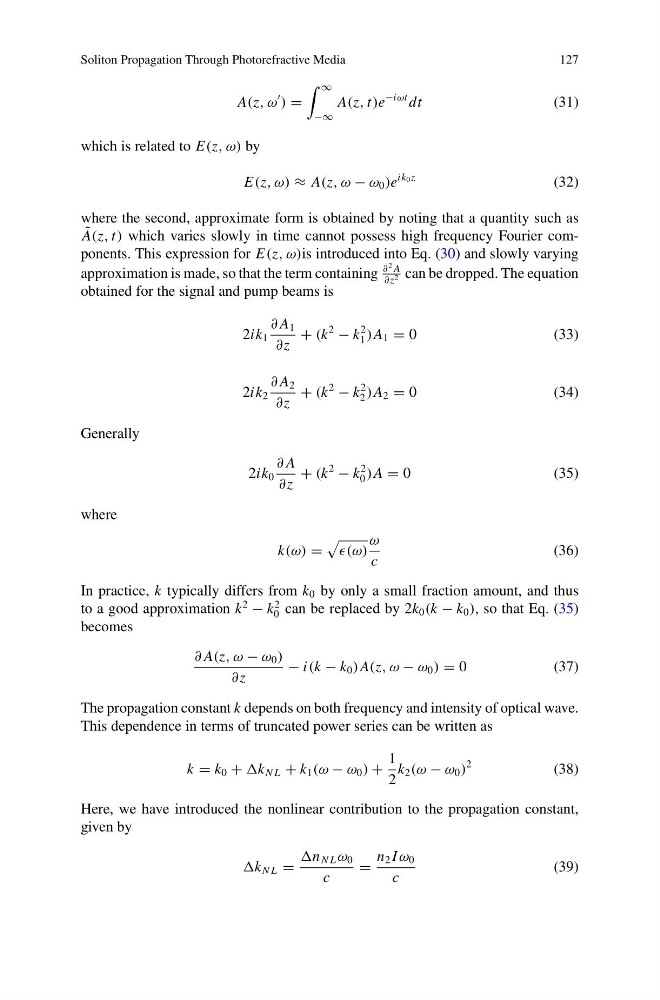
which is related to E(z, ω) by
E(z, ω) ≈ A(z, ω − ω 0 )e
ik 0 z
(32)
where the second, approximate form is obtained by noting that a quantity such as
˜
A(z, t) which varies slowly in time cannot possess high frequency Fourier components. This expression for E(z, ω)is introduced into Eq. (30) and slowly varying
approximation is made, so that the term containing
∂
2 A
∂z 2 can be dropped. The equation
obtained for the signal and pump beams is
2ik 1
∂ A 1
∂z
+ (k
2
− k
2
1 )A 1 = 0
(33)
2ik 2
∂ A 2
∂z
+ (k
2
− k
2
2 )A 2 = 0
( 3 4 )
Generally
2ik 0
∂ A
∂z
+ (k
2
− k
2
0 )A = 0
(35)
where
k(ω) =
(ω)
ω
c
(36)
In practice, k typically differs from k 0 by only a small fraction amount, and thus
to a good approximation k
2
− k
2
0 can be replaced by 2k 0 (k − k 0 ), so that Eq. (35)
becomes
∂ A(z, ω − ω 0 )
∂z
− i(k − k 0 )A(z, ω − ω 0 ) = 0
(37)
The propagation constant k depends on both frequency and intensity of optical wave.
This dependence in terms of truncated power series can be written as
k = k 0 + k N L + k 1 (ω − ω 0 ) +
1
2
k 2 (ω − ω 0 )
2
(38)
Here, we have introduced the nonlinear contribution to the propagation constant,
given by
k N L =
n N L ω 0
c
=
n 2 I ω 0
c
(39)
127
A(z, ω
) =
∞
−∞
A(z, t)e
−iωt dt
(31)
which is related to E(z, ω) by
E(z, ω) ≈ A(z, ω − ω 0 )e
ik 0 z
(32)
where the second, approximate form is obtained by noting that a quantity such as
˜
A(z, t) which varies slowly in time cannot possess high frequency Fourier components. This expression for E(z, ω)is introduced into Eq. (30) and slowly varying
approximation is made, so that the term containing
∂
2 A
∂z 2 can be dropped. The equation
obtained for the signal and pump beams is
2ik 1
∂ A 1
∂z
+ (k
2
− k
2
1 )A 1 = 0
(33)
2ik 2
∂ A 2
∂z
+ (k
2
− k
2
2 )A 2 = 0
( 3 4 )
Generally
2ik 0
∂ A
∂z
+ (k
2
− k
2
0 )A = 0
(35)
where
k(ω) =
(ω)
ω
c
(36)
In practice, k typically differs from k 0 by only a small fraction amount, and thus
to a good approximation k
2
− k
2
0 can be replaced by 2k 0 (k − k 0 ), so that Eq. (35)
becomes
∂ A(z, ω − ω 0 )
∂z
− i(k − k 0 )A(z, ω − ω 0 ) = 0
(37)
The propagation constant k depends on both frequency and intensity of optical wave.
This dependence in terms of truncated power series can be written as
k = k 0 + k N L + k 1 (ω − ω 0 ) +
1
2
k 2 (ω − ω 0 )
2
(38)
Here, we have introduced the nonlinear contribution to the propagation constant,
given by
k N L =
n N L ω 0
c
=
n 2 I ω 0
c
(39)