

Soliton Propagation Through Photorefractive Media
125
˜
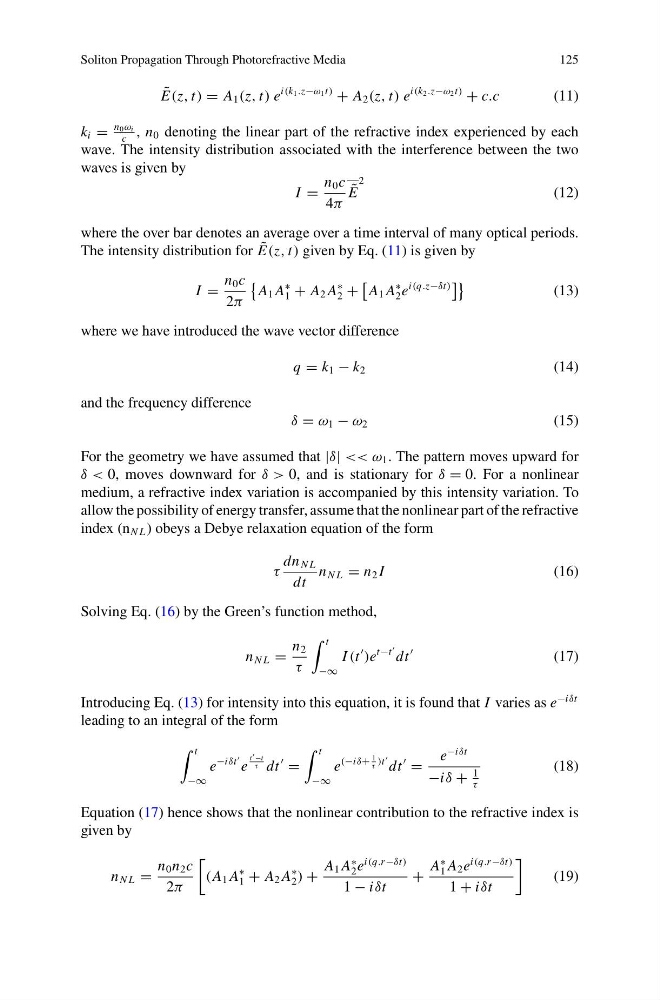
E(z, t) = A 1 (z, t) e
i(k 1 .z−ω 1 t)
+ A 2 (z, t) e
i(k 2 .z−ω 2 t)
+ c.c
(11)
k i =
n 0 ω i
c
, n 0 denoting the linear part of the refractive index experienced by each
wave. The intensity distribution associated with the interference between the two
waves is given by
I =
n 0 c
4π
˜
E
2
(12)
where the over bar denotes an average over a time interval of many optical periods.
The intensity distribution for ˜
E(z, t) given by Eq. (11) is given by
I =
n 0 c
2π
A 1 A
∗
1 + A 2 A
∗
2 +
A 1 A
∗
2 e
i(q.z−δt)
(13)
where we have introduced the wave vector difference
q = k 1 − k 2
(14)
and the frequency difference
δ = ω 1 − ω 2
(15)
For the geometry we have assumed that |δ| << ω 1 . The pattern moves upward for
δ < 0, moves downward for δ > 0, and is stationary for δ = 0. For a nonlinear
medium, a refractive index variation is accompanied by this intensity variation. To
allow the possibility of energy transfer, assume that the nonlinear part of the refractive
index (n N L ) obeys a Debye relaxation equation of the form
τ
dn N L
dt
n N L = n 2 I
(16)
Solving Eq. (16) by the Green’s function method,
n N L =
n 2
τ
t
−∞
I (t
)e
t−t
dt
(17)
Introducing Eq. (13) for intensity into this equation, it is found that I varies as e
−iδt
leading to an integral of the form
t
−∞
e
−iδt
e
t −t
τ dt
=
t
−∞
e
(−iδ+
1
τ )t
dt
=
e
−iδt
−iδ +
1
τ
(18)
Equation (17) hence shows that the nonlinear contribution to the refractive index is
given by
n N L =
n 0 n 2 c
2π
(A 1 A
∗
1 + A 2 A
∗
2 ) +
A 1 A
∗
2 e
i(q.r −δt)
1 − iδt
+
A
∗
1 A 2 e
i(q.r −δt)
1 + iδt
(19)
125
˜
E(z, t) = A 1 (z, t) e
i(k 1 .z−ω 1 t)
+ A 2 (z, t) e
i(k 2 .z−ω 2 t)
+ c.c
(11)
k i =
n 0 ω i
c
, n 0 denoting the linear part of the refractive index experienced by each
wave. The intensity distribution associated with the interference between the two
waves is given by
I =
n 0 c
4π
˜
E
2
(12)
where the over bar denotes an average over a time interval of many optical periods.
The intensity distribution for ˜
E(z, t) given by Eq. (11) is given by
I =
n 0 c
2π
A 1 A
∗
1 + A 2 A
∗
2 +
A 1 A
∗
2 e
i(q.z−δt)
(13)
where we have introduced the wave vector difference
q = k 1 − k 2
(14)
and the frequency difference
δ = ω 1 − ω 2
(15)
For the geometry we have assumed that |δ| << ω 1 . The pattern moves upward for
δ < 0, moves downward for δ > 0, and is stationary for δ = 0. For a nonlinear
medium, a refractive index variation is accompanied by this intensity variation. To
allow the possibility of energy transfer, assume that the nonlinear part of the refractive
index (n N L ) obeys a Debye relaxation equation of the form
τ
dn N L
dt
n N L = n 2 I
(16)
Solving Eq. (16) by the Green’s function method,
n N L =
n 2
τ
t
−∞
I (t
)e
t−t
dt
(17)
Introducing Eq. (13) for intensity into this equation, it is found that I varies as e
−iδt
leading to an integral of the form
t
−∞
e
−iδt
e
t −t
τ dt
=
t
−∞
e
(−iδ+
1
τ )t
dt
=
e
−iδt
−iδ +
1
τ
(18)
Equation (17) hence shows that the nonlinear contribution to the refractive index is
given by
n N L =
n 0 n 2 c
2π
(A 1 A
∗
1 + A 2 A
∗
2 ) +
A 1 A
∗
2 e
i(q.r −δt)
1 − iδt
+
A
∗
1 A 2 e
i(q.r −δt)
1 + iδt
(19)