

122
L. Parameswar
full three-dimensional (3D) interaction between solitons and soliton spiraling, vortex
solitons, angular momentum effects, rotating dipole vector solitons, etc.
4 Nonlinear Schrödinger Equation (NLSE) and Optical
Solitons
The study of optical wave propagation in a nonlinear dispersive (dielectric) has
been receiving considerable attention in recent times as the fiber can support under
suitable circumstances a stable pulse called optical soliton [2–8] which arises due to
compensation of the effect of dispersion of the pulses by nonlinear response of the
medium. The analysis of such pulse propagation starts from the Maxwell’s equation
for the electromagnetic wave propagation in a dielectric medium given by where ˜
P is
the induced polarization given in (3), E represents the electric field, c is the velocity
of light, μ 0 is the permeability of free space.
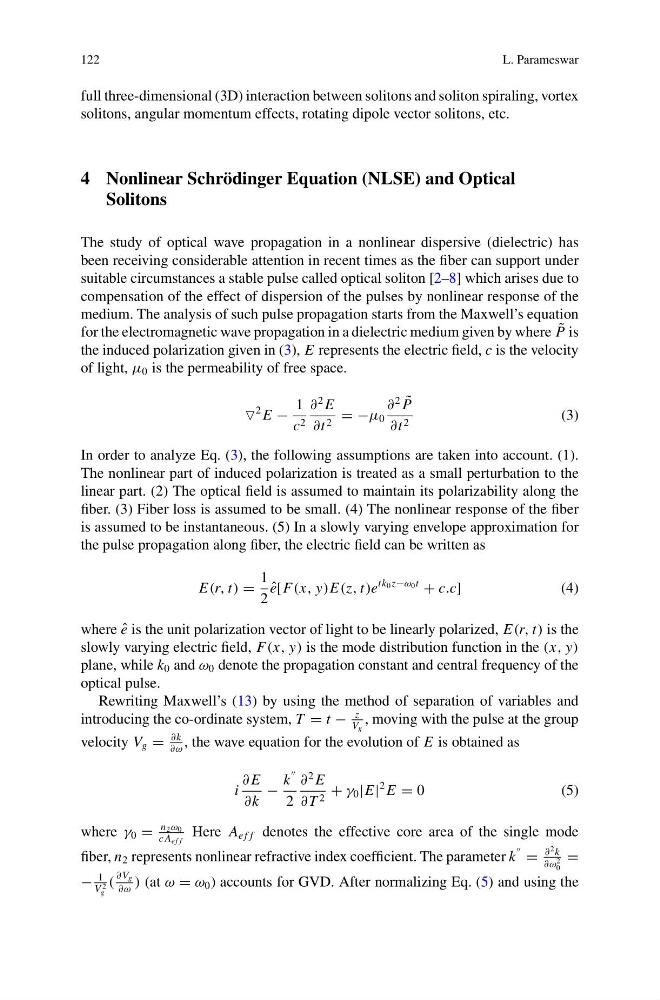
2 E −
1
c 2
∂
2 E
∂t 2 = −μ 0
∂
2 ˜
P
∂t 2
(3)
In order to analyze Eq. (3), the following assumptions are taken into account. (1).
The nonlinear part of induced polarization is treated as a small perturbation to the
linear part. (2) The optical field is assumed to maintain its polarizability along the
fiber. (3) Fiber loss is assumed to be small. (4) The nonlinear response of the fiber
is assumed to be instantaneous. (5) In a slowly varying envelope approximation for
the pulse propagation along fiber, the electric field can be written as
E(r, t) =
1
2
ˆ
e[F(x, y)E(z, t)e
tk 0 z−ω 0 t
+ c.c]
(4)
where ˆ
e is the unit polarization vector of light to be linearly polarized, E(r, t) is the
slowly varying electric field, F(x, y) is the mode distribution function in the (x, y)
plane, while k 0 and ω 0 denote the propagation constant and central frequency of the
optical pulse.
Rewriting Maxwell’s (13) by using the method of separation of variables and
introducing the co-ordinate system, T = t −
z
V g
, moving with the pulse at the group
velocity V g =
∂k
∂ω
, the wave equation for the evolution of E is obtained as
i
∂ E
∂k
−
k
2
∂
2 E
∂ T 2 + γ 0 |E|
2 E = 0
( 5 )
where γ 0 =
n 2 ω 0
c A ef f
Here A e f f denotes the effective core area of the single mode
fiber, n 2 represents nonlinear refractive index coefficient. The parameter k
=
∂
2 k
∂ω
2
0
=
−
1
V 2
g
(
∂ V g
∂ω
) (at ω = ω 0 ) accounts for GVD. After normalizing Eq. (5) and using the
L. Parameswar
full three-dimensional (3D) interaction between solitons and soliton spiraling, vortex
solitons, angular momentum effects, rotating dipole vector solitons, etc.
4 Nonlinear Schrödinger Equation (NLSE) and Optical
Solitons
The study of optical wave propagation in a nonlinear dispersive (dielectric) has
been receiving considerable attention in recent times as the fiber can support under
suitable circumstances a stable pulse called optical soliton [2–8] which arises due to
compensation of the effect of dispersion of the pulses by nonlinear response of the
medium. The analysis of such pulse propagation starts from the Maxwell’s equation
for the electromagnetic wave propagation in a dielectric medium given by where ˜
P is
the induced polarization given in (3), E represents the electric field, c is the velocity
of light, μ 0 is the permeability of free space.
2 E −
1
c 2
∂
2 E
∂t 2 = −μ 0
∂
2 ˜
P
∂t 2
(3)
In order to analyze Eq. (3), the following assumptions are taken into account. (1).
The nonlinear part of induced polarization is treated as a small perturbation to the
linear part. (2) The optical field is assumed to maintain its polarizability along the
fiber. (3) Fiber loss is assumed to be small. (4) The nonlinear response of the fiber
is assumed to be instantaneous. (5) In a slowly varying envelope approximation for
the pulse propagation along fiber, the electric field can be written as
E(r, t) =
1
2
ˆ
e[F(x, y)E(z, t)e
tk 0 z−ω 0 t
+ c.c]
(4)
where ˆ
e is the unit polarization vector of light to be linearly polarized, E(r, t) is the
slowly varying electric field, F(x, y) is the mode distribution function in the (x, y)
plane, while k 0 and ω 0 denote the propagation constant and central frequency of the
optical pulse.
Rewriting Maxwell’s (13) by using the method of separation of variables and
introducing the co-ordinate system, T = t −
z
V g
, moving with the pulse at the group
velocity V g =
∂k
∂ω
, the wave equation for the evolution of E is obtained as
i
∂ E
∂k
−
k
2
∂
2 E
∂ T 2 + γ 0 |E|
2 E = 0
( 5 )
where γ 0 =
n 2 ω 0
c A ef f
Here A e f f denotes the effective core area of the single mode
fiber, n 2 represents nonlinear refractive index coefficient. The parameter k
=
∂
2 k
∂ω
2
0
=
−
1
V 2
g
(
∂ V g
∂ω
) (at ω = ω 0 ) accounts for GVD. After normalizing Eq. (5) and using the