

116
P. B. Vinod Kumar
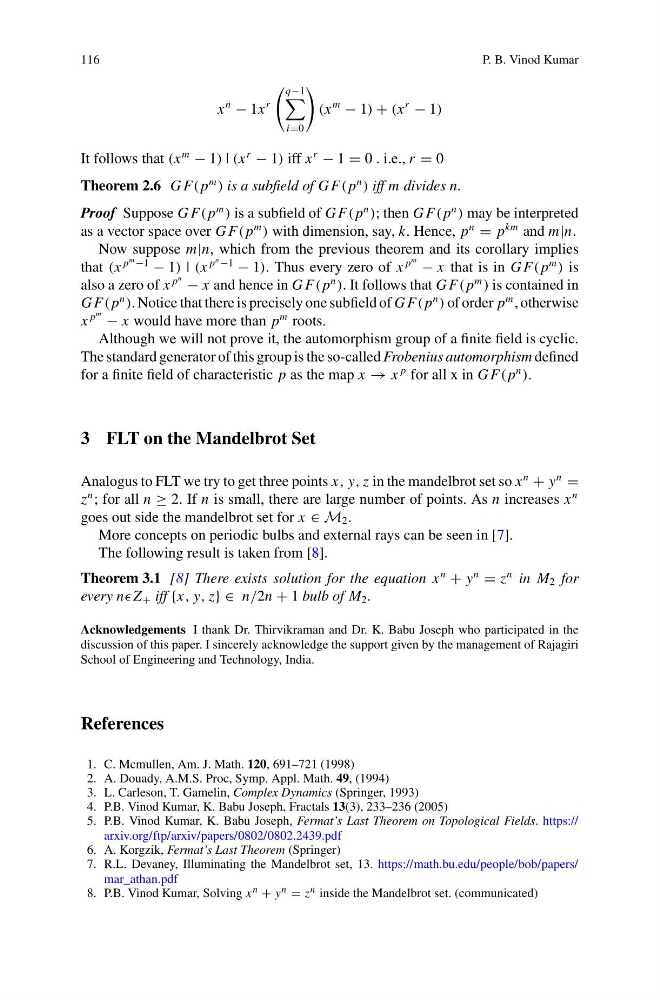
x
n
− 1x
r
q−1
i=0
(x
m
− 1) + (x
r
− 1)
It follows that (x
m
− 1) | (x
r
− 1) iff x
r
− 1 = 0 . i.e., r = 0
Theorem 2.6 G F( p
m
) is a subfield of G F( p
n
) iff m divides n.
Proof Suppose G F( p
m
) is a subfield of G F( p
n
); then G F( p
n
) may be interpreted
as a vector space over G F( p
m
) with dimension, say, k. Hence, p
n
= p
km and m|n.
Now suppose m|n, which from the previous theorem and its corollary implies
that (x
p
m −1
− 1) | (x
p
n −1
− 1). Thus every zero of x
p
m − x that is in G F( p
m
) is
also a zero of x
p
n − x and hence in G F( p
n
). It follows that G F( p
m
) is contained in
G F( p
n
). Notice that there is precisely one subfield of G F( p
n
) of order p
m , otherwise
x
p
m − x would have more than p
m roots.
Although we will not prove it, the automorphism group of a finite field is cyclic.
The standard generator of this group is the so-called Frobenius automorphism defined
for a finite field of characteristic p as the map x → x
p for all x in G F( p
n
).
3 FLT on the Mandelbrot Set
Analogus to FLT we try to get three points x, y, z in the mandelbrot set so x
n
+ y
n
=
z
n ; for all n ≥ 2. If n is small, there are large number of points. As n increases x
n
goes out side the mandelbrot set for x ∈ M 2 .
More concepts on periodic bulbs and external rays can be seen in [7].
The following result is taken from [8].
Theorem 3.1 [8] There exists solution for the equation x
n
+ y
n
= z
n in M 2 for
every n Z + iff {x, y, z} ∈ n/2n + 1 bulb of M 2 .
Acknowledgements I thank Dr. Thirvikraman and Dr. K. Babu Joseph who participated in the
discussion of this paper. I sincerely acknowledge the support given by the management of Rajagiri
School of Engineering and Technology, India.
References
1. C. Mcmullen, Am. J. Math. 120, 691–721 (1998)
2. A. Douady, A.M.S. Proc, Symp. Appl. Math. 49, (1994)
3. L. Carleson, T. Gamelin, Complex Dynamics (Springer, 1993)
4. P.B. Vinod Kumar, K. Babu Joseph, Fractals 13(3), 233–236 (2005)
5. P.B. Vinod Kumar, K. Babu Joseph, Fermat’s Last Theorem on Topological Fields. https://
arxiv.org/ftp/arxiv/papers/0802/0802.2439.pdf
6. A. Korgzik, Fermat’s Last Theorem (Springer)
7. R.L. Devaney, Illuminating the Mandelbrot set, 13. https://math.bu.edu/people/bob/papers/
mar_athan.pdf
8. P.B. Vinod Kumar, Solving x n + y n = z n inside the Mandelbrot set. (communicated)
P. B. Vinod Kumar
x
n
− 1x
r
q−1
i=0
(x
m
− 1) + (x
r
− 1)
It follows that (x
m
− 1) | (x
r
− 1) iff x
r
− 1 = 0 . i.e., r = 0
Theorem 2.6 G F( p
m
) is a subfield of G F( p
n
) iff m divides n.
Proof Suppose G F( p
m
) is a subfield of G F( p
n
); then G F( p
n
) may be interpreted
as a vector space over G F( p
m
) with dimension, say, k. Hence, p
n
= p
km and m|n.
Now suppose m|n, which from the previous theorem and its corollary implies
that (x
p
m −1
− 1) | (x
p
n −1
− 1). Thus every zero of x
p
m − x that is in G F( p
m
) is
also a zero of x
p
n − x and hence in G F( p
n
). It follows that G F( p
m
) is contained in
G F( p
n
). Notice that there is precisely one subfield of G F( p
n
) of order p
m , otherwise
x
p
m − x would have more than p
m roots.
Although we will not prove it, the automorphism group of a finite field is cyclic.
The standard generator of this group is the so-called Frobenius automorphism defined
for a finite field of characteristic p as the map x → x
p for all x in G F( p
n
).
3 FLT on the Mandelbrot Set
Analogus to FLT we try to get three points x, y, z in the mandelbrot set so x
n
+ y
n
=
z
n ; for all n ≥ 2. If n is small, there are large number of points. As n increases x
n
goes out side the mandelbrot set for x ∈ M 2 .
More concepts on periodic bulbs and external rays can be seen in [7].
The following result is taken from [8].
Theorem 3.1 [8] There exists solution for the equation x
n
+ y
n
= z
n in M 2 for
every n Z + iff {x, y, z} ∈ n/2n + 1 bulb of M 2 .
Acknowledgements I thank Dr. Thirvikraman and Dr. K. Babu Joseph who participated in the
discussion of this paper. I sincerely acknowledge the support given by the management of Rajagiri
School of Engineering and Technology, India.
References
1. C. Mcmullen, Am. J. Math. 120, 691–721 (1998)
2. A. Douady, A.M.S. Proc, Symp. Appl. Math. 49, (1994)
3. L. Carleson, T. Gamelin, Complex Dynamics (Springer, 1993)
4. P.B. Vinod Kumar, K. Babu Joseph, Fractals 13(3), 233–236 (2005)
5. P.B. Vinod Kumar, K. Babu Joseph, Fermat’s Last Theorem on Topological Fields. https://
arxiv.org/ftp/arxiv/papers/0802/0802.2439.pdf
6. A. Korgzik, Fermat’s Last Theorem (Springer)
7. R.L. Devaney, Illuminating the Mandelbrot set, 13. https://math.bu.edu/people/bob/papers/
mar_athan.pdf
8. P.B. Vinod Kumar, Solving x n + y n = z n inside the Mandelbrot set. (communicated)