

Quantum Groups, q-Oscillators and q-Deformed Quantum Mechanics
101
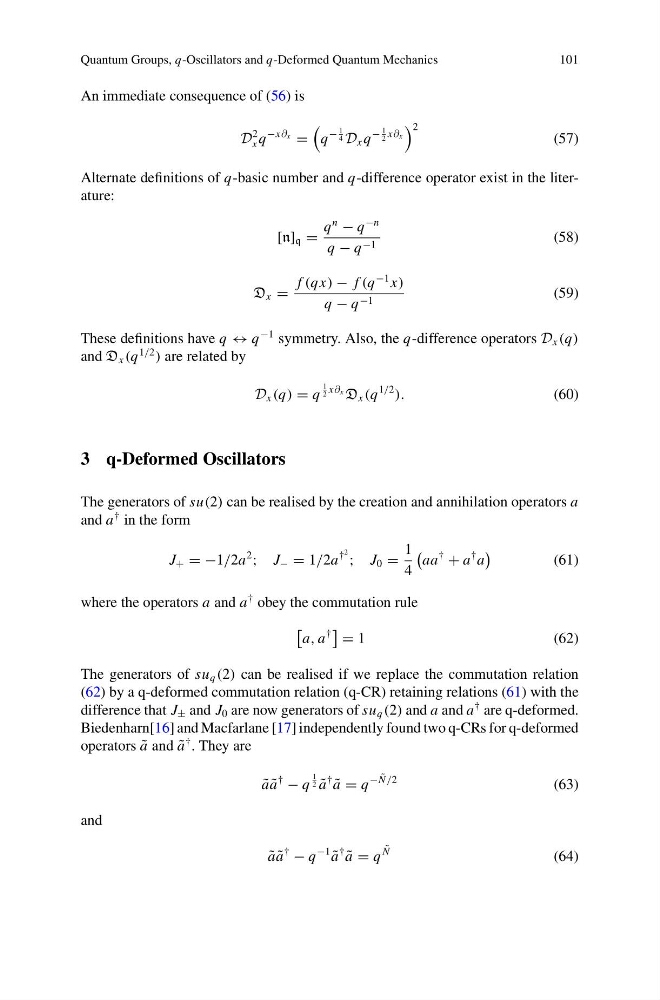
An immediate consequence of (56) is
D
2
x q
−x∂ x =
q
−
1
4 D x q
−
1
2 x∂ x
2
(57)
Alternate definitions of q-basic number and q-difference operator exist in the literature:
[n] q =
q
n
− q
−n
q − q −1
(58)
D x =
f (qx) − f (q
−1 x)
q − q −1
(59)
These definitions have q ↔ q
−1 symmetry. Also, the q-difference operators D x (q)
and D x (q
1/2
) are related by
D x (q) = q
1
2 x∂ x D x (q
1/2
).
(60)
3 q-Deformed Oscillators
The generators of su(2) can be realised by the creation and annihilation operators a
and a
† in the form
J + = −1/2a
2
; J − = 1/2a
†
2 ; J 0 =
1
4
aa
†
+ a
† a
(61)
where the operators a and a
† obey the commutation rule
a, a
†
= 1
( 6 2 )
The generators of su q (2) can be realised if we replace the commutation relation
(62) by a q-deformed commutation relation (q-CR) retaining relations (61) with the
difference that J ± and J 0 are now generators of su q (2) and a and a
† are q-deformed.
Biedenharn[16] and Macfarlane [17] independently found two q-CRs for q-deformed
operators ˜
a and ˜
a
† . They are
˜
a ˜
a
†
− q
1
2 ˜
a
†
˜
a = q
− ˜
N /2
(63)
and
˜
a ˜
a
†
− q
−1
˜
a
†
˜
a = q
˜
N
(64)
101
An immediate consequence of (56) is
D
2
x q
−x∂ x =
q
−
1
4 D x q
−
1
2 x∂ x
2
(57)
Alternate definitions of q-basic number and q-difference operator exist in the literature:
[n] q =
q
n
− q
−n
q − q −1
(58)
D x =
f (qx) − f (q
−1 x)
q − q −1
(59)
These definitions have q ↔ q
−1 symmetry. Also, the q-difference operators D x (q)
and D x (q
1/2
) are related by
D x (q) = q
1
2 x∂ x D x (q
1/2
).
(60)
3 q-Deformed Oscillators
The generators of su(2) can be realised by the creation and annihilation operators a
and a
† in the form
J + = −1/2a
2
; J − = 1/2a
†
2 ; J 0 =
1
4
aa
†
+ a
† a
(61)
where the operators a and a
† obey the commutation rule
a, a
†
= 1
( 6 2 )
The generators of su q (2) can be realised if we replace the commutation relation
(62) by a q-deformed commutation relation (q-CR) retaining relations (61) with the
difference that J ± and J 0 are now generators of su q (2) and a and a
† are q-deformed.
Biedenharn[16] and Macfarlane [17] independently found two q-CRs for q-deformed
operators ˜
a and ˜
a
† . They are
˜
a ˜
a
†
− q
1
2 ˜
a
†
˜
a = q
− ˜
N /2
(63)
and
˜
a ˜
a
†
− q
−1
˜
a
†
˜
a = q
˜
N
(64)