

98
G. Vinod
E =
∂
∂b
| I
F =
∂
∂c
| I
I =
∂
∂a
+
∂
∂d
| I
F =
∂
∂a
+
∂
∂d
| I
(29)
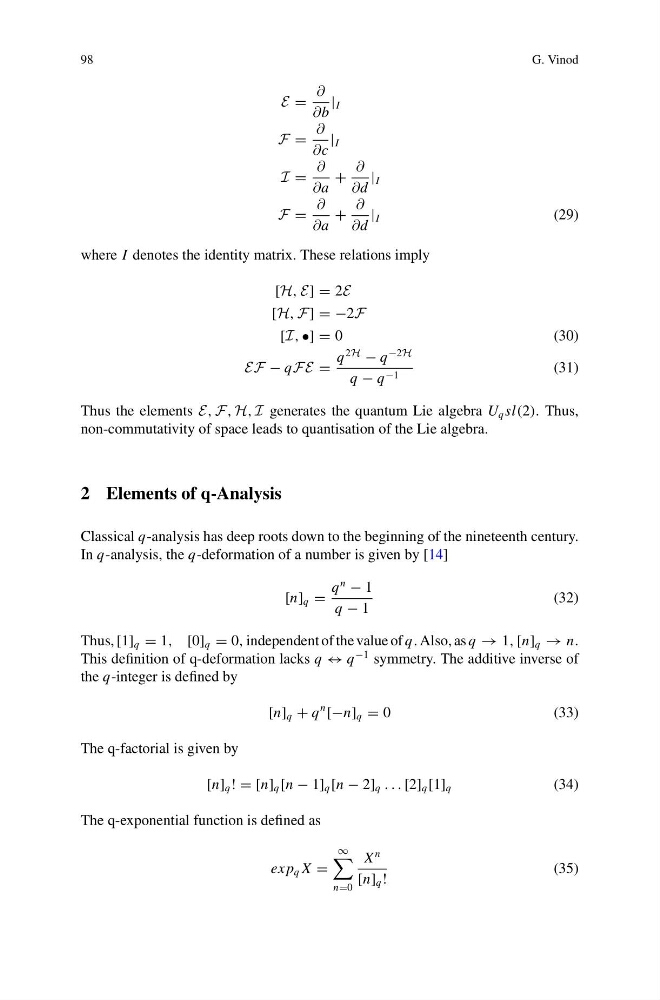
where I denotes the identity matrix. These relations imply
[H, E] = 2E
[H, F] = −2F
[I, •] = 0
( 3 0 )
EF − qFE =
q
2H
− q
−2H
q − q −1
(31)
Thus the elements E, F, H, I generates the quantum Lie algebra U q sl(2). Thus,
non-commutativity of space leads to quantisation of the Lie algebra.
2 Elements of q-Analysis
Classical q-analysis has deep roots down to the beginning of the nineteenth century.
In q-analysis, the q-deformation of a number is given by [14]
[n] q =
q
n
− 1
q − 1
(32)
Thus, [1] q = 1, [0] q = 0, independent of the value of q. Also, as q → 1, [n] q → n.
This definition of q-deformation lacks q ↔ q
−1 symmetry. The additive inverse of
the q-integer is defined by
[n] q + q
n
[−n] q = 0
(33)
The q-factorial is given by
[n] q ! = [n] q [n − 1] q [n − 2] q . . . [2] q [1] q
(34)
The q-exponential function is defined as
ex p q X =
∞
n=0
X
n
[n] q !
(35)
G. Vinod
E =
∂
∂b
| I
F =
∂
∂c
| I
I =
∂
∂a
+
∂
∂d
| I
F =
∂
∂a
+
∂
∂d
| I
(29)
where I denotes the identity matrix. These relations imply
[H, E] = 2E
[H, F] = −2F
[I, •] = 0
( 3 0 )
EF − qFE =
q
2H
− q
−2H
q − q −1
(31)
Thus the elements E, F, H, I generates the quantum Lie algebra U q sl(2). Thus,
non-commutativity of space leads to quantisation of the Lie algebra.
2 Elements of q-Analysis
Classical q-analysis has deep roots down to the beginning of the nineteenth century.
In q-analysis, the q-deformation of a number is given by [14]
[n] q =
q
n
− 1
q − 1
(32)
Thus, [1] q = 1, [0] q = 0, independent of the value of q. Also, as q → 1, [n] q → n.
This definition of q-deformation lacks q ↔ q
−1 symmetry. The additive inverse of
the q-integer is defined by
[n] q + q
n
[−n] q = 0
(33)
The q-factorial is given by
[n] q ! = [n] q [n − 1] q [n − 2] q . . . [2] q [1] q
(34)
The q-exponential function is defined as
ex p q X =
∞
n=0
X
n
[n] q !
(35)