

Quantum Groups, q-Oscillators and q-Deformed Quantum Mechanics
95
H, X ±
= ±X ±
X + , X −
= f (H )
(9)
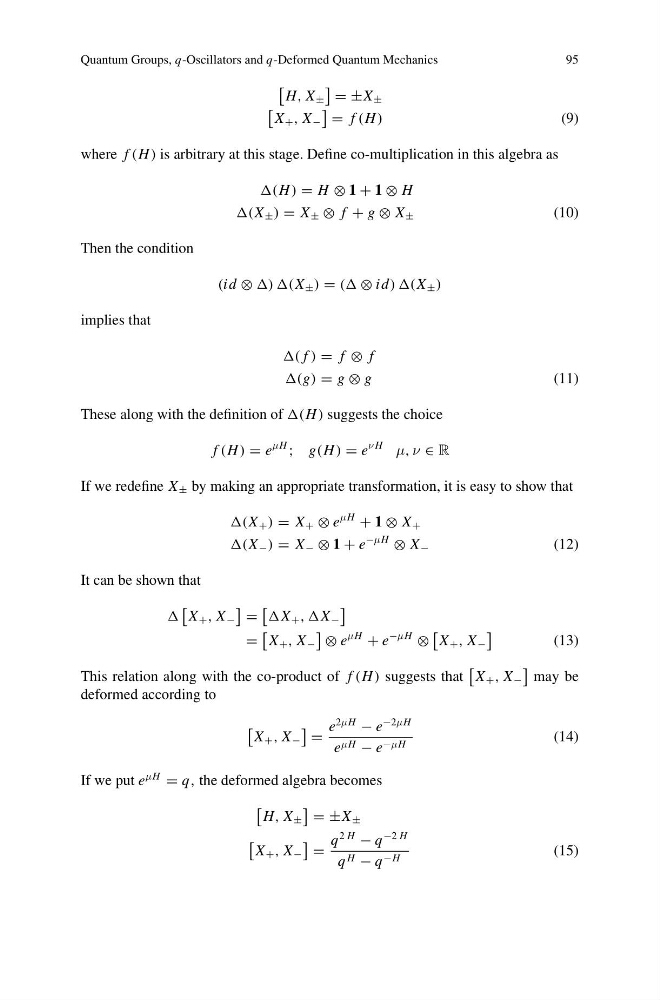
where f (H ) is arbitrary at this stage. Define co-multiplication in this algebra as
(H ) = H ⊗ 1 + 1 ⊗ H
(X ± ) = X ± ⊗ f + g ⊗ X ±
(10)
Then the condition
(id ⊗ ) (X ± ) = ( ⊗ id) (X ± )
implies that
( f ) = f ⊗ f
(g) = g ⊗ g
(11)
These along with the definition of (H ) suggests the choice
f (H ) = e
μH
; g(H ) = e
ν H
μ, ν ∈ R
If we redefine X ± by making an appropriate transformation, it is easy to show that
(X + ) = X + ⊗ e
μH
+ 1 ⊗ X +
(X − ) = X − ⊗ 1 + e
−μH
⊗ X −
(12)
It can be shown that
X + , X −
=
X + , ,X −
=
X + , X −
⊗ e
μH
+ e
−μH
⊗
X + , X −
(13)
This relation along with the co-product of f (H ) suggests that
X + , X −
may be
deformed according to
X + , X −
=
e
2μH
− e
−2μH
e μH − e −μH
(14)
If we put e
μH
= q, the deformed algebra becomes
H, X ±
= ±X ±
X + , X −
=
q
2 H
− q
−2 H
q H − q −H
(15)
95
H, X ±
= ±X ±
X + , X −
= f (H )
(9)
where f (H ) is arbitrary at this stage. Define co-multiplication in this algebra as
(H ) = H ⊗ 1 + 1 ⊗ H
(X ± ) = X ± ⊗ f + g ⊗ X ±
(10)
Then the condition
(id ⊗ ) (X ± ) = ( ⊗ id) (X ± )
implies that
( f ) = f ⊗ f
(g) = g ⊗ g
(11)
These along with the definition of (H ) suggests the choice
f (H ) = e
μH
; g(H ) = e
ν H
μ, ν ∈ R
If we redefine X ± by making an appropriate transformation, it is easy to show that
(X + ) = X + ⊗ e
μH
+ 1 ⊗ X +
(X − ) = X − ⊗ 1 + e
−μH
⊗ X −
(12)
It can be shown that
X + , X −
=
X + , ,X −
=
X + , X −
⊗ e
μH
+ e
−μH
⊗
X + , X −
(13)
This relation along with the co-product of f (H ) suggests that
X + , X −
may be
deformed according to
X + , X −
=
e
2μH
− e
−2μH
e μH − e −μH
(14)
If we put e
μH
= q, the deformed algebra becomes
H, X ±
= ±X ±
X + , X −
=
q
2 H
− q
−2 H
q H − q −H
(15)