

1.6 Study of the Influence of Mismatch of the Polarization Planes …
47
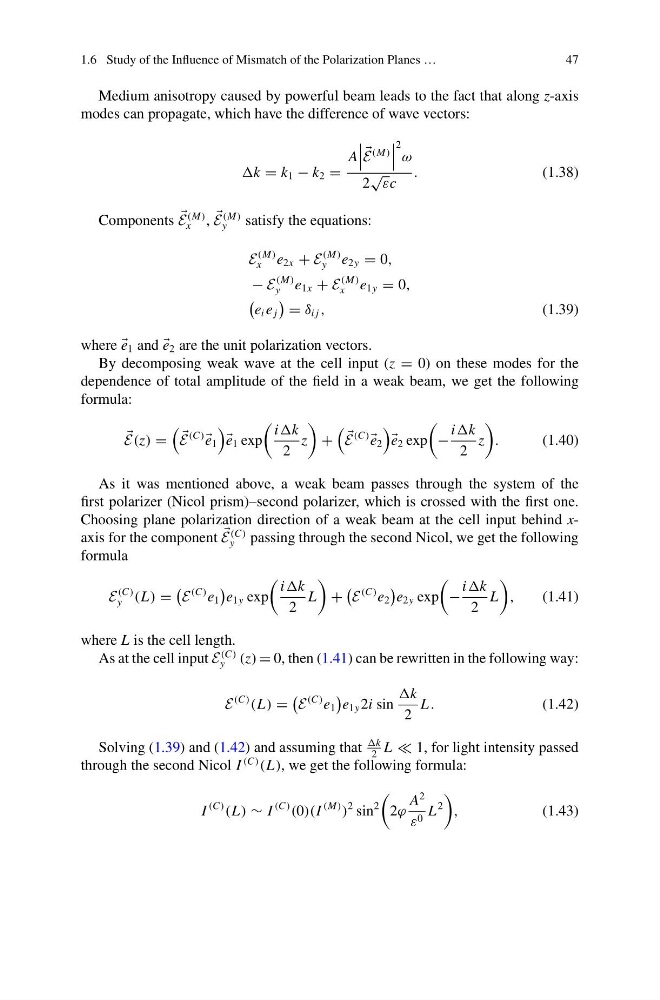
Medium anisotropy caused by powerful beam leads to the fact that along z-axis
modes can propagate, which have the difference of wave vectors:
k = k 1 − k 2 =
A
E
(M)
2 ω
2
√
εc
.
(1.38)
Components
E
(M)
x ,
E
(M)
y
satisfy the equations:
E
(M)
x e 2x + E
(M)
y e 2y = 0,
− E
(M)
y e 1x + E
(M)
x e 1y = 0,
e i e j
= δ i j ,
(1.39)
where
e 1 and
e 2 are the unit polarization vectors.
By decomposing weak wave at the cell input (z = 0) on these modes for the
dependence of total amplitude of the field in a weak beam, we get the following
formula:
E(z) =
E
(C)
e 1
e 1 exp
ik
2
z
+
E
(C)
e 2
e 2 exp
−
ik
2
z
.
(1.40)
As it was mentioned above, a weak beam passes through the system of the
first polarizer (Nicol prism)–second polarizer, which is crossed with the first one.
Choosing plane polarization direction of a weak beam at the cell input behind xaxis for the component
E
(C)
y
passing through the second Nicol, we get the following
formula
E
(C)
y (L) =
E
(C) e 1
e 1y exp
ik
2
L
+
E
(C) e 2
e 2y exp
−
ik
2
L
,
(1.41)
where L is the cell length.
As at the cell input E
(C)
y (z) = 0, then (1.41) can be rewritten in the following way:
E
(C)
(L) =
E
(C) e 1
e 1y 2i sin
k
2
L .
(1.42)
Solving (1.39) and (1.42) and assuming that
k
2
L 1, for light intensity passed
through the second Nicol I
(C)
(L), we get the following formula:
I
(C)
(L) ∼ I
(C)
(0)(I
(M)
)
2 sin
2
2ϕ
A
2
ε 0 L
2
,
(1.43)
47
Medium anisotropy caused by powerful beam leads to the fact that along z-axis
modes can propagate, which have the difference of wave vectors:
k = k 1 − k 2 =
A
E
(M)
2 ω
2
√
εc
.
(1.38)
Components
E
(M)
x ,
E
(M)
y
satisfy the equations:
E
(M)
x e 2x + E
(M)
y e 2y = 0,
− E
(M)
y e 1x + E
(M)
x e 1y = 0,
e i e j
= δ i j ,
(1.39)
where
e 1 and
e 2 are the unit polarization vectors.
By decomposing weak wave at the cell input (z = 0) on these modes for the
dependence of total amplitude of the field in a weak beam, we get the following
formula:
E(z) =
E
(C)
e 1
e 1 exp
ik
2
z
+
E
(C)
e 2
e 2 exp
−
ik
2
z
.
(1.40)
As it was mentioned above, a weak beam passes through the system of the
first polarizer (Nicol prism)–second polarizer, which is crossed with the first one.
Choosing plane polarization direction of a weak beam at the cell input behind xaxis for the component
E
(C)
y
passing through the second Nicol, we get the following
formula
E
(C)
y (L) =
E
(C) e 1
e 1y exp
ik
2
L
+
E
(C) e 2
e 2y exp
−
ik
2
L
,
(1.41)
where L is the cell length.
As at the cell input E
(C)
y (z) = 0, then (1.41) can be rewritten in the following way:
E
(C)
(L) =
E
(C) e 1
e 1y 2i sin
k
2
L .
(1.42)
Solving (1.39) and (1.42) and assuming that
k
2
L 1, for light intensity passed
through the second Nicol I
(C)
(L), we get the following formula:
I
(C)
(L) ∼ I
(C)
(0)(I
(M)
)
2 sin
2
2ϕ
A
2
ε 0 L
2
,
(1.43)