

44
1 Resonance Methods for Increasing Sensitivity of Interferometry …
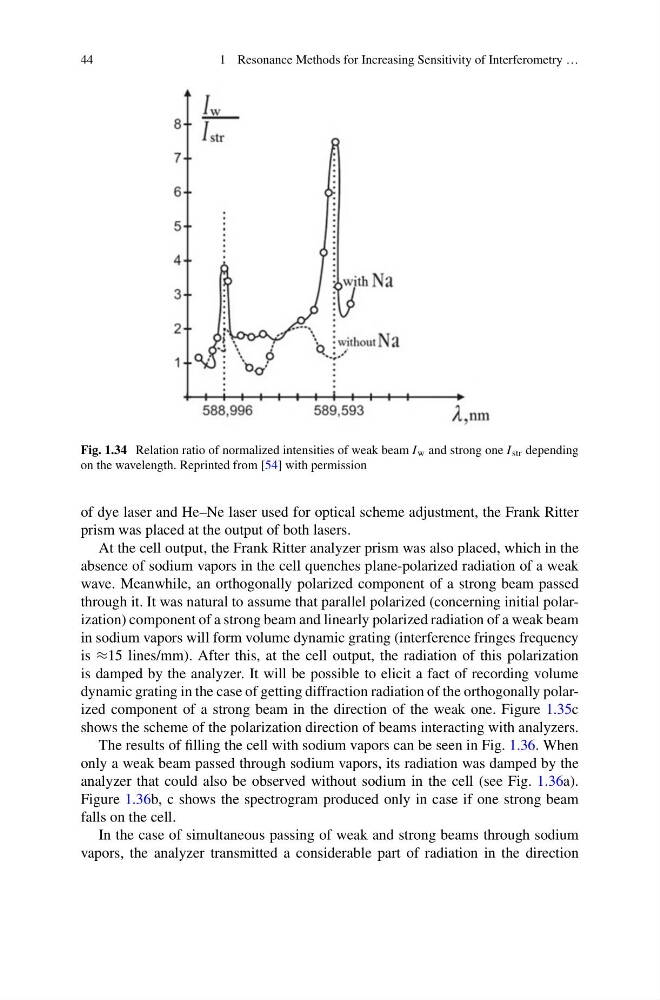
Fig. 1.34 Relation ratio of normalized intensities of weak beam I w and strong one I str depending
on the wavelength. Reprinted from [54] with permission
of dye laser and He–Ne laser used for optical scheme adjustment, the Frank Ritter
prism was placed at the output of both lasers.
At the cell output, the Frank Ritter analyzer prism was also placed, which in the
absence of sodium vapors in the cell quenches plane-polarized radiation of a weak
wave. Meanwhile, an orthogonally polarized component of a strong beam passed
through it. It was natural to assume that parallel polarized (concerning initial polarization) component of a strong beam and linearly polarized radiation of a weak beam
in sodium vapors will form volume dynamic grating (interference fringes frequency
is ≈15 lines/mm). After this, at the cell output, the radiation of this polarization
is damped by the analyzer. It will be possible to elicit a fact of recording volume
dynamic grating in the case of getting diffraction radiation of the orthogonally polarized component of a strong beam in the direction of the weak one. Figure 1.35c
shows the scheme of the polarization direction of beams interacting with analyzers.
The results of filling the cell with sodium vapors can be seen in Fig. 1.36. When
only a weak beam passed through sodium vapors, its radiation was damped by the
analyzer that could also be observed without sodium in the cell (see Fig. 1.36a).
Figure 1.36b, c shows the spectrogram produced only in case if one strong beam
falls on the cell.
In the case of simultaneous passing of weak and strong beams through sodium
vapors, the analyzer transmitted a considerable part of radiation in the direction
1 Resonance Methods for Increasing Sensitivity of Interferometry …
Fig. 1.34 Relation ratio of normalized intensities of weak beam I w and strong one I str depending
on the wavelength. Reprinted from [54] with permission
of dye laser and He–Ne laser used for optical scheme adjustment, the Frank Ritter
prism was placed at the output of both lasers.
At the cell output, the Frank Ritter analyzer prism was also placed, which in the
absence of sodium vapors in the cell quenches plane-polarized radiation of a weak
wave. Meanwhile, an orthogonally polarized component of a strong beam passed
through it. It was natural to assume that parallel polarized (concerning initial polarization) component of a strong beam and linearly polarized radiation of a weak beam
in sodium vapors will form volume dynamic grating (interference fringes frequency
is ≈15 lines/mm). After this, at the cell output, the radiation of this polarization
is damped by the analyzer. It will be possible to elicit a fact of recording volume
dynamic grating in the case of getting diffraction radiation of the orthogonally polarized component of a strong beam in the direction of the weak one. Figure 1.35c
shows the scheme of the polarization direction of beams interacting with analyzers.
The results of filling the cell with sodium vapors can be seen in Fig. 1.36. When
only a weak beam passed through sodium vapors, its radiation was damped by the
analyzer that could also be observed without sodium in the cell (see Fig. 1.36a).
Figure 1.36b, c shows the spectrogram produced only in case if one strong beam
falls on the cell.
In the case of simultaneous passing of weak and strong beams through sodium
vapors, the analyzer transmitted a considerable part of radiation in the direction