

40
1 Resonance Methods for Increasing Sensitivity of Interferometry …
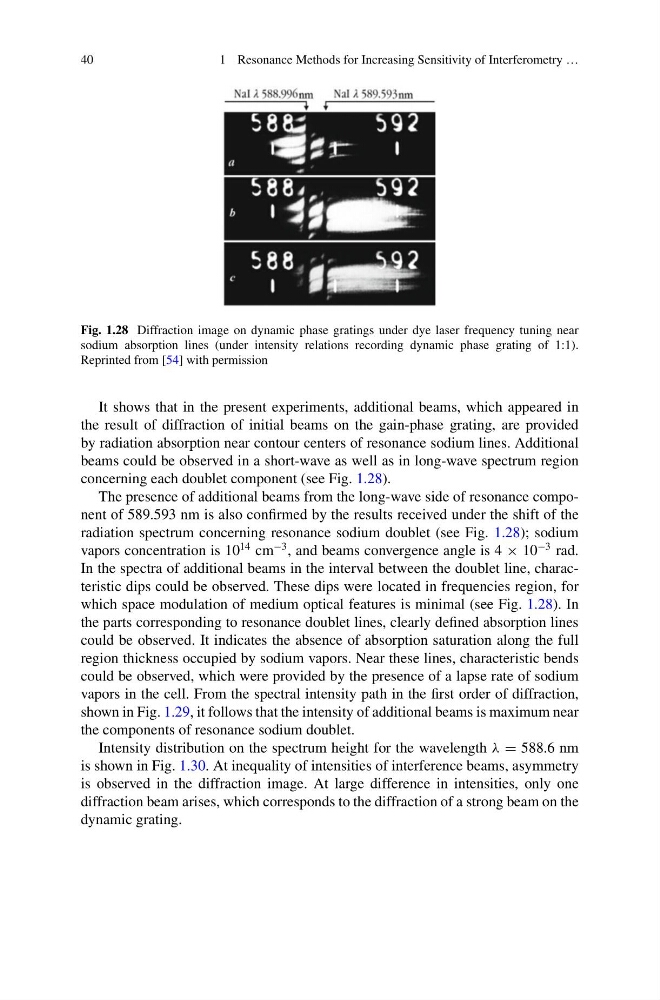
Fig. 1.28 Diffraction image on dynamic phase gratings under dye laser frequency tuning near
sodium absorption lines (under intensity relations recording dynamic phase grating of 1:1).
Reprinted from [54] with permission
It shows that in the present experiments, additional beams, which appeared in
the result of diffraction of initial beams on the gain-phase grating, are provided
by radiation absorption near contour centers of resonance sodium lines. Additional
beams could be observed in a short-wave as well as in long-wave spectrum region
concerning each doublet component (see Fig. 1.28).
The presence of additional beams from the long-wave side of resonance component of 589.593 nm is also confirmed by the results received under the shift of the
radiation spectrum concerning resonance sodium doublet (see Fig. 1.28); sodium
vapors concentration is 10
14 cm
−3 , and beams convergence angle is 4 × 10
−3 rad.
In the spectra of additional beams in the interval between the doublet line, characteristic dips could be observed. These dips were located in frequencies region, for
which space modulation of medium optical features is minimal (see Fig. 1.28). In
the parts corresponding to resonance doublet lines, clearly defined absorption lines
could be observed. It indicates the absence of absorption saturation along the full
region thickness occupied by sodium vapors. Near these lines, characteristic bends
could be observed, which were provided by the presence of a lapse rate of sodium
vapors in the cell. From the spectral intensity path in the first order of diffraction,
shown in Fig. 1.29, it follows that the intensity of additional beams is maximum near
the components of resonance sodium doublet.
Intensity distribution on the spectrum height for the wavelength λ = 588.6 nm
is shown in Fig. 1.30. At inequality of intensities of interference beams, asymmetry
is observed in the diffraction image. At large difference in intensities, only one
diffraction beam arises, which corresponds to the diffraction of a strong beam on the
dynamic grating.
1 Resonance Methods for Increasing Sensitivity of Interferometry …
Fig. 1.28 Diffraction image on dynamic phase gratings under dye laser frequency tuning near
sodium absorption lines (under intensity relations recording dynamic phase grating of 1:1).
Reprinted from [54] with permission
It shows that in the present experiments, additional beams, which appeared in
the result of diffraction of initial beams on the gain-phase grating, are provided
by radiation absorption near contour centers of resonance sodium lines. Additional
beams could be observed in a short-wave as well as in long-wave spectrum region
concerning each doublet component (see Fig. 1.28).
The presence of additional beams from the long-wave side of resonance component of 589.593 nm is also confirmed by the results received under the shift of the
radiation spectrum concerning resonance sodium doublet (see Fig. 1.28); sodium
vapors concentration is 10
14 cm
−3 , and beams convergence angle is 4 × 10
−3 rad.
In the spectra of additional beams in the interval between the doublet line, characteristic dips could be observed. These dips were located in frequencies region, for
which space modulation of medium optical features is minimal (see Fig. 1.28). In
the parts corresponding to resonance doublet lines, clearly defined absorption lines
could be observed. It indicates the absence of absorption saturation along the full
region thickness occupied by sodium vapors. Near these lines, characteristic bends
could be observed, which were provided by the presence of a lapse rate of sodium
vapors in the cell. From the spectral intensity path in the first order of diffraction,
shown in Fig. 1.29, it follows that the intensity of additional beams is maximum near
the components of resonance sodium doublet.
Intensity distribution on the spectrum height for the wavelength λ = 588.6 nm
is shown in Fig. 1.30. At inequality of intensities of interference beams, asymmetry
is observed in the diffraction image. At large difference in intensities, only one
diffraction beam arises, which corresponds to the diffraction of a strong beam on the
dynamic grating.