

1.3 Resonance Method for Increasing Interferometry Sensitivity …
27
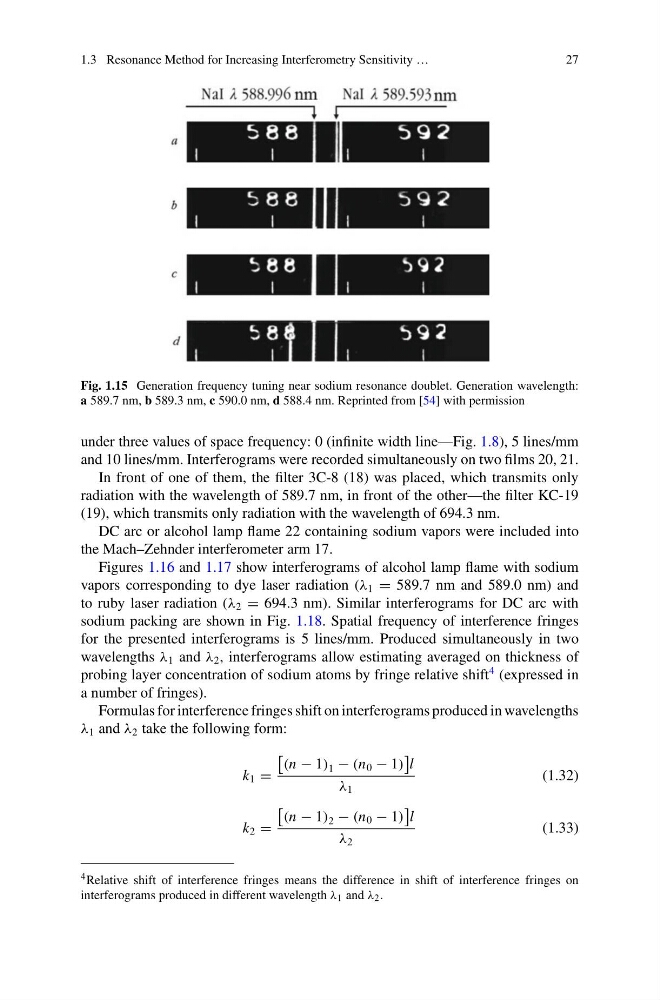
Fig. 1.15 Generation frequency tuning near sodium resonance doublet. Generation wavelength:
a 589.7 nm, b 589.3 nm, c 590.0 nm, d 588.4 nm. Reprinted from [54] with permission
under three values of space frequency: 0 (infinite width line—Fig. 1.8), 5 lines/mm
and 10 lines/mm. Interferograms were recorded simultaneously on two films 20, 21.
In front of one of them, the filter 3C-8 (18) was placed, which transmits only
radiation with the wavelength of 589.7 nm, in front of the other—the filter KC-19
(19), which transmits only radiation with the wavelength of 694.3 nm.
DC arc or alcohol lamp flame 22 containing sodium vapors were included into
the Mach–Zehnder interferometer arm 17.
Figures 1.16 and 1.17 show interferograms of alcohol lamp flame with sodium
vapors corresponding to dye laser radiation (λ 1 = 589.7 nm and 589.0 nm) and
to ruby laser radiation (λ 2 = 694.3 nm). Similar interferograms for DC arc with
sodium packing are shown in Fig. 1.18. Spatial frequency of interference fringes
for the presented interferograms is 5 lines/mm. Produced simultaneously in two
wavelengths λ 1 and λ 2 , interferograms allow estimating averaged on thickness of
probing layer concentration of sodium atoms by fringe relative shift
4 (expressed in
a number of fringes).
Formulas for interference fringes shift on interferograms produced in wavelengths
λ 1 and λ 2 take the following form:
k 1 =
(n − 1) 1 − (n 0 − 1)
l
λ 1
(1.32)
k 2 =
(n − 1) 2 − (n 0 − 1)
l
λ 2
(1.33)
4 Relative shift of interference fringes means the difference in shift of interference fringes on
interferograms produced in different wavelength λ 1 and λ 2 .
27
Fig. 1.15 Generation frequency tuning near sodium resonance doublet. Generation wavelength:
a 589.7 nm, b 589.3 nm, c 590.0 nm, d 588.4 nm. Reprinted from [54] with permission
under three values of space frequency: 0 (infinite width line—Fig. 1.8), 5 lines/mm
and 10 lines/mm. Interferograms were recorded simultaneously on two films 20, 21.
In front of one of them, the filter 3C-8 (18) was placed, which transmits only
radiation with the wavelength of 589.7 nm, in front of the other—the filter KC-19
(19), which transmits only radiation with the wavelength of 694.3 nm.
DC arc or alcohol lamp flame 22 containing sodium vapors were included into
the Mach–Zehnder interferometer arm 17.
Figures 1.16 and 1.17 show interferograms of alcohol lamp flame with sodium
vapors corresponding to dye laser radiation (λ 1 = 589.7 nm and 589.0 nm) and
to ruby laser radiation (λ 2 = 694.3 nm). Similar interferograms for DC arc with
sodium packing are shown in Fig. 1.18. Spatial frequency of interference fringes
for the presented interferograms is 5 lines/mm. Produced simultaneously in two
wavelengths λ 1 and λ 2 , interferograms allow estimating averaged on thickness of
probing layer concentration of sodium atoms by fringe relative shift
4 (expressed in
a number of fringes).
Formulas for interference fringes shift on interferograms produced in wavelengths
λ 1 and λ 2 take the following form:
k 1 =
(n − 1) 1 − (n 0 − 1)
l
λ 1
(1.32)
k 2 =
(n − 1) 2 − (n 0 − 1)
l
λ 2
(1.33)
4 Relative shift of interference fringes means the difference in shift of interference fringes on
interferograms produced in different wavelength λ 1 and λ 2 .