

5.13 Analysis of Spectral Characteristics of Radiation Scattered by …
459
sex of the respondents and are explained by the different degrees of pigmentation of
skin of every individual.
5.13.2 Absorption Spectra of Blood Preparation at Different
Oxyhemoglobin Concentrations
The pigments contained in blood, such as hemoglobin, oxyhemoglobin, β-carotene
and bilirubin, in considerable degree distinguish the absorption of the radiation of
the visible area of spectrum in dermis in vivo. Hemoglobin and oxyhemoglobin
have a discrete area of absorption at the range of 400–1000 nm [272, 279]. Spectral
reflection in the area from 400 to 510 nm can be used for the noninvasive assessment
of the level of bilirubin in blood [280], and shortwave part of the spectrum of visible
radiation corresponds to the main area of absorption of β-carotene [272].
With the aim of a contactless noninvasive method of defining the degree of blood
oxygenation, absorption spectra of blood preparation at different concentrations of
oxyhemoglobin were studied. The studies were conducted with the help of special
attachment “Specord M-40” for the measurement of transmission and absorption.
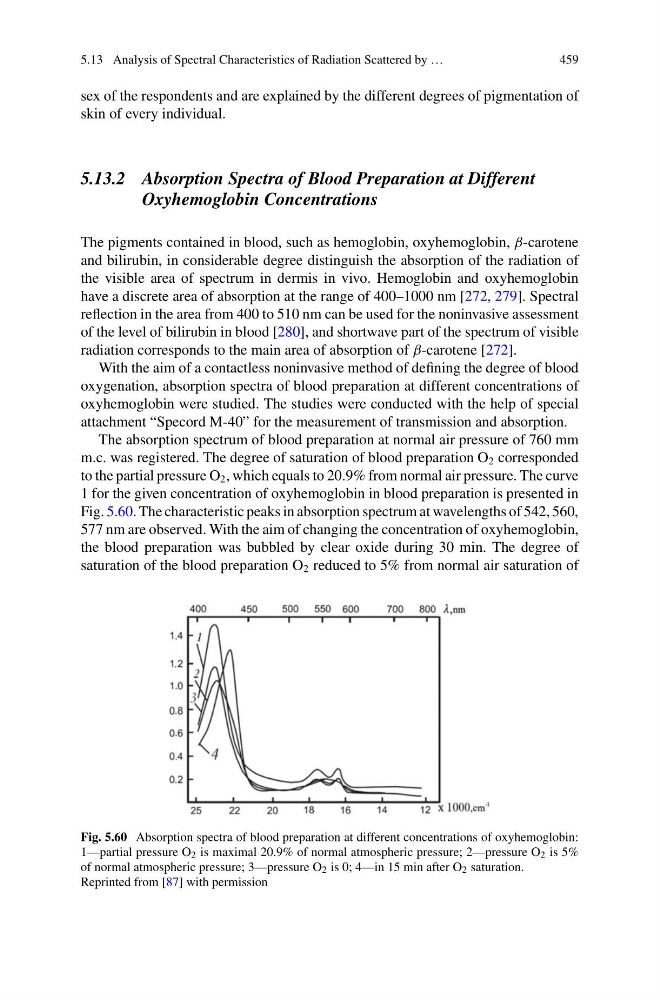
The absorption spectrum of blood preparation at normal air pressure of 760 mm
m.c. was registered. The degree of saturation of blood preparation O 2 corresponded
to the partial pressure O 2 , which equals to 20.9% from normal air pressure. The curve
1 for the given concentration of oxyhemoglobin in blood preparation is presented in
Fig. 5.60. The characteristic peaks in absorption spectrum at wavelengths of 542, 560,
577 nm are observed. With the aim of changing the concentration of oxyhemoglobin,
the blood preparation was bubbled by clear oxide during 30 min. The degree of
saturation of the blood preparation O 2 reduced to 5% from normal air saturation of
Fig. 5.60 Absorption spectra of blood preparation at different concentrations of oxyhemoglobin:
1—partial pressure O 2 is maximal 20.9% of normal atmospheric pressure; 2—pressure O 2 is 5%
of normal atmospheric pressure; 3—pressure O 2 is 0; 4—in 15 min after O 2 saturation.
Reprinted from [87] with permission
459
sex of the respondents and are explained by the different degrees of pigmentation of
skin of every individual.
5.13.2 Absorption Spectra of Blood Preparation at Different
Oxyhemoglobin Concentrations
The pigments contained in blood, such as hemoglobin, oxyhemoglobin, β-carotene
and bilirubin, in considerable degree distinguish the absorption of the radiation of
the visible area of spectrum in dermis in vivo. Hemoglobin and oxyhemoglobin
have a discrete area of absorption at the range of 400–1000 nm [272, 279]. Spectral
reflection in the area from 400 to 510 nm can be used for the noninvasive assessment
of the level of bilirubin in blood [280], and shortwave part of the spectrum of visible
radiation corresponds to the main area of absorption of β-carotene [272].
With the aim of a contactless noninvasive method of defining the degree of blood
oxygenation, absorption spectra of blood preparation at different concentrations of
oxyhemoglobin were studied. The studies were conducted with the help of special
attachment “Specord M-40” for the measurement of transmission and absorption.
The absorption spectrum of blood preparation at normal air pressure of 760 mm
m.c. was registered. The degree of saturation of blood preparation O 2 corresponded
to the partial pressure O 2 , which equals to 20.9% from normal air pressure. The curve
1 for the given concentration of oxyhemoglobin in blood preparation is presented in
Fig. 5.60. The characteristic peaks in absorption spectrum at wavelengths of 542, 560,
577 nm are observed. With the aim of changing the concentration of oxyhemoglobin,
the blood preparation was bubbled by clear oxide during 30 min. The degree of
saturation of the blood preparation O 2 reduced to 5% from normal air saturation of
Fig. 5.60 Absorption spectra of blood preparation at different concentrations of oxyhemoglobin:
1—partial pressure O 2 is maximal 20.9% of normal atmospheric pressure; 2—pressure O 2 is 5%
of normal atmospheric pressure; 3—pressure O 2 is 0; 4—in 15 min after O 2 saturation.
Reprinted from [87] with permission