

5.8 Development of Diagnostic Speckle-Optical Criteria for …
427
The use of optics of speckles for studying processes in living tissues gave the
possibility to obtain information about mobility of the scattering particles and their
velocities. Laser radiation penetrates into skin, which is full of capillaries into the
depth of 500 μm and scatters back. It forms a dynamic speckle-pattern, and its
velocity of change depends on the intensity of microcirculations [44, 75, 84]. Though
at such depth, there are many small blood vessels, in particular the mobile blood cells
(first of all erythrocytes), which take part in forming of the dynamic speckle-structure.
Small depth of penetration gives the possibility to estimate selectively the surface
blood flow in comparison, for example, with ultrasonic study, which estimate the
data averaged from the depth of 1 cm [84].
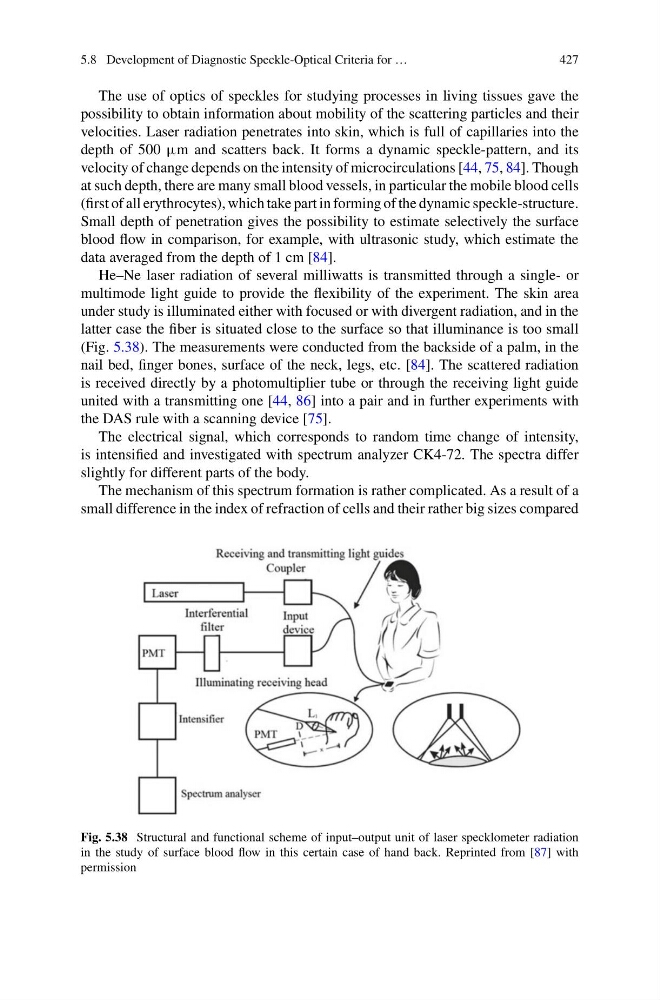
He–Ne laser radiation of several milliwatts is transmitted through a single- or
multimode light guide to provide the flexibility of the experiment. The skin area
under study is illuminated either with focused or with divergent radiation, and in the
latter case the fiber is situated close to the surface so that illuminance is too small
(Fig. 5.38). The measurements were conducted from the backside of a palm, in the
nail bed, finger bones, surface of the neck, legs, etc. [84]. The scattered radiation
is received directly by a photomultiplier tube or through the receiving light guide
united with a transmitting one [44, 86] into a pair and in further experiments with
the DAS rule with a scanning device [75].
The electrical signal, which corresponds to random time change of intensity,
is intensified and investigated with spectrum analyzer CK4-72. The spectra differ
slightly for different parts of the body.
The mechanism of this spectrum formation is rather complicated. As a result of a
small difference in the index of refraction of cells and their rather big sizes compared
Fig. 5.38 Structural and functional scheme of input–output unit of laser specklometer radiation
in the study of surface blood flow in this certain case of hand back. Reprinted from [87] with
permission
427
The use of optics of speckles for studying processes in living tissues gave the
possibility to obtain information about mobility of the scattering particles and their
velocities. Laser radiation penetrates into skin, which is full of capillaries into the
depth of 500 μm and scatters back. It forms a dynamic speckle-pattern, and its
velocity of change depends on the intensity of microcirculations [44, 75, 84]. Though
at such depth, there are many small blood vessels, in particular the mobile blood cells
(first of all erythrocytes), which take part in forming of the dynamic speckle-structure.
Small depth of penetration gives the possibility to estimate selectively the surface
blood flow in comparison, for example, with ultrasonic study, which estimate the
data averaged from the depth of 1 cm [84].
He–Ne laser radiation of several milliwatts is transmitted through a single- or
multimode light guide to provide the flexibility of the experiment. The skin area
under study is illuminated either with focused or with divergent radiation, and in the
latter case the fiber is situated close to the surface so that illuminance is too small
(Fig. 5.38). The measurements were conducted from the backside of a palm, in the
nail bed, finger bones, surface of the neck, legs, etc. [84]. The scattered radiation
is received directly by a photomultiplier tube or through the receiving light guide
united with a transmitting one [44, 86] into a pair and in further experiments with
the DAS rule with a scanning device [75].
The electrical signal, which corresponds to random time change of intensity,
is intensified and investigated with spectrum analyzer CK4-72. The spectra differ
slightly for different parts of the body.
The mechanism of this spectrum formation is rather complicated. As a result of a
small difference in the index of refraction of cells and their rather big sizes compared
Fig. 5.38 Structural and functional scheme of input–output unit of laser specklometer radiation
in the study of surface blood flow in this certain case of hand back. Reprinted from [87] with
permission