

1.2 Spatial Coherence of Rhodamine 6G Laser Radiation …
11
intensity and depending on the value H can be considerably changed along the whole
hologram surface. But in small hologram parts, it is assumed that f is a constant and
does not depend on δH. Using the work studies [69] and (1.11), it is easy to get the
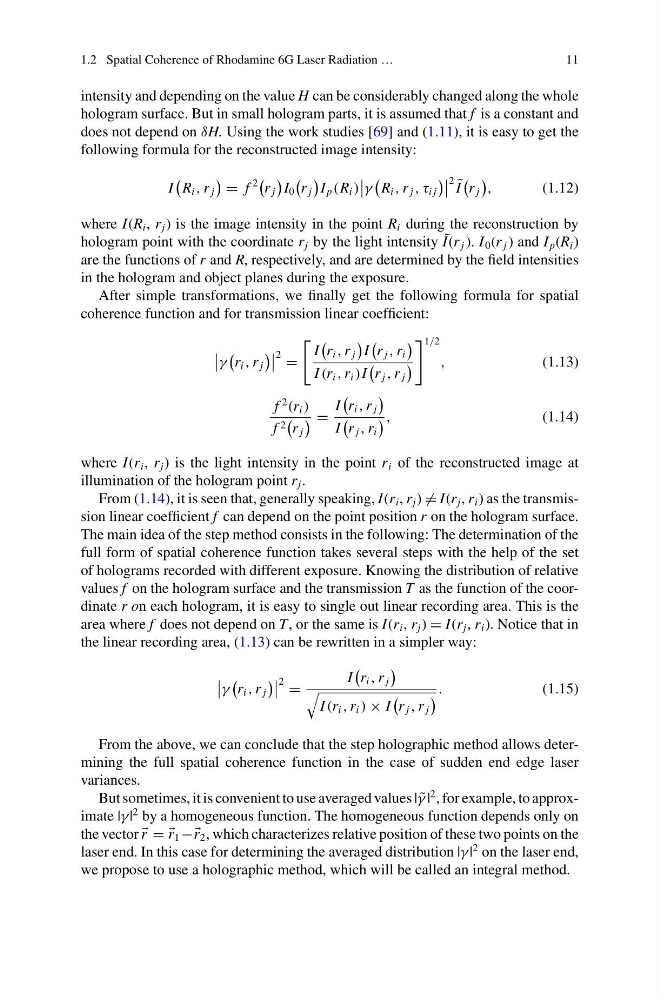
following formula for the reconstructed image intensity:
I
R i , r j
= f
2
r j
I 0
r j
I p (R i )
γ
R i , r j , τ i j
2 ˜
I
r j
,
(1.12)
where I(R i , r j ) is the image intensity in the point R i during the reconstruction by
hologram point with the coordinate r j by the light intensity ˜
I(r j ). I 0 (r j ) and I p (R i )
are the functions of r and R, respectively, and are determined by the field intensities
in the hologram and object planes during the exposure.
After simple transformations, we finally get the following formula for spatial
coherence function and for transmission linear coefficient:
γ
r i , r j
2 =
I
r i , r j
I
r j , r i
I (r i , r i )I
r j , r j
1/2
,
(1.13)
f
2
(r i )
f 2
r j
=
I
r i , r j
I
r j , r i
,
(1.14)
where I(r i , r j ) is the light intensity in the point r i of the reconstructed image at
illumination of the hologram point r j .
From (1.14), it is seen that, generally speaking, I(r i , r j ) = I(r j , r i ) as the transmission linear coefficient f can depend on the point position r on the hologram surface.
The main idea of the step method consists in the following: The determination of the
full form of spatial coherence function takes several steps with the help of the set
of holograms recorded with different exposure. Knowing the distribution of relative
values f on the hologram surface and the transmission T as the function of the coordinate r on each hologram, it is easy to single out linear recording area. This is the
area where f does not depend on T, or the same is I(r i , r j ) = I(r j , r i ). Notice that in
the linear recording area, (1.13) can be rewritten in a simpler way:
γ
r i , r j
2 =
I
r i , r j
I (r i , r i ) × I
r j , r j
.
(1.15)
From the above, we can conclude that the step holographic method allows determining the full spatial coherence function in the case of sudden end edge laser
variances.
But sometimes, it is convenient to use averaged values | ˜
γ |
2 , for example, to approximate |γ |
2 by a homogeneous function. The homogeneous function depends only on
the vector
r = =
r 1 −− r 2 , which characterizes relative position of these two points on the
laser end. In this case for determining the averaged distribution |γ |
2 on the laser end,
we propose to use a holographic method, which will be called an integral method.
11
intensity and depending on the value H can be considerably changed along the whole
hologram surface. But in small hologram parts, it is assumed that f is a constant and
does not depend on δH. Using the work studies [69] and (1.11), it is easy to get the
following formula for the reconstructed image intensity:
I
R i , r j
= f
2
r j
I 0
r j
I p (R i )
γ
R i , r j , τ i j
2 ˜
I
r j
,
(1.12)
where I(R i , r j ) is the image intensity in the point R i during the reconstruction by
hologram point with the coordinate r j by the light intensity ˜
I(r j ). I 0 (r j ) and I p (R i )
are the functions of r and R, respectively, and are determined by the field intensities
in the hologram and object planes during the exposure.
After simple transformations, we finally get the following formula for spatial
coherence function and for transmission linear coefficient:
γ
r i , r j
2 =
I
r i , r j
I
r j , r i
I (r i , r i )I
r j , r j
1/2
,
(1.13)
f
2
(r i )
f 2
r j
=
I
r i , r j
I
r j , r i
,
(1.14)
where I(r i , r j ) is the light intensity in the point r i of the reconstructed image at
illumination of the hologram point r j .
From (1.14), it is seen that, generally speaking, I(r i , r j ) = I(r j , r i ) as the transmission linear coefficient f can depend on the point position r on the hologram surface.
The main idea of the step method consists in the following: The determination of the
full form of spatial coherence function takes several steps with the help of the set
of holograms recorded with different exposure. Knowing the distribution of relative
values f on the hologram surface and the transmission T as the function of the coordinate r on each hologram, it is easy to single out linear recording area. This is the
area where f does not depend on T, or the same is I(r i , r j ) = I(r j , r i ). Notice that in
the linear recording area, (1.13) can be rewritten in a simpler way:
γ
r i , r j
2 =
I
r i , r j
I (r i , r i ) × I
r j , r j
.
(1.15)
From the above, we can conclude that the step holographic method allows determining the full spatial coherence function in the case of sudden end edge laser
variances.
But sometimes, it is convenient to use averaged values | ˜
γ |
2 , for example, to approximate |γ |
2 by a homogeneous function. The homogeneous function depends only on
the vector
r = =
r 1 −− r 2 , which characterizes relative position of these two points on the
laser end. In this case for determining the averaged distribution |γ |
2 on the laser end,
we propose to use a holographic method, which will be called an integral method.