

338
4 Speckle-Optical Methods and Devices for Studying …
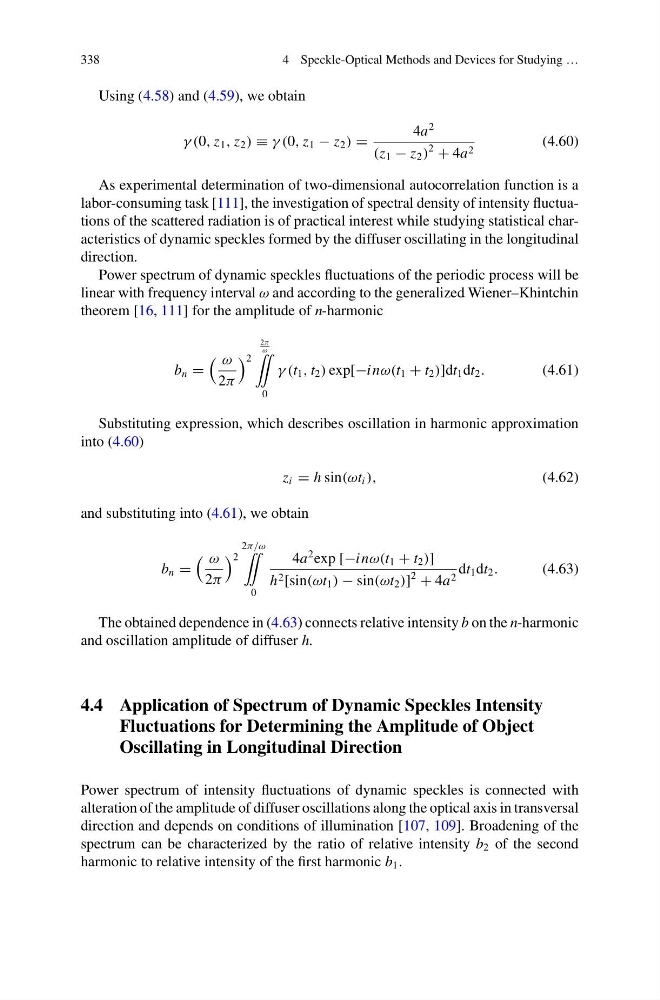
Using (4.58) and (4.59), we obtain
γ (0, z 1 , z 2 ) ≡ γ (0, z 1 − z 2 ) =
4a
2
(z 1 − z 2 )
2
+ 4a 2
(4.60)
As experimental determination of two-dimensional autocorrelation function is a
labor-consuming task [111], the investigation of spectral density of intensity fluctuations of the scattered radiation is of practical interest while studying statistical characteristics of dynamic speckles formed by the diffuser oscillating in the longitudinal
direction.
Power spectrum of dynamic speckles fluctuations of the periodic process will be
linear with frequency interval ω and according to the generalized Wiener–Khintchin
theorem [16, 111] for the amplitude of n-harmonic
b n =
ω
2π
2
2π
ω
¨
0
γ (t 1 , t 2 ) exp[−inω(t 1 + t 2 )]dt 1 dt 2 .
(4.61)
Substituting expression, which describes oscillation in harmonic approximation
into (4.60)
z i = h sin(ωt i ),
(4.62)
and substituting into (4.61), we obtain
b n =
ω
2π
2
2π/ω ¨
0
4a
2 exp [−inω(t 1 + t 2 )]
h 2 [sin(ωt 1 ) − sin(ωt 2 )]
2
+ 4a 2 dt 1 dt 2 .
(4.63)
The obtained dependence in (4.63) connects relative intensity b on the n-harmonic
and oscillation amplitude of diffuser h.
4.4 Application of Spectrum of Dynamic Speckles Intensity
Fluctuations for Determining the Amplitude of Object
Oscillating in Longitudinal Direction
Power spectrum of intensity fluctuations of dynamic speckles is connected with
alteration of the amplitude of diffuser oscillations along the optical axis in transversal
direction and depends on conditions of illumination [107, 109]. Broadening of the
spectrum can be characterized by the ratio of relative intensity b 2 of the second
harmonic to relative intensity of the first harmonic b 1 .
4 Speckle-Optical Methods and Devices for Studying …
Using (4.58) and (4.59), we obtain
γ (0, z 1 , z 2 ) ≡ γ (0, z 1 − z 2 ) =
4a
2
(z 1 − z 2 )
2
+ 4a 2
(4.60)
As experimental determination of two-dimensional autocorrelation function is a
labor-consuming task [111], the investigation of spectral density of intensity fluctuations of the scattered radiation is of practical interest while studying statistical characteristics of dynamic speckles formed by the diffuser oscillating in the longitudinal
direction.
Power spectrum of dynamic speckles fluctuations of the periodic process will be
linear with frequency interval ω and according to the generalized Wiener–Khintchin
theorem [16, 111] for the amplitude of n-harmonic
b n =
ω
2π
2
2π
ω
¨
0
γ (t 1 , t 2 ) exp[−inω(t 1 + t 2 )]dt 1 dt 2 .
(4.61)
Substituting expression, which describes oscillation in harmonic approximation
into (4.60)
z i = h sin(ωt i ),
(4.62)
and substituting into (4.61), we obtain
b n =
ω
2π
2
2π/ω ¨
0
4a
2 exp [−inω(t 1 + t 2 )]
h 2 [sin(ωt 1 ) − sin(ωt 2 )]
2
+ 4a 2 dt 1 dt 2 .
(4.63)
The obtained dependence in (4.63) connects relative intensity b on the n-harmonic
and oscillation amplitude of diffuser h.
4.4 Application of Spectrum of Dynamic Speckles Intensity
Fluctuations for Determining the Amplitude of Object
Oscillating in Longitudinal Direction
Power spectrum of intensity fluctuations of dynamic speckles is connected with
alteration of the amplitude of diffuser oscillations along the optical axis in transversal
direction and depends on conditions of illumination [107, 109]. Broadening of the
spectrum can be characterized by the ratio of relative intensity b 2 of the second
harmonic to relative intensity of the first harmonic b 1 .