

4.2 Application of Spectral Characteristics of Dynamic Speckle-Field …
329
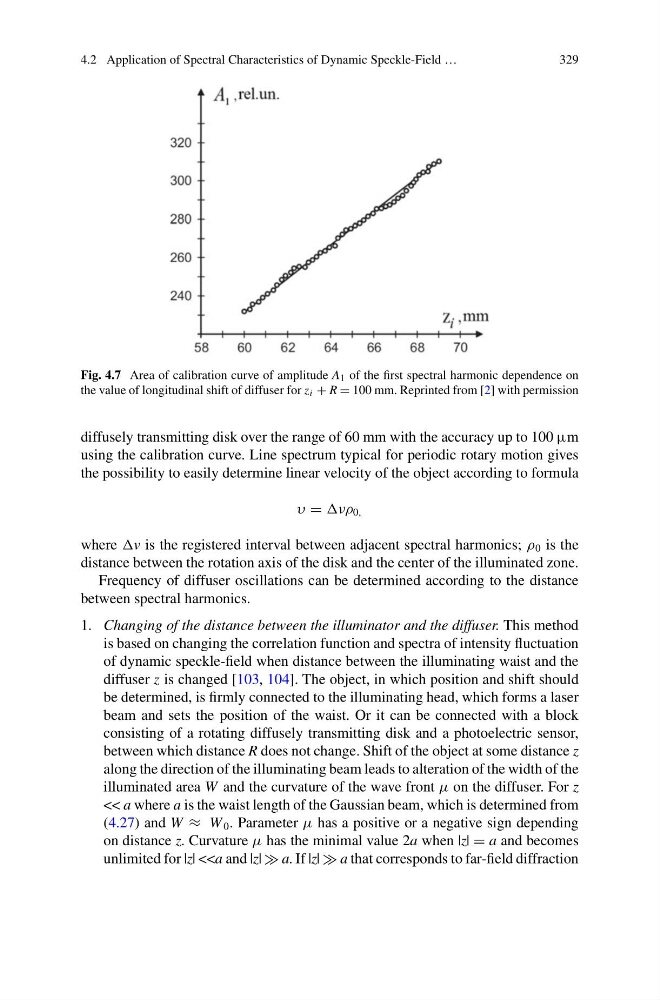
Fig. 4.7 Area of calibration curve of amplitude A 1 of the first spectral harmonic dependence on
the value of longitudinal shift of diffuser for z i + R = 100 mm. Reprinted from [2] with permission
diffusely transmitting disk over the range of 60 mm with the accuracy up to 100 μm
using the calibration curve. Line spectrum typical for periodic rotary motion gives
the possibility to easily determine linear velocity of the object according to formula
υ = 0,
where v is the registered interval between adjacent spectral harmonics; ρ 0 is the
distance between the rotation axis of the disk and the center of the illuminated zone.
Frequency of diffuser oscillations can be determined according to the distance
between spectral harmonics.
1. Changing of the distance between the illuminator and the diffuser. This method
is based on changing the correlation function and spectra of intensity fluctuation
of dynamic speckle-field when distance between the illuminating waist and the
diffuser z is changed [103, 104]. The object, in which position and shift should
be determined, is firmly connected to the illuminating head, which forms a laser
beam and sets the position of the waist. Or it can be connected with a block
consisting of a rotating diffusely transmitting disk and a photoelectric sensor,
between which distance R does not change. Shift of the object at some distance z
along the direction of the illuminating beam leads to alteration of the width of the
illuminated area W and the curvature of the wave front μ on the diffuser. For z
<< a where a is the waist length of the Gaussian beam, which is determined from
(4.27) and W ≈ W 0 . Parameter μ has a positive or a negative sign depending
on distance z. Curvature μ has the minimal value 2a when |z| = a and becomes
unlimited for |z| <
329
Fig. 4.7 Area of calibration curve of amplitude A 1 of the first spectral harmonic dependence on
the value of longitudinal shift of diffuser for z i + R = 100 mm. Reprinted from [2] with permission
diffusely transmitting disk over the range of 60 mm with the accuracy up to 100 μm
using the calibration curve. Line spectrum typical for periodic rotary motion gives
the possibility to easily determine linear velocity of the object according to formula
υ = 0,
where v is the registered interval between adjacent spectral harmonics; ρ 0 is the
distance between the rotation axis of the disk and the center of the illuminated zone.
Frequency of diffuser oscillations can be determined according to the distance
between spectral harmonics.
1. Changing of the distance between the illuminator and the diffuser. This method
is based on changing the correlation function and spectra of intensity fluctuation
of dynamic speckle-field when distance between the illuminating waist and the
diffuser z is changed [103, 104]. The object, in which position and shift should
be determined, is firmly connected to the illuminating head, which forms a laser
beam and sets the position of the waist. Or it can be connected with a block
consisting of a rotating diffusely transmitting disk and a photoelectric sensor,
between which distance R does not change. Shift of the object at some distance z
along the direction of the illuminating beam leads to alteration of the width of the
illuminated area W and the curvature of the wave front μ on the diffuser. For z
<< a where a is the waist length of the Gaussian beam, which is determined from
(4.27) and W ≈ W 0 . Parameter μ has a positive or a negative sign depending
on distance z. Curvature μ has the minimal value 2a when |z| = a and becomes
unlimited for |z| <