

4.2 Application of Spectral Characteristics of Dynamic Speckle-Field …
327
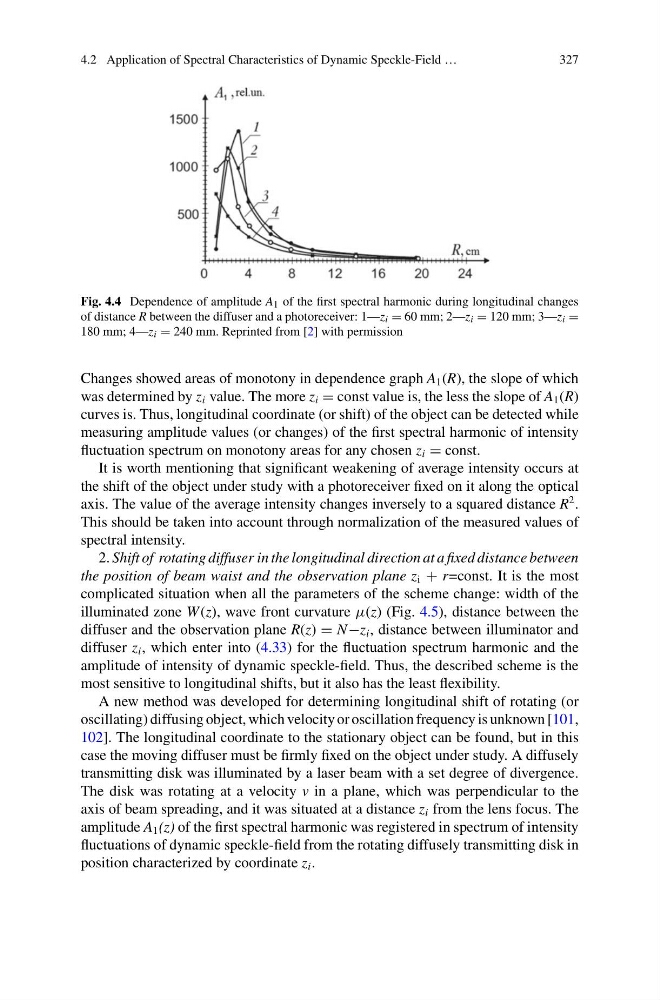
Fig. 4.4 Dependence of amplitude A 1 of the first spectral harmonic during longitudinal changes
of distance R between the diffuser and a photoreceiver: 1—z i = 60 mm; 2—z i = 120 mm; 3—z i =
180 mm; 4—z i = 240 mm. Reprinted from [2] with permission
Changes showed areas of monotony in dependence graph A 1 (R), the slope of which
was determined by z i value. The more z i = const value is, the less the slope of A 1 (R)
curves is. Thus, longitudinal coordinate (or shift) of the object can be detected while
measuring amplitude values (or changes) of the first spectral harmonic of intensity
fluctuation spectrum on monotony areas for any chosen z i = const.
It is worth mentioning that significant weakening of average intensity occurs at
the shift of the object under study with a photoreceiver fixed on it along the optical
axis. The value of the average intensity changes inversely to a squared distance R
2 .
This should be taken into account through normalization of the measured values of
spectral intensity.
2. Shift of rotating diffuser in the longitudinal direction at a fixed distance between
the position of beam waist and the observation plane z i + r=const. It is the most
complicated situation when all the parameters of the scheme change: width of the
illuminated zone W (z), wave front curvature μ(z) (Fig. 4.5), distance between the
diffuser and the observation plane R(z) = N−z i , distance between illuminator and
diffuser z i , which enter into (4.33) for the fluctuation spectrum harmonic and the
amplitude of intensity of dynamic speckle-field. Thus, the described scheme is the
most sensitive to longitudinal shifts, but it also has the least flexibility.
A new method was developed for determining longitudinal shift of rotating (or
oscillating) diffusing object, which velocity or oscillation frequency is unknown [101,
102]. The longitudinal coordinate to the stationary object can be found, but in this
case the moving diffuser must be firmly fixed on the object under study. A diffusely
transmitting disk was illuminated by a laser beam with a set degree of divergence.
The disk was rotating at a velocity v in a plane, which was perpendicular to the
axis of beam spreading, and it was situated at a distance z i from the lens focus. The
amplitude A 1 (z) of the first spectral harmonic was registered in spectrum of intensity
fluctuations of dynamic speckle-field from the rotating diffusely transmitting disk in
position characterized by coordinate z i .
327
Fig. 4.4 Dependence of amplitude A 1 of the first spectral harmonic during longitudinal changes
of distance R between the diffuser and a photoreceiver: 1—z i = 60 mm; 2—z i = 120 mm; 3—z i =
180 mm; 4—z i = 240 mm. Reprinted from [2] with permission
Changes showed areas of monotony in dependence graph A 1 (R), the slope of which
was determined by z i value. The more z i = const value is, the less the slope of A 1 (R)
curves is. Thus, longitudinal coordinate (or shift) of the object can be detected while
measuring amplitude values (or changes) of the first spectral harmonic of intensity
fluctuation spectrum on monotony areas for any chosen z i = const.
It is worth mentioning that significant weakening of average intensity occurs at
the shift of the object under study with a photoreceiver fixed on it along the optical
axis. The value of the average intensity changes inversely to a squared distance R
2 .
This should be taken into account through normalization of the measured values of
spectral intensity.
2. Shift of rotating diffuser in the longitudinal direction at a fixed distance between
the position of beam waist and the observation plane z i + r=const. It is the most
complicated situation when all the parameters of the scheme change: width of the
illuminated zone W (z), wave front curvature μ(z) (Fig. 4.5), distance between the
diffuser and the observation plane R(z) = N−z i , distance between illuminator and
diffuser z i , which enter into (4.33) for the fluctuation spectrum harmonic and the
amplitude of intensity of dynamic speckle-field. Thus, the described scheme is the
most sensitive to longitudinal shifts, but it also has the least flexibility.
A new method was developed for determining longitudinal shift of rotating (or
oscillating) diffusing object, which velocity or oscillation frequency is unknown [101,
102]. The longitudinal coordinate to the stationary object can be found, but in this
case the moving diffuser must be firmly fixed on the object under study. A diffusely
transmitting disk was illuminated by a laser beam with a set degree of divergence.
The disk was rotating at a velocity v in a plane, which was perpendicular to the
axis of beam spreading, and it was situated at a distance z i from the lens focus. The
amplitude A 1 (z) of the first spectral harmonic was registered in spectrum of intensity
fluctuations of dynamic speckle-field from the rotating diffusely transmitting disk in
position characterized by coordinate z i .