

4.1 Correlation and Spectral Characteristics of Dynamic Speckle-Field …
319
Mathematic description of movement of the speckle-image from the diffuser
moving at a constant velocity was made by many authors [14, 16, 47, 84,
95]. Spatiotemporal autocorrelated intensity function in the normalized form is
determined in the work [96] in the following way:
C 1 (
p 1 ,
p 2 , t 1 , t 2 ) =
I (
p 1 , t 1 )I (
p 2 , t 2 ) − I (
p 1 , t 1 )I (
p 2 , t 2 )
I 2 (
p 1 , t 1 )
− I (
p 1 , t 1 )
2
1
2
I 2 (
p 2 , t 2 )
− I (
p 2 , t 2 )
2
1
2
,
(4.1)
where I (
p, t) is the optical intensity in point
p of the observation plane in time
moment t.
Let us examine the results of the study and the main parameters of dynamic
speckle-field from the rotating diffusing object while illuminating it with laser
radiation [96].
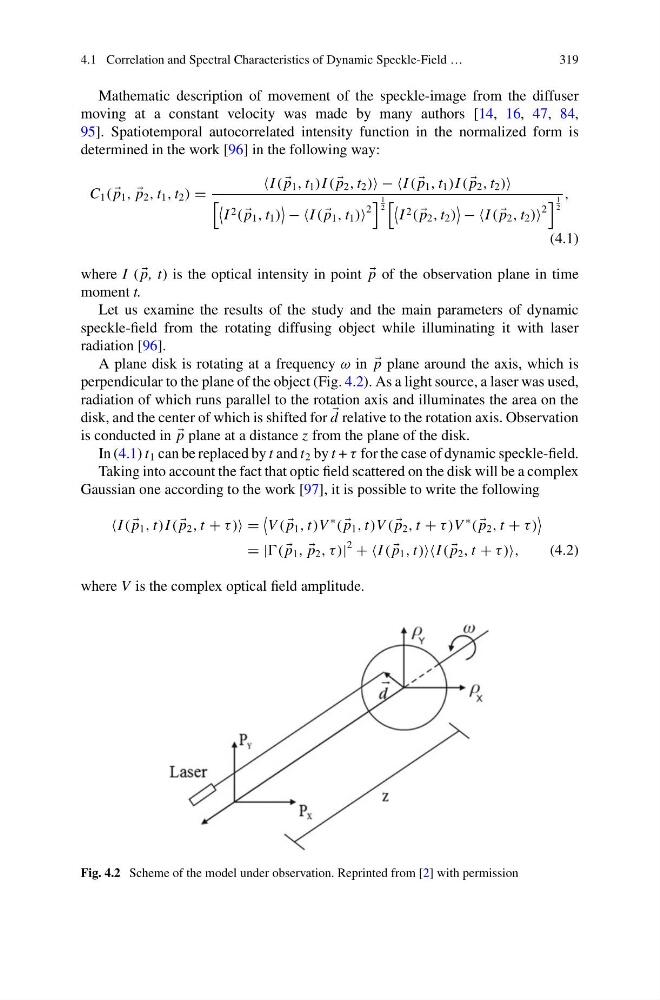
A plane disk is rotating at a frequency ω in
p plane around the axis, which is
perpendicular to the plane of the object (Fig. 4.2). As a light source, a laser was used,
radiation of which runs parallel to the rotation axis and illuminates the area on the
disk, and the center of which is shifted for
d relative to the rotation axis. Observation
is conducted in
p plane at a distance z from the plane of the disk.
In (4.1) t 1 can be replaced by t and t 2 by t + τ for the case of dynamic speckle-field.
Taking into account the fact that optic field scattered on the disk will be a complex
Gaussian one according to the work [97], it is possible to write the following
I (
p 1 , t)I (
p 2 , t + τ ) =
V (
p 1 , t)V
∗
(
p 1 , t)V (
p 2 , t + τ )V
∗
(
p 2 , t + τ )
= |(
p 1 ,
p 2 , τ )|
2 + I (
p 1 , t)I (
p 2 , t + τ ),
(4.2)
where V is the complex optical field amplitude.
Fig. 4.2 Scheme of the model under observation. Reprinted from [2] with permission
319
Mathematic description of movement of the speckle-image from the diffuser
moving at a constant velocity was made by many authors [14, 16, 47, 84,
95]. Spatiotemporal autocorrelated intensity function in the normalized form is
determined in the work [96] in the following way:
C 1 (
p 1 ,
p 2 , t 1 , t 2 ) =
I (
p 1 , t 1 )I (
p 2 , t 2 ) − I (
p 1 , t 1 )I (
p 2 , t 2 )
I 2 (
p 1 , t 1 )
− I (
p 1 , t 1 )
2
1
2
I 2 (
p 2 , t 2 )
− I (
p 2 , t 2 )
2
1
2
,
(4.1)
where I (
p, t) is the optical intensity in point
p of the observation plane in time
moment t.
Let us examine the results of the study and the main parameters of dynamic
speckle-field from the rotating diffusing object while illuminating it with laser
radiation [96].
A plane disk is rotating at a frequency ω in
p plane around the axis, which is
perpendicular to the plane of the object (Fig. 4.2). As a light source, a laser was used,
radiation of which runs parallel to the rotation axis and illuminates the area on the
disk, and the center of which is shifted for
d relative to the rotation axis. Observation
is conducted in
p plane at a distance z from the plane of the disk.
In (4.1) t 1 can be replaced by t and t 2 by t + τ for the case of dynamic speckle-field.
Taking into account the fact that optic field scattered on the disk will be a complex
Gaussian one according to the work [97], it is possible to write the following
I (
p 1 , t)I (
p 2 , t + τ ) =
V (
p 1 , t)V
∗
(
p 1 , t)V (
p 2 , t + τ )V
∗
(
p 2 , t + τ )
= |(
p 1 ,
p 2 , τ )|
2 + I (
p 1 , t)I (
p 2 , t + τ ),
(4.2)
where V is the complex optical field amplitude.
Fig. 4.2 Scheme of the model under observation. Reprinted from [2] with permission