

3.4 Holographic Research Methods in Biology and Medicine
281
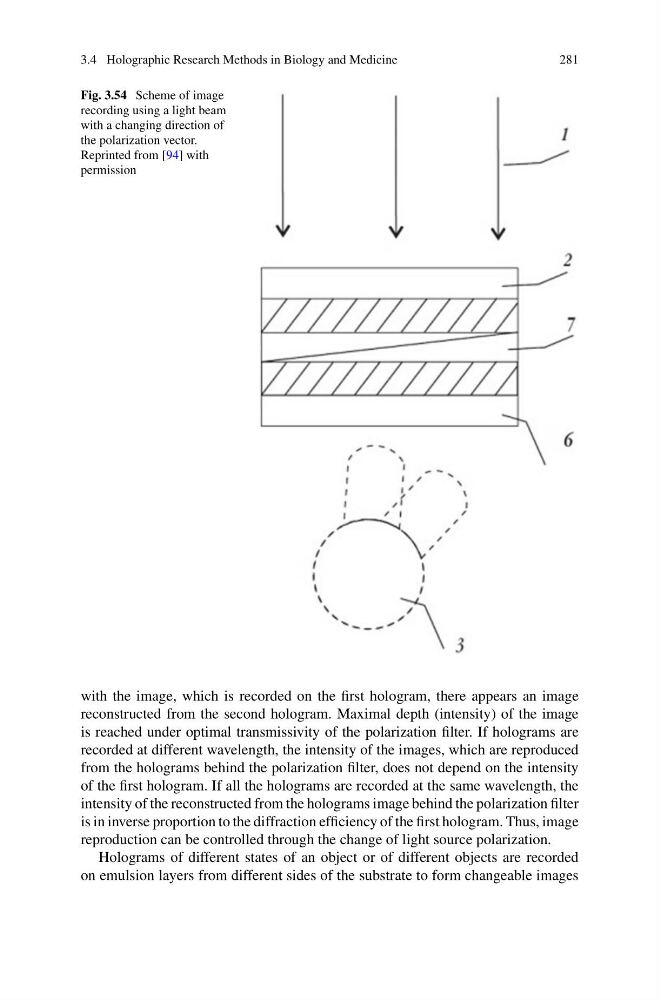
Fig. 3.54 Scheme of image
recording using a light beam
with a changing direction of
the polarization vector.
Reprinted from [94] with
permission
with the image, which is recorded on the first hologram, there appears an image
reconstructed from the second hologram. Maximal depth (intensity) of the image
is reached under optimal transmissivity of the polarization filter. If holograms are
recorded at different wavelength, the intensity of the images, which are reproduced
from the holograms behind the polarization filter, does not depend on the intensity
of the first hologram. If all the holograms are recorded at the same wavelength, the
intensity of the reconstructed from the holograms image behind the polarization filter
is in inverse proportion to the diffraction efficiency of the first hologram. Thus, image
reproduction can be controlled through the change of light source polarization.
Holograms of different states of an object or of different objects are recorded
on emulsion layers from different sides of the substrate to form changeable images
281
Fig. 3.54 Scheme of image
recording using a light beam
with a changing direction of
the polarization vector.
Reprinted from [94] with
permission
with the image, which is recorded on the first hologram, there appears an image
reconstructed from the second hologram. Maximal depth (intensity) of the image
is reached under optimal transmissivity of the polarization filter. If holograms are
recorded at different wavelength, the intensity of the images, which are reproduced
from the holograms behind the polarization filter, does not depend on the intensity
of the first hologram. If all the holograms are recorded at the same wavelength, the
intensity of the reconstructed from the holograms image behind the polarization filter
is in inverse proportion to the diffraction efficiency of the first hologram. Thus, image
reproduction can be controlled through the change of light source polarization.
Holograms of different states of an object or of different objects are recorded
on emulsion layers from different sides of the substrate to form changeable images