

3.2 Holographic Interferometry Using Generation Regime …
227
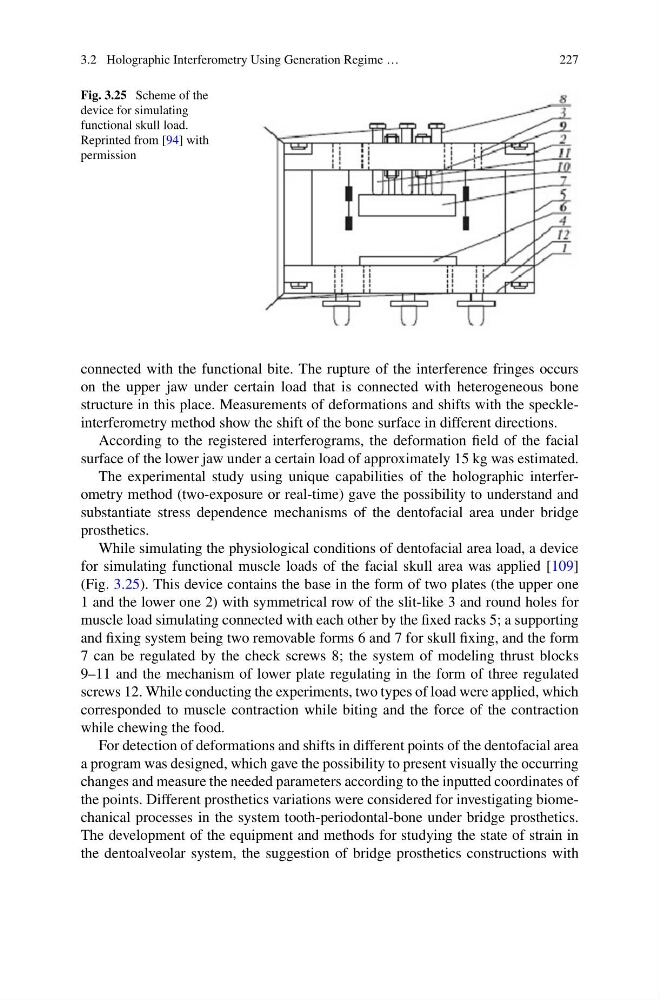
Fig. 3.25 Scheme of the
device for simulating
functional skull load.
Reprinted from [94] with
permission
connected with the functional bite. The rupture of the interference fringes occurs
on the upper jaw under certain load that is connected with heterogeneous bone
structure in this place. Measurements of deformations and shifts with the speckleinterferometry method show the shift of the bone surface in different directions.
According to the registered interferograms, the deformation field of the facial
surface of the lower jaw under a certain load of approximately 15 kg was estimated.
The experimental study using unique capabilities of the holographic interferometry method (two-exposure or real-time) gave the possibility to understand and
substantiate stress dependence mechanisms of the dentofacial area under bridge
prosthetics.
While simulating the physiological conditions of dentofacial area load, a device
for simulating functional muscle loads of the facial skull area was applied [109]
(Fig. 3.25). This device contains the base in the form of two plates (the upper one
1 and the lower one 2) with symmetrical row of the slit-like 3 and round holes for
muscle load simulating connected with each other by the fixed racks 5; a supporting
and fixing system being two removable forms 6 and 7 for skull fixing, and the form
7 can be regulated by the check screws 8; the system of modeling thrust blocks
9–11 and the mechanism of lower plate regulating in the form of three regulated
screws 12. While conducting the experiments, two types of load were applied, which
corresponded to muscle contraction while biting and the force of the contraction
while chewing the food.
For detection of deformations and shifts in different points of the dentofacial area
a program was designed, which gave the possibility to present visually the occurring
changes and measure the needed parameters according to the inputted coordinates of
the points. Different prosthetics variations were considered for investigating biomechanical processes in the system tooth-periodontal-bone under bridge prosthetics.
The development of the equipment and methods for studying the state of strain in
the dentoalveolar system, the suggestion of bridge prosthetics constructions with
227
Fig. 3.25 Scheme of the
device for simulating
functional skull load.
Reprinted from [94] with
permission
connected with the functional bite. The rupture of the interference fringes occurs
on the upper jaw under certain load that is connected with heterogeneous bone
structure in this place. Measurements of deformations and shifts with the speckleinterferometry method show the shift of the bone surface in different directions.
According to the registered interferograms, the deformation field of the facial
surface of the lower jaw under a certain load of approximately 15 kg was estimated.
The experimental study using unique capabilities of the holographic interferometry method (two-exposure or real-time) gave the possibility to understand and
substantiate stress dependence mechanisms of the dentofacial area under bridge
prosthetics.
While simulating the physiological conditions of dentofacial area load, a device
for simulating functional muscle loads of the facial skull area was applied [109]
(Fig. 3.25). This device contains the base in the form of two plates (the upper one
1 and the lower one 2) with symmetrical row of the slit-like 3 and round holes for
muscle load simulating connected with each other by the fixed racks 5; a supporting
and fixing system being two removable forms 6 and 7 for skull fixing, and the form
7 can be regulated by the check screws 8; the system of modeling thrust blocks
9–11 and the mechanism of lower plate regulating in the form of three regulated
screws 12. While conducting the experiments, two types of load were applied, which
corresponded to muscle contraction while biting and the force of the contraction
while chewing the food.
For detection of deformations and shifts in different points of the dentofacial area
a program was designed, which gave the possibility to present visually the occurring
changes and measure the needed parameters according to the inputted coordinates of
the points. Different prosthetics variations were considered for investigating biomechanical processes in the system tooth-periodontal-bone under bridge prosthetics.
The development of the equipment and methods for studying the state of strain in
the dentoalveolar system, the suggestion of bridge prosthetics constructions with